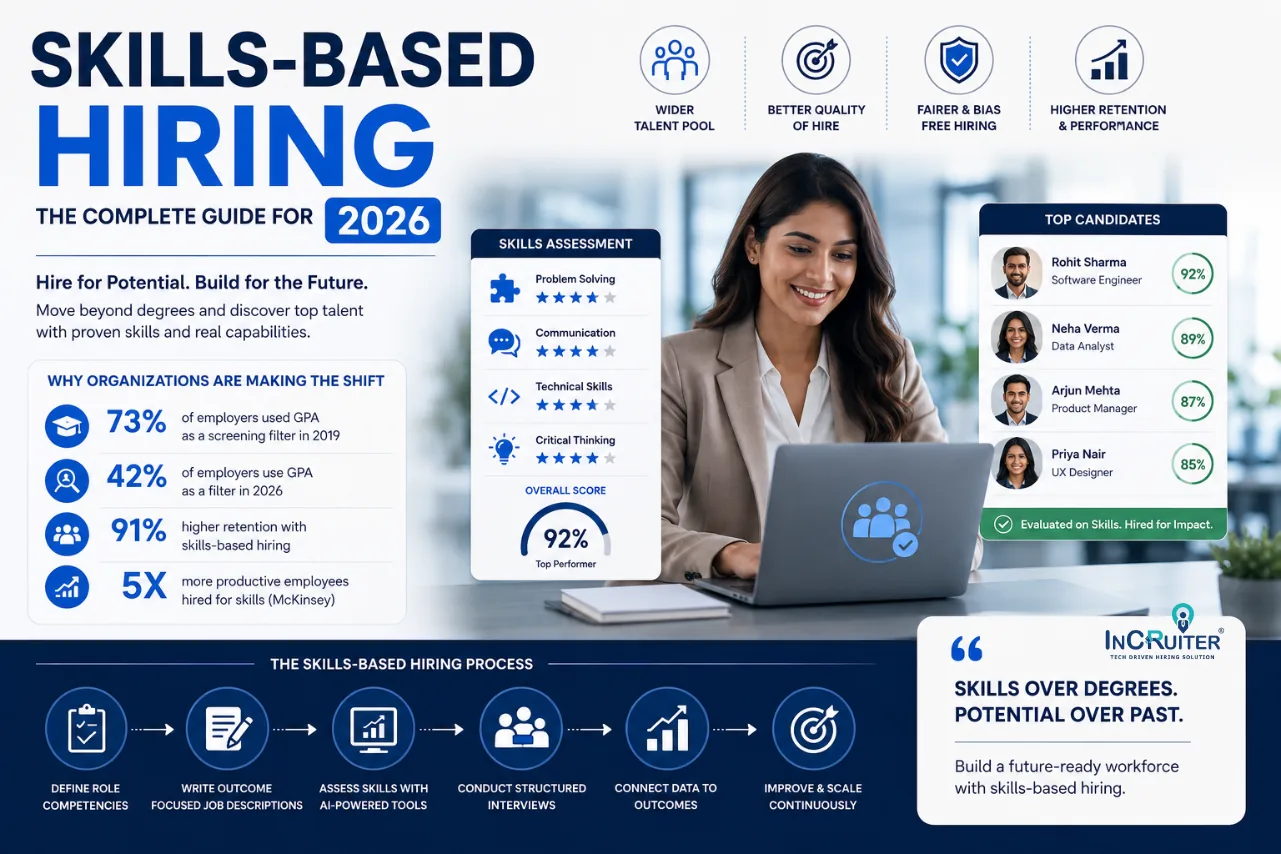
If we take a look at the statistics, the basic filter for a job application was a four-year degree in 2019, which has changed to skills-based hiring using advanced platforms. The majority of big names like Google, IBM, Bank of America, and plenty of others have already eliminated the degree-based hiring and moved to skills & competencies. Other data also highlights that around 20% of U.S.-based companies have already started screening candidates on the basis of their performance during interviews and assessments.
In this guide, we’re going to understand the gap between the hiring policies and practices. Skills or competency-based hiring is meant in the job descriptions to define roles, evaluate candidates, and specify the tools used to handle both efficiently. Further, in this article, let’s explore the potential of Artificial Intelligence in covering the gap between the intention and outcome.
What Skills-Based Hiring Actually Means
Skills-based hiring is a modern approach to evaluating new candidates for open roles by testing them against various tests and challenges. While earlier, the companies used to prioritize academics, colleges, diplomas, etc, the same is being replaced by skills and competencies. On a high level, this changes the hiring culture as per the following factors –
- Job descriptions change from listing just academic qualifications to defining the specific skill requirements or outcome-based.
- The candidate screening moves from resume browsing or degree verification to AI screening, automated interviews, coding rounds, and more.
- The applicant’s scoring happens with standard formats that remain applicable to every candidate, irrespective of their educational or career background.
It’s also essential to understand what a skills-based recruitment strategy doesn’t mean in 2026, which is ignoring experience, changing the entire hiring process, or considering every candidate similar. On the contrary, it means changing degree expectations, resume credentials, with direct proof of work or ability.
As per McKinsey, in the debate of skills vs degree hiring, the skill-focused candidates remain around five times more productive than those hired according to their educational qualifications. The data also reports around 91% improvement in retaining the employees hired on skill grounds.
Why Degree-Based Hiring Is Losing Ground In 2026
A university degree used to be no less than a shortcut for employers to find and hire talent. But, the same seems to be changing very quickly because of three major reasons as listed below –
a) Skills Replace Diplomas
Gone are the days when old degrees fail to predict success for modern job roles and responsibilities. Since modern roles need new skills, there were plenty of jobs switching their focus from the degree requirements to skills-based hiring.
b) Moving Excellent Talent Away
Often, it happens that demanding a degree unnecessarily moves the great candidates away. While this even happens for jobs that don’t need a degree, it makes the hiring process more critical. Nowadays, U.S. employers prefer candidates who have actual experience over a fresh college graduate.
c) Removing GPA From Picture
GPA as a hiring filter doesn’t work anymore for employers. While GPA-using employers were around 73% employers in 2019, the same drops to just 42% in 2026. This proves that organizations are quietly retiring old metric systems for hiring.
Skills-Based vs. Degree-Based Hiring: A Comparative Study
| **Factor** | **Degree-Based Hiring** | **Skill-Based Hiring** |
| Main Filter | Degree-based hiring majorly looks at the college paper | Skills hiring looks at what you can actually do |
| Success Rate | This fails at ensuring that the candidate will be good enough | Skill-based hiring is much better at ensuring job success |
| Talent Pool | Degree requirements often ignore the good candidates with expertise | With **skills-first hiring**, you can have an entire pool of talented professionals |
| Fair Hiring | Checking degrees often brings bias because some can’t even afford college | Testing the skills of candidates makes the hiring process fair for everyone |
| Staying Potential | Companies choosing degrees as a priority often see candidates switching jobs or leaving too early | Companies that hire for skills usually see a huge jump in employee retention |
| Using AI | AI tools fails to find great talent when scanning resumes for degrees | AI platform works great when it comes to testing candidate skills via challenges |
| Job Readiness | Degree hiring assumes that you’re well-versed in the job roles and responsibilities. | Skill hiring proves you can do the job efficiently before you’re even onboarded. |
Step-by-Step to Implement Skills-Based Hiring In Your Organization
In order to change your hiring culture from degree-based to skills-based hiring, you do not need to change the entire HR functionalities and systems. All you need to make some specific changes at each stage of the hiring process. Let’s start exploring what the actual implementation looks like in hiring practice.
Step 1: Define Role Competencies First
The very first step is to refine the job descriptions as per the expected skills and expertise. Before framing the content for any job opening, you need to work with the managers to figure out the right skills, behaviors, and outcomes for the role. This mapping is important as it creates a benchmark for candidate evaluation and clarifies the 90-day scope for successful candidates, technical skills requirements, and behavioral traits in the applicants.
Step 2: Rewrite Job Descriptions Around Outcomes
Next, you need to remove any sort of vague degree/certification requirements in the job descriptions. Instead of degree/diploma requirements, mention clear outcome expectations from the candidate. For example, instead of putting a computer science degree requirement, you can keep “looking for someone to architect and deploy microservices”. Not just you, it will be beneficial for candidates to learn about what they’ll actually do in that specific job role.
Step 3: Replace Resume Screening with Assessments
When it comes to changing the hiring culture, most organizations fail at the resume screening stage because of the traditional manual review process in place. Instead, you can use AI-powered platforms that automate the review of the candidate’s skills and performances based on customized tests and challenges. For example, you can use a coding assessment platform to screen candidates applying for a technical role in the organization. On the other hand, AI-powered interviews can be a great alternative to check candidates’ communication and behavioral skills on the same parameters for everyone.
Step 4: Use Standardized Interview Frameworks
When candidate interviews go random, there is a high chance that interviewers end up making biased decisions based on the credentials. However, with competency-based hiring approaches, standard interviews use pre-vetted questions to evaluate candidates across academic and performance grounds. Skill tests serve as a great alternative to manually designed tests for evaluating candidate capabilities in skill-focused hiring.
Step 5: Connect Screening Data to Post-Hire Outcomes
Skills-based recruitment strategy generates excellent and measurable data from the very start of the hiring rounds. You can further use these pre-hiring data reports and candidate scores for the 90-day review period or 12-month retention rates. With this, your hiring and employee management system will have an essential feedback loop to refine your candidate employment and retention to a huge extent.
Where AI Makes Skills-Based Hiring Scalable
| **Hiring Stage** | **Manual Skills-Based Approach** | **AI-powered Skills-Based Approach** |
| Job Description | Mapping candidates with expected skills with the help of human manpower | AI-platform makes the auto-generation of job descriptions aligned with skills and competencies |
| Application Screening | Manual one-by-one review of resumes with no degree-based filters | AI uses automated interviews to screen every single applicant on a consistent basis |
| Technical Evaluation | The manual technical evaluation lead to slow tests and inconsistent code reviews | Artificial Intelligence-powered live coding challenges with automated scoring and cheating prevention |
| Automated Interviews | The manual screening approach is based on human-led interviews | AI automates first-round interviews, while expert manual review is conducted in the middle and final rounds |
| Evaluation Record | Leaves messy and inconsistent interviewer notes | AI approach offers organized candidate scoring backed by evidence and proof of work |
| Feedback Loop | Manual feedback process lags behind in terms of hiring quality and experience | AI automatically tracks initial assessment scores against post-employment performance metrics |
How Does InCruiter Support Skills-Based Candidate Hiring at Scale?
With more and more companies/entrepreneurs focusing on talent and skills rather than degrees, there is a huge adoption of AI tools, which are designed to assess such competencies. Not just the evaluation part, the platform is also capable of evaluating candidates at scale without creating blockers wherever human involvement is required. InCruiter AI-powered recruitment software handles the skill evaluation for both technical and non-technical openings.
InCruiter’s IncBot, an AI interview software, automates first-round competency-based hiring interviews as per the predefined checklist or criteria. Further, the same process provides candidate scoring as an outcome to highlight their ability, instead of just their degree credentials. Similarly, the coding assessment platform, like IncCode, evaluates candidates as per the coding challenges and judges them on the basis of coding expertise, quality, accuracy, optimization, uniqueness, and more.
The interview-as-a-service platform, like IncServe, brings an expert human panel of interviewers to screen applicants for mid and senior roles. This saves time and effort from your internal company team while removing any sort of dependency for candidate hiring.
Are you ready to move your hiring processes from degree-based screening to skills-first hiring? Book a demo with InCruiter to experience how exactly you can utilize Artificial Intelligence to screen, judge, and hire the top-skilled professionals.
Frequently asked questions
What is a skills-based hiring approach?
Skill-based hiring, also known as skill-first hiring, is an approach followed by organizations or recruitment agencies in the modern world. Instead of just looking at their resume or past experiences, this allows the recruiters to evaluate candidates on the basis of their skills & performance. With predefined assessments, coding challenges, and other tests, ensure that all candidates are screened on the basis of similar criteria. This removes the bias on a huge scale and ensures that the talent is judged with accuracy and fairness.
How is skills-based hiring different from competency-based hiring?
Both skills-based hiring and competency-based hiring are the same terms from a broader point of view. Skills-based recruitment focuses on avoiding degree requirements or certifications and tests the candidates on the basis of real knowledge and performance. Competency-based hiring oversees all sorts of aspects, including behavior and soft skills, to ensure that the candidate is the right fit for both role and organization. The majority of companies prefer to utilize both and screen the candidates based on the skill, knowledge, and personality traits.
Why are companies like IBM and Google switching to skills-based hiring?
Top global giants like Google & IBM are dropping degree requirements as the modern world is relying more on the good candidates with the right skills. Programs like IBM’s “New Collar” hire and train people without four-year degrees because they offer a better job success rate in comparison to a degree or diploma. The candidates are even moving towards skill learning rather than just sitting and relying on college degrees or certifications.
How does AI support skills-based recruitment?
Artificial Intelligence helps in bringing automation to the recruitment processes at multiple stages. At the candidate screening stage, the software conducts interviews while applying the same criteria for all applicants irrespective of the application volume. Further, at the assessment stage, coding platforms put real challenges and tests in front of the candidates to test their technical knowledge & rank them accordingly. The AI-powered scoring tools keep the personal and academic details to focus purely on the skills while evaluating talent.
What is the biggest mistake companies make when implementing skills-based hiring?
The most common mistake from the company’s side is to remove the degree requirements from job postings, but without changing the process of candidate screening. Various studies show that without real skill assessments, the recruiters tend to prefer the traditional mediums, like university grades, etc. You can only get positive outcomes from a skills-based recruitment strategy if you have direct competency measurement available throughout the hiring journey.
Ready to Transform Your Hiring Process?
Discover how our AI-powered interview platform can streamline your recruitment and find the best candidates faster.
Make Your Hiring Process Smart and Fast