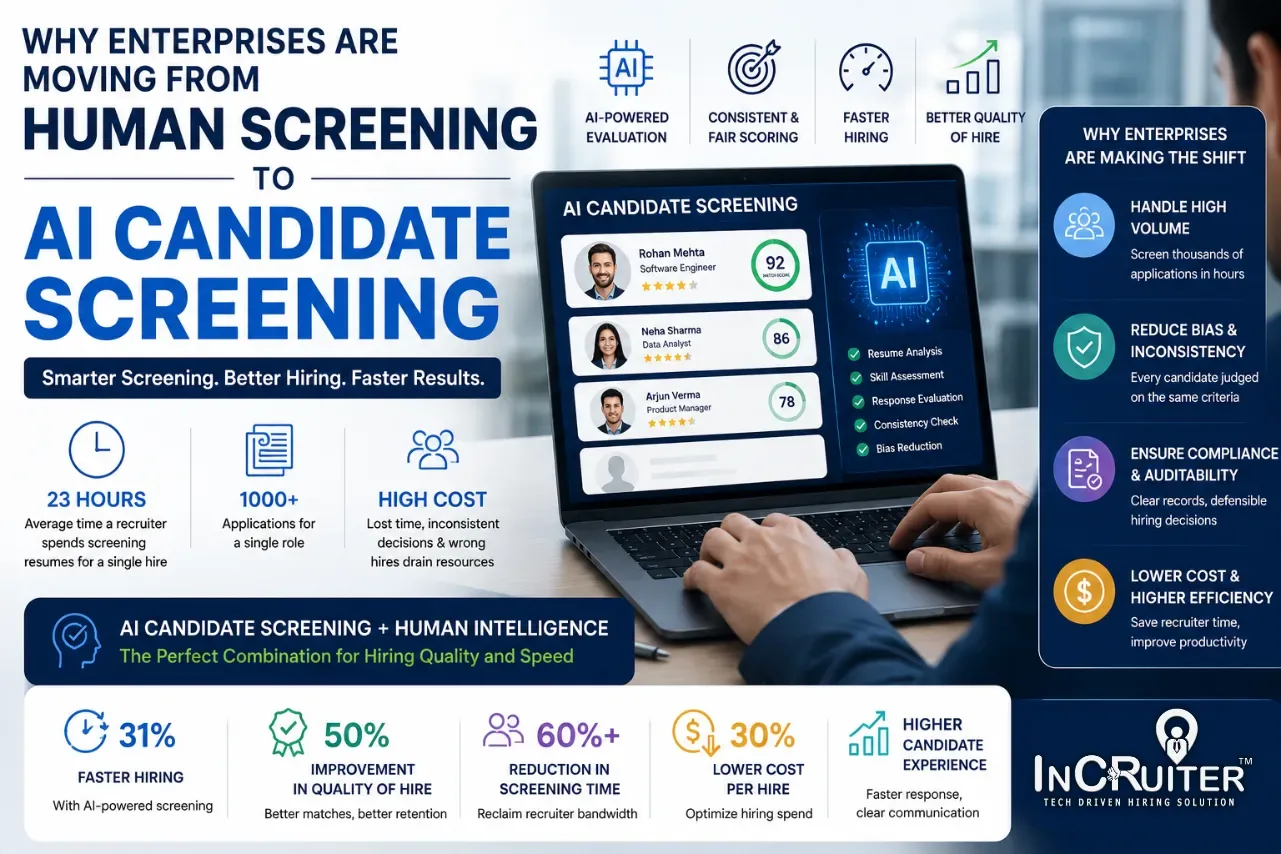
The Problem That Forced Enterprises to Change
As per a report, a recruiter earning a standard salary spends an average of 23 hours screening resumes for a single hire.In a real-world scenario, this is almost three working days in screening a candidate’s resume, even before scheduling the interview. Imagine this for an enterprise that has around 50 or 100 roles open at any given time. While this is not a skill problem, it is a system issue, and enterprises have started treating it in the right manner.
Manual candidate screening was for a world when hiring volumes were easy to manage and predictable application numbers. But, with bulk applications for a single role, the only solution is an AI recruiter with advanced capabilities.
What Was Broken About Manual Screening
a) Inconsistency Across Reviewers
If two recruiters are screening the same candidate’s resume, they’re likely to notice different aspects and score the candidate differently. Since human evaluators with AI recruiter solutions always remain under pressure, there are chances of inconsistent or unfair screenings. Instead of intentional discrimination, this just happens because of bulk resume screening.
b) Speed That Loses Candidates
Top candidates are likely to stay active on the job market for less than two weeks. If your candidate screening process takes longer than that, they are most likely to drop off and go for other competitive offers. Manual hiring processes used to slow down the entire hiring journey at multiple stages.
c) Cost That Compounds Invisibly
A major portion of the hiring expenses goes into the recruiter’s time on candidate screening. For enterprises having hundreds of open roles, the optimization and automation of the screening process is a must to save money in the long run.
Why Enterprises Specifically Are Making the Shift
Gone are the days when individual hiring teams used to struggle with the automation of candidate screening processes. Now, in the age of advanced AI, there are plenty of reliable tools and platforms like InCruiter, a recruitment automation solution for enterprises. Let’s dig into three major factors driving this shift from manual hiring campaigns to automated recruitment drives.
a) Increasing Hiring Volume
SHRM reports highlight the fact that AI adoption in HR teams increased to around 44% in 2025. This was mainly because the teams used to struggle with managing higher application volumes. The AI recruiter software solves the problem of multiple recruitment teams. Enterprises that need to hire across multiple locations, departments, and roles fail to handle the manual screening quality standards.
b) Inconsistent Candidate Evaluation
All the enterprises remain more concerned about the legal risks, and manual subjective screening can lead to one. It becomes difficult to make the hiring process consistent based on who reviewed the application, when, and where. AI candidate screening solves the auditable record where each applicant is judged & scored against the same criteria.
c) Reliable Hiring Processes
Earlier, the automated hiring solutions used to have bias because of historical hiring data and keyword matching. Although those problems are still there, the best AI screening software handles them through varied training data, transcript-based evaluation, and periodic bias audits.
What Automated Candidate Screening Actually Does
Automated AI candidate screeningis not always about how fast we can evaluate resumes, but a lot more. Modern AI interview software evaluates responses and scores candidates on the basis of pre-defined parameters. Further, it creates reports to offer valuable insights to hiring managers.
Let’s try to understand the core mechanism of how an AI recruiter actually works. A candidate applies for a role, followed by an AI-powered system reviewing applications automatically. The system analyzes the candidate responses and compares them to the shortlist for further stages.
The major benefit of this is that the recruiter gets a refined list of candidates instead of a pile of unread applications. They can clearly get a high-level overview of each candidate and make a decision to move forward with which candidate.
While comparing various recruitment platforms, the major differentiator remains its capability in evaluating the interview responses or only browsing resumes. Response-based candidate evaluation provides more reliable screening results instead of matching the keywords alone.
The Practical Difference An AI Recruiter Makes
The enterprise has been experiencing huge benefits in terms of hiring quality, faster evaluations, and lower expenses with AI-powered automation. But the practical gains vary significantly depending on which platform you choose and how it is implemented.
The drop in the screening time and first-round interview filling in within a week are two examples of speedy hiring with AI automation. These might seem like averages, but they become huge when applied to enterprise-scale hiring.
Imagine a team that used to be busy in filtering resumes and screening candidates manually is now free for productive work and operations. With AI candidate screening in place, the internal resources and engineering teams can contribute more towards candidate engagement, panel coordination, and offer management.
On top of these, the AI recruitment software boosts the hiring outputs along with enhancing recruiters’ and candidates’ experience. The responses become quicker along with consistent communication to retain the top talent.
| **Target Area** | **Pre-Implementation Setup** | **Post-Implementation Gains** |
| Response Speed | Candidates wait weeks for an initial application status | System reviews and updates candidates within hours |
| Data Quality | Decisions are made using mixed notes and quick scans | Teams use centralized tracking sheets and fair metrics to evaluate candidates |
| Team Focus | Staff handles paperwork and repetitive tracking task | Recruiters focus on personal outreach and final negotiations |
What to Look for Before Making the Switch
| **Evaluation Question** | **What It Avoids** | **What It Ensures** |
| Structured responses or text parsing? | Basic, surface-level keyword filtering | True competency-based capability assessments. |
| How does it handle bias? | Programmed or historical data bias | Transcript-only reviews and independent data audits |
| Does it integrate with existing tools? | Disconnected parallel workflows | Smooth data flow across your current ATS and scheduling tools |
| Is there a human review layer? | Dangerous fully automated hiring | Clear & auditable evidence lines that human recruiters can override |
See How InCruiter Handles AI Screening at Enterprise Scale
If you’ve all the candidate evaluation questions sorted, InCruiter can be the right recruitment platform that checks all boxes for enterprise-grade AI candidate screening.
InCruiter, the advanced AI-powered recruitment solution, automates the first round of candidate screening with a network of verified human interviewers. With this, the enterprises do not have to worry about the slow hiring cycles and the quality.
An AI interview software like InCruiter IncBot conducts organized interviews automatically to score candidates with fairness. Further, this ranks the shortlisted candidates and moves them to the next stage without manual burden.
For roles requiring deeper evaluation, an interview-as-a-service platform like InCruiter IncServe bridges the gap between the experts conducting structured evaluations. As an outcome, the AI recruiter software speeds up the hiring stage at the top of the funnel, where it matters the most.
If your enterprise is still struggling to hire good talent because of missing speed and automation, there are higher cost impacts than you can presume. As an outcome, you’ll get a complete candidate screening setup with AI doing the heavy lifting at the top levels of the hiring stages. While humans and manual screening are used to ensure hiring quality at the bottom levels.
Book a demo with InCruiter to see the full screening workflow live and evaluate whether it fits your enterprise hiring process.
Frequently asked questions
What is AI candidate screening?
As the name suggests, AI candidate screening means to screen the candidate with the help of AI-powered capabilities and automation. It involves organized interviews, resume analysis, and other consistent parameters to assess candidature. Post analysis, the AI-powered recruitment solution scores candidates against the pre-defined criteria and moves the worthy candidates to the next stage of review. With the assistance of Artificial Intelligence, the HR & recruitment teams can stay away from the burden of manual evaluation.
How is AI candidate screening different from manual screening?
Traditional manual candidate screening used to rely on every interviewer’s perspective and judgment. On the contrary, automated candidate screening with AI removes the problem of inconsistent review of hundreds of job applications. An artificial intelligence-powered solution applies the same kind of criteria to every applicant, irrespective of the individual, application volume, or other parameters.
Does automated candidate screening reduce bias?
The powerful and advanced AI recruiter reduces the concerns of human bias, inconsistent scrutiny, and fatigue-based decisions. The problem becomes more serious when a manual interviewer needs to review a huge volume of applications. However, the Artificial Intelligence-powered systems, which are trained on traditional hiring data, can even leave the chances of existing bias. On the other hand, the best AI candidate screening solutions come with transcript-only evaluation, diverse training data, and regular audits to ensure that fair candidates move ahead in the hiring journey.
Can AI candidate screening replace human recruiters?
No, AI candidate screening software is a great solution to solve the bulk volume analysis, but it is not a replacement for human recruiters. The involvement of human intelligence and judgment is important for final hiring decisions, senior role evaluations, and various other areas of the hiring journey. The best hiring processes for enterprises keep the Artificial Intelligence for hiring scale while keeping humans for depth and decisions.
What types of roles benefit most from AI candidate screening?
AI recruitment software automates the initial round of interviews for junior technical roles, customer-facing positions, and more. This helps in taking care of high-volume roles that come with pre-defined qualification questions. Once the AI screening filters the initial candidates, the human-led evaluation becomes more productive for senior and specialized roles.
How do enterprises ensure AI screening stays compliant?
Enterprises need to be very concerned about choosing the AI screening tool in 2026. It should have candidate consent disclosures, audit logs of candidate screenings, and checks on bias testing. The solution should comply with the requirements as per the candidate region under GDPR, the EU AI Act, and various US state laws.
What is the ROI of switching from manual to AI candidate screening?
Organizations switching from manual to AI-powered hiring solutions experience less screening time, lower drop-off rates, and reduced cost-per-hire. The faster and consistent candidate screening avoid the chances of hiring mismatch that lead to employee leaving within six months or before. The time and resources saved with AI automated screening can be used to enhance the hiring quality, boost productivity, and improve customer experience in parallel.
Is AI candidate screening suitable for enterprises with complex technical roles?
Yes, if used wisely, the AI candidate screening can be a great solution to simplify complex technical roles hiring. The AI-powered screening takes care of first-round qualification effectively for technical job roles. For more comprehensive candidate evaluation, the AI-powered solution offers coding assessments and tech interviews for quality hiring decisions.
How do I choose the right AI candidate screening platform for my enterprise?
The best way to find the best AI candidate screening platform is to look for the four non-negotiable criteria. The platform needs to evaluate organized interview responses instead of just resume text. Additionally, it should be able to provide a complete audit of every screening decision. Check for the integration capabilities with existing ATS and HR systems. The best AI hiring platform should have a clear human review layer to bring in human intelligence with automation. Along with these, the platform should be free from interviewer bias and comply with security requirements and certifications.
Ready to Transform Your Hiring Process?
Discover how our AI-powered interview platform can streamline your recruitment and find the best candidates faster.
Make Your Hiring Process Smart and Fast