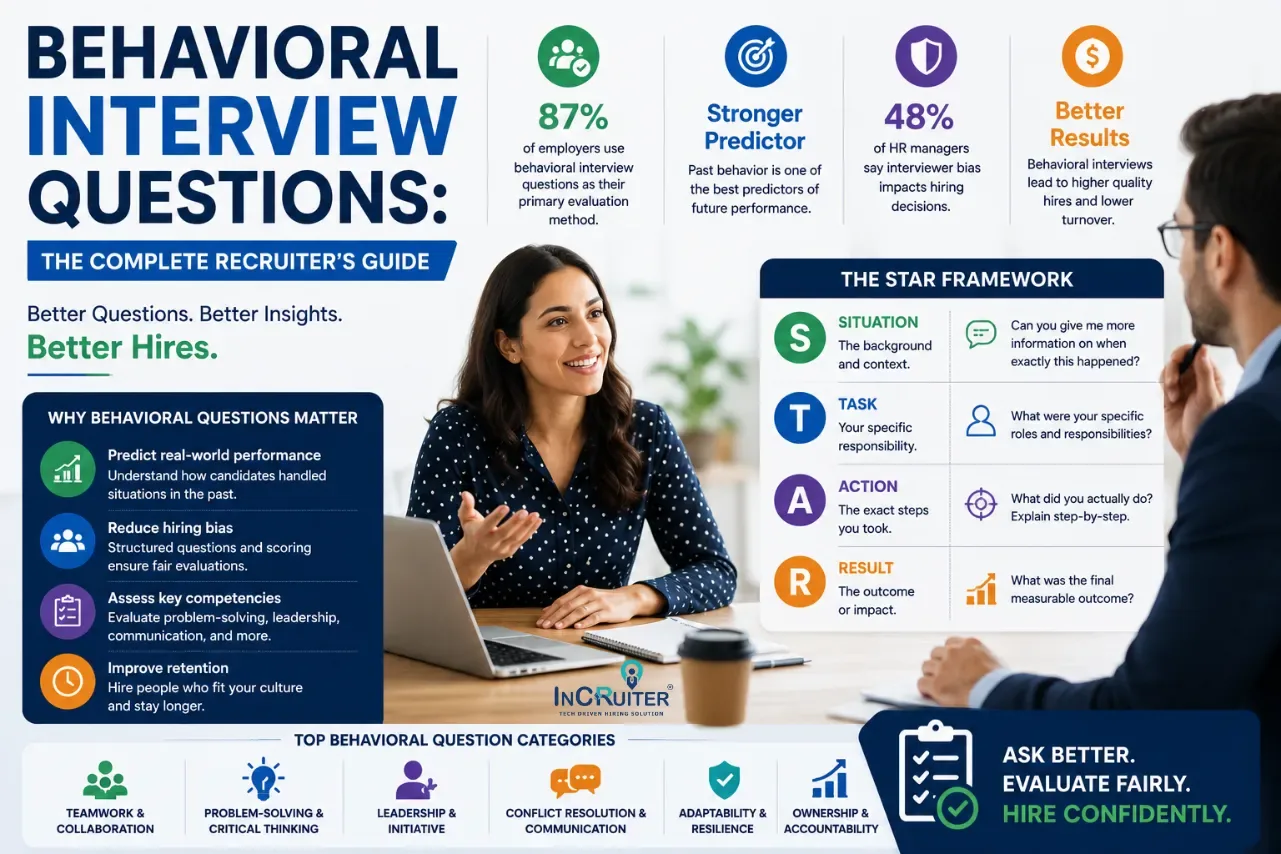
Did you know that around 87% of modern-age employers consider behavioral interview questions as the primary evaluation method of the hiring journey? Well, the reason behind this is the simple logic that strong past behavior skills ensure the future job role performance & success. In simple words, the hypothetical questions about the past workplace, culture, responsibilities, and more just set the foundation for assessing the candidature for the rest of the hiring process.
However, the behavioral questions are only relatable if they are asked properly with structure and consistency. As per data, around 48% of HR managers agree that interviewer bias affects their interviews, and that happens because there is no pre-defined set of questions or scoring mechanism in place.
In this guide, we will explore the importance of behavior-related queries, their competency levels, the STAR framework for scoring every answer, and a lot more that you can implement to streamline your company’s hiring culture.
The STAR Method to Score Every Behavioral Answer
As per the full form, the STAR here stands for Situation, Task, Action, Result. This serves as the standard framework for candidates to structure their answers. On the other hand, it is useful for recruiters to evaluate candidates on the basis of different parameters. For a recruiter, your job is to check all four standards and investigate when a candidate skips one.
| **Component** | **What to Listen For** | **Quick Follow-Up Question** |
| Situation | The background story (when, where, and context) | Can you give me more information on when exactly this happened? |
| Task | Their personal responsibility rather than the achievements of teamwork | What were your specific roles and responsibilities under various projects. |
| Action | The exact steps they took for the specific job responsibilities (this should be the core of their answer) | What did you actually do, explain in step-by-step manner? |
| Result | Numbers, impact, or what they learned if things went wrong | What was the final measurable outcome? |
As per the data, a strong STAR framework spends around 60% of its time on the Action component. So, for example, if a candidate takes about three minutes describing the scenario, the ten seconds will be to explain what they did in their past job role. Such behavior-based interview questions and answers lead to an imbalance in the evaluation signal, highlighting the candidate’s actual contribution even when the outcome was limited.
Common Behavioral Interview Questions – Examples
Teamwork and Collaboration
- Can you specify a scenario in which you worked in a team to solve a difficult issue or achieve goals?
- Can you help in understanding a situation when you had to collaborate with someone having a very different mindset and thought process?
- Had you helped any fellow teammate who was struggling but hesitating to ask for assistance?
- Tell me about a time your team was not agreeing on the correct approach to resolve a problem.
- Describe your important role in a project that led to success.
- Tell me when you had to rely on others for delivering a specific part of a project.
Problem-Solving and Critical Thinking
- Describe a case when you had to solve a complex problem with very limited information or resources?
- Explain a scenario in which you identified a problem before anyone else noticed it.
- Give me an example of a case when you had to make a decision without solid data.
- Was there any case when your first solution didn’t work & what was your next move?
- Explain a time when you had to think creatively to solve a problem with a critical timeline.
- Were you able to find and fix a repeated issue at the last job or in any employment?
Leadership and Initiative
- Can you tell about a time when you led a team through a difficult phase?
- Can you walk through some scenarios when you took some extra work even when no one asked for it?
- Describe a scenario when you had to influence other team members.
- Tell me about a time you had to motivate a team during a low point.
- Describe a decision you made that others disagreed with at first.
- Tell me how you were assigning tasks to others and ensuring they were completed without delays.
Conflict Resolution and Communication
- Describe a scenario when you were having some disagreements within your team.
- Describe a situation where you had to deliver difficult feedback to juniors.
- Give an example of an internal team conflict, and whether you were able to resolve it.
- Tell me about a time you were given a tough task to send low growth metrics to clients.
- Describe a time you misunderstood someone, and how you corrected the situation.
- Give me a case when you had to hold someone accountable for their performance.
Adaptability and Resilience
- Explain a time when you were handling a sudden and unexpected change at the workplace.
- Can you tell me about a time when you had to upskill for some urgent tasks?
- Give me a scenario when you left your comfort zone to grow a project.
- How were you reacting when the project’s scope was changed multiple times?
- Describe your view of the situation where the company culture keeps changing.
- How can you adjust your communication style based on the new audience?
Handling Failure and Growth Mindset
- Can you tell me about a failure in your previous roles and what you learned from it?
- How smoothly can you handle and implement feedback for a new project?
- Were you lagging behind the project goal, and what was the approach?
- Tell me when you messed up that led to a real loss in a project.
- Describe a time your idea was rejected and how you handled it?
Ownership and Accountability
- Tell me about a job role when you took complete ownership of the project.
- Describe a situation where something went wrong on your watch
- Give an example of when you went beyond your job description to get something done.
- Tell me about a time you caught your own mistake before anyone else did.
- Can you tell about a time you had to handle a problem someone else created?
Time Management and Prioritization
- Describe a time you had to manage several project priorities together.
- Tell me about a time you had to meet a close and non-negotiable deadline.
- Can you give me an example of when to keep projects on low priority and why?
- Describe how you organize your work when handling multiple ongoing projects.
A Simple Candidate Scoring Structure For Behavioral Answers
The recruitment team or interviewer needs to rate the candidate on a scale of 1 to 5 immediately after the interview. This is the right time to do this, as the details are fresh in the mind of the recruiter. On the contrary, if the same thing is followed after days, the memory is likely to fade because the interviewer loses the specific talking points. The organization should make it mandatory that findings related to the behavioral interview questions and answers be submitted within 24 hours.
The scale below should be applicable on a consistent basis for all candidates appearing for the job role. At the same time, this should make it mandatory for the interview teams to submit their scores independently before group discussion. This single rule for the interviewers saves a lot of time in the group discussions and avoids any chance of interviewer bias.
| **Score** | **Label** | **What It Actually Means** |
| 5 | Exceptional | Perfect STAR format with clear personal impact with solid & proven results |
| 4 | Strong | Good format and believable results, just missing minor details |
| 3 | Acceptable | Incomplete format with vague results and no clarification for the job roles and responsibilities. <br> The outcome is vague, or their exact role is unclear |
| 2 | Weak | Missing major parts because of generic answers to **behavioral interview questions** |
| 1 | Poor | Major red flags with no real example shared for any scenario or task |
How AI Makes Evaluating Behavioral Interview Questions Consistent
The major challenge with the behavioral interview questions and answers is not the questions, but how we apply them consistently across every candidate. The same level of standard should be there across every interviewer and hiring round. It becomes a common problem with the recruitment team when there are 8-10 screening calls every day. Post interview, they fail to maintain the same level of questions for the follow-up programs.
An AI interview software like InCruiter IncBot offers organized behavioral interviews automatically. This automation, with the power of Artificial Intelligence, conducts structured sessions asking the same competency-level queries from every candidate. Further, the follow-up coordination is also based on the completion level of the STAR framework. With this, the recruitment team will get a consistent candidate evaluation foundation before any human interviewer comes into the loop. With AI-powered software, the transcript-based scorecard removes the problem of memory fade that leads to inconsistent scoring under pressure.
In case of job roles and responsibilities requiring deeper evaluation for behavior-based interview questions, an interview-as-a-service platform like InCruiter IncServe brings expert interviewers on board to give your internal team free time. These domain experts are trained to investigate behavioral answers thoroughly & provide the scores to the candidates as per the set standard.
Do you want a consistent behavioral scorecard for every new candidate? Book a demo with InCruiter recruitment software and witness the power of AI in evaluating every candidate and role.
Frequently asked questions
What are behavioral interview questions?
Behavioral interview questions play a crucial role in an organization’s recruitment process to describe the particular skill or competency in the job role. Such questions include “Tell me about a time when you were stuck in any challenge,” or “Describe a scenario where you successfully delivered results,” or more. These behavioral interview questions help in predicting the candidate’s future performance rather than relying on just hypothetical or general questions.
What is the STAR method, and how is it used to score answers?
STAR framework in behavioral interview questions and answers stands for Situation, Task, Action, and Result, used to organize behavioral answers, and recruiters use them to evaluate the candidates. A complete response as per this framework describes the context (Situation), the candidate’s specific responsibility (Task), the reliable steps the candidate took to solve a specific problem, and a measurable outcome. Recruiters score various candidates by checking whether all four components are present and specific, instead of general and common answers.
How many behavioral questions should I ask in one interview?
Most organized interviews work best when you have a few top behavioral interview questions ready by your side. On the other hand, trying out all questions in judging every candidate’s competency can make the process more complex. Select two to three competencies for the required role and be ready with the follow-up questions rather than asking anything randomly.
What red flags should recruiters watch for in behavioral answers?
Some of the common red flags in behavioral-based interview questions are those that receive a generic answer with no real-world example or highlight the contribution of the person. In other words, such responses for the behavioral questions are mainly focused on blaming others for self-failure and come with a pre-defined mindset. Although the interviewers don’t disqualify the candidate on the basis of red flags, there needs to be follow-up investigations before reaching the final judgment.
How can recruiters reduce bias when scoring behavioral interviews?
The most effective approach to reducing interviewer bias is through implementing a standard process of candidate scoring for behavior-based interview questions. In simple words, the scores matter when you ask the same set of questions to multiple candidates and get scores based on the responses. Every recruiter or interviewer will score independently before coming to a group discussion for the employee.
Ready to Transform Your Hiring Process?
Discover how our AI-powered interview platform can streamline your recruitment and find the best candidates faster.
Make Your Hiring Process Smart and Fast