In 2026, the majority of HR teams fail to explain their expenses on hiring new talent, whether that’s been on the job boards or agency fees. In reality, very few will be able to have the clarity of the exact cost of hiring a single candidate in the organization. They usually check the number on the invoice when it comes to the cost per hire metric, but that’s just one part of the whole picture.
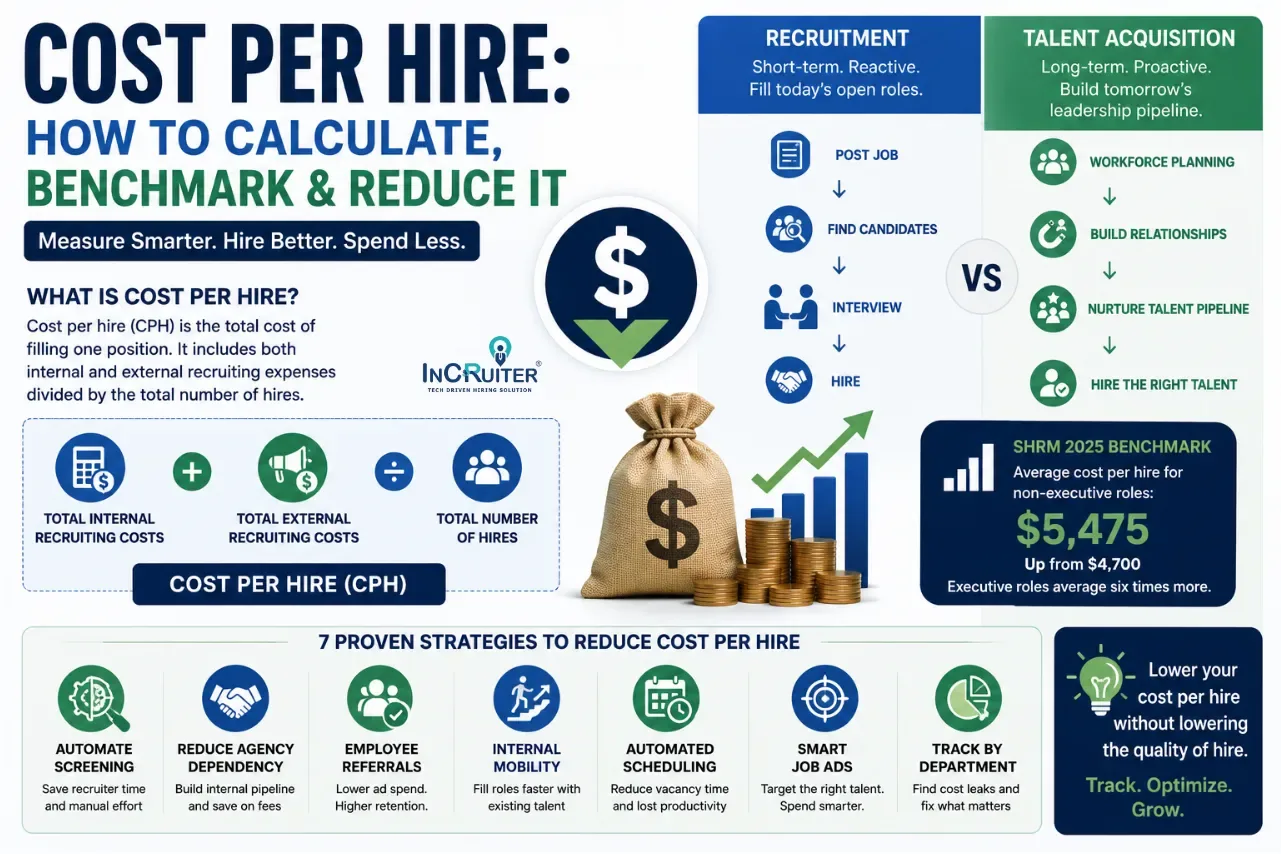
Cost per hire (commonly known as CPH) is a recruitment metric that covers the total expense of filling one position. As per SHRM’s 2025 Human Capital Benchmarking Report, the average CPH expenses for non-executive roles have gone up to $5,475, up from $4,700. If we talk about hiring for the executive roles, the average expenses are around six times the same. The major jump in the expenses has been in the past couple of years, because HR teams and organizations fail to actually measure it properly.
Most of the companies undercalculate their cost per hire recruiting metric by 30% to 40% if they only check the numbers mentioned on the billing invoices. Whether they are from job board fees, agency commissions, background check costs, or others, there is a high chance that they will miss the major portion of details.
In this guide, we’ll walk you through the cost per hire formula, real scenarios as per company size and roles, and how AI or advanced systems can help in streamlining the metric calculation with every hire.
What Is Cost Per Hire?
Cost per hire is the total amount of expenses from the company to source and hire candidates for a single open role. This metric covers every penny that goes into multiple stages of hiring, such as job postings, agency fees, background verification, employee evaluation, and recruiters’ or managers’ expenses, too.
Cost Per Hire = (Total Internal Recruiting Costs + Total External Recruiting Costs) ÷ Total Number of Hires
When it comes to the relevance of CPH recruiting metrics, that’s majorly for the three different teams in an organization. First, it is important for HR leaders because it plays a key role in calculating and handling the overall recruiting budget. Next, it matters for finance managers from the perspective of growth cost and company turnover. Last, it’s essential for recruitment managers to get an understanding of the cost of their interview hours to the business.
All these numbers for different teams remain nearly invisible if they fail to calculate average cost per hire in the right manner, and that’s what we’re going to cover.
Cost Per Hire Benchmarks
| **Category** | **Group / Role Type** | **Typical Cost** | **Why** |
| Company Size | Small Teams | Higher cost | These companies lack bulk discounts on hiring tools. They also do not have a dedicated internal recruiting team. |
| Company Size | Mid-Size Firms | Standard average cost | This range represents the standard market benchmark. Most established mid-size businesses fall into this budget category. |
| Company Size | Growing Companies | Reduced cost | Bulk hiring advantages begin to lower expenses. Larger operations make the overall process more efficient. |
| Company Size | Large Enterprises | Lowest cost | Massive hiring volumes unlock the best discounts. Fully dedicated internal recruitment teams handle everything efficiently. |
| Role Type | Entry-Level/ High-Volume | Low cost | These positions pull the average company expense down. The interview process is fast and highly repeatable. |
| Role Type | Mid-Level Professional | Moderate Cost | The recruitment process requires a longer evaluation. It also takes a moderate amount of sourcing effort. |
| Role Type | Manager/Director | High Cost | These leadership positions involve much longer timelines. Companies also depend heavily on expensive outside agencies. |
| Role Type | Technical/Specialist Roles | Premium cost | High competition for scarce talent drives up expenses. Finding specific technical skills requires a major premium. |
| Role Type | Executive/VP and Above | Highest cost | Executive search firms charge incredibly high fees. The process involves multiple stakeholders and long timelines. |
Cost Per Hire vs. Quality of Hire: Why You Need Both
A cost per hire number can usually be misleading in most cases. So, it gets important for the team to look into all possible and essential metrics before cutting down the CPH anywhere.
You need to check the structured candidate assessment, reduce interview rounds, and change offers that can impact the metric. Also, there needs to be a rare case of bad hiring that could increase the cost per hire at a significant level.
| **Metric** | **What It Measures** | **Risk If Tracked Alone** |
| Cost Per Hire | Total money spent to fill an open job. | You might lower expenses by skipping important interview steps. This often leads to bad hiring choices. |
| Quality of Hire | How well the new employee performs and fits in. | It is hard to improve worker quality without looking at your actual budget. You might end up spending way too much money. |
| Time to Hire | The total speed of the recruitment process | Hiring people too quickly can hurt your evaluation standards. Fast choices are not always the best choices. |
| Combined Metrics | The complete value of your overall hiring success. | Looking at just one metric hides the real issues. You need the whole picture to see true efficiency. |
You need to keep an eye on the cost-per-hire metric along with the quality of hire and 90-day retention rate for every group. The cost-per-hire recruitment metric trends down, while the quality of hire and candidate retention are also low, which does not progress in any way.
On the other hand, it is a clear sign that your recruitment process is just ignoring the serious problems that are going to come back later with more sudden expenses.
Seven Proven Strategies to Reduce Cost Per Hire
| **Strategy** | **Cost It Reduces** | **Main Benefit** |
| Automate Screening | Recruiter time and manual effort | Software filters resumes quickly to save valuable hours. This allows your hiring team to focus on connecting with top candidates. |
| Reduce Agency Dependency | High external recruitment fees | Building an internal talent pipeline keeps your sourcing in-house. It saves money by avoiding expensive third-party finder fees. |
| Employee Referrals | External sourcing and ad spend | Paying small referral bonuses replaces costly job board ads. This strategy also brings in reliable workers who stay longer. |
| Internal Mobility | External sourcing and onboarding costs | Promoting current staff fills open roles much faster. It lowers your hiring expenses while boosting overall team morale. |
| Automated Scheduling | Vacancy costs and lost productivity | Automated calendar tools eliminate time-consuming back-and-forth emails. This compresses your timeline to fill open positions quickly. |
| Smart Job Ads | Flat-fee job board advertising | Programmatic ads automatically target the right platforms for you. Your budget is only spent when candidates actually interact with posts. |
| Track by Department | Unfocused spending across all categories | Reviewing costs by specific teams reveals hidden financial leaks. It allows you to apply targeted fixes where they matter most. |
How AI Changes the Economics of the Cost Per Hire Metric
With all the technology and Artificial Intelligence advancements flooding in, you can use them to calculate and automate the cost per hire formula to get better clarity of where your recruitment budget is going. In this context, the usage of AI-based platforms is not just for the speed, but mainly for the process updates that increase this cost per hire metric in the first place. Two major factors behind that are recruiter administrative time (screening, scorecards, scheduling coordination) and panel interview (interview rounds and coordination). Apart from this, there might be a little contribution from the job boards’ side, but that’s not a serious issue.
An AI interview software like InCruiter IncBot solves the factor that consumes the maximum part of the hiring budget, i.e., initial rounds and interviews. Not just the automation part, such platforms ensure that the same kind of parameters and criteria are applicable for candidate evaluation to avoid any kind of bias. It provides a structured candidate scoring that reduces the screening time and expenses that could be huge because of the manual resources taking care of this stage.
Similarly, the job roles that require more enhanced evaluation (like for mid-level and senior-level roles), an interview-as-a-service platform like InCruiter IncServe serves as an alternative to the cost of maintaining an internal panel and resources. With this, you’ll get an on-demand panel of experts to evaluate pre-vetted candidates that changes the fixed cost to a flexible cost that increases only when the hiring volume increases.
Are you ready to experience where your cost per hire is leaking? See how AI-powered InCruiter recruitment software automates the screening and scheduling work that consumes most of the internal recruiting cost.
Frequently asked questions
What is the cost per hire formula?
Usually, we refer to the cost per hire formula as Cost Per Hire = (Total Internal Recruiting Costs + Total External Recruiting Costs) ÷ Total Number of Hires. Internal recruiting costs cover hiring manager time efforts, ATS subscriptions, and internal training resources. On the other hand, the external expenses include agency fees, job board postings, background verification, and candidate evaluation tools. You can easily calculate the CPH recruiting metrics per candidate hire, department, or company-wide for any defined timeline.
What is the average cost per hire in 2025 and 2026?
According to SHRM’s 2025 Human Capital Benchmarking Report, the average CPH value for non-executive roles remained around $5,475. The same parameter for executive hiring went to an average of $35,879. The numbers differ based on the company size, role, dedicated talent acquisition teams, and hiring volume.
Why do most companies underestimate their true cost per hire?
Most of the companies try to keep an eye on the cost and quality of hire based on the billing invoice. These bills can be from the job boards, agencies, background verification teams, and more. However, these leave a gap of larger and less visible costs of recruiter and manager time spent on candidate screening, interviewing, and coordination throughout the hiring process. This gap usually leaves companies with the wrong or undercounted number as per the individual hirings.
How is cost per hire different from quality of hire?
The cost per hire formula is all about getting insights into how much money is going into filling a single role. On the other hand, the quality of hire recruitment metric is about whether the candidate is going to be hired and actually stays in the organization. Both of these metrics need to be tracked together if an organization wants to check and lower the expenses related to hiring campaigns. The HR teams can check the expenses and cut the additional expenses that lead to bad hiring practices.
What is the most effective way to reduce cost per hire without hurting quality?
The first step should be to automate the initial rounds of interviews, which could have a significant impact in terms of lowering expenses. This is because the administration time, management, and interview panel take up a significant portion of your hiring budget. Sometimes, it’s even more than the other costs associated with the hiring journey and often gets ignored as well. Reducing the dependency on the job boards and agencies can also lead to deductions in cost per hire. On the contrary, your organization should rely on referrals and external searches more.
Ready to Transform Your Hiring Process?
Discover how our AI-powered interview platform can streamline your recruitment and find the best candidates faster.
Make Your Hiring Process Smart and Fast