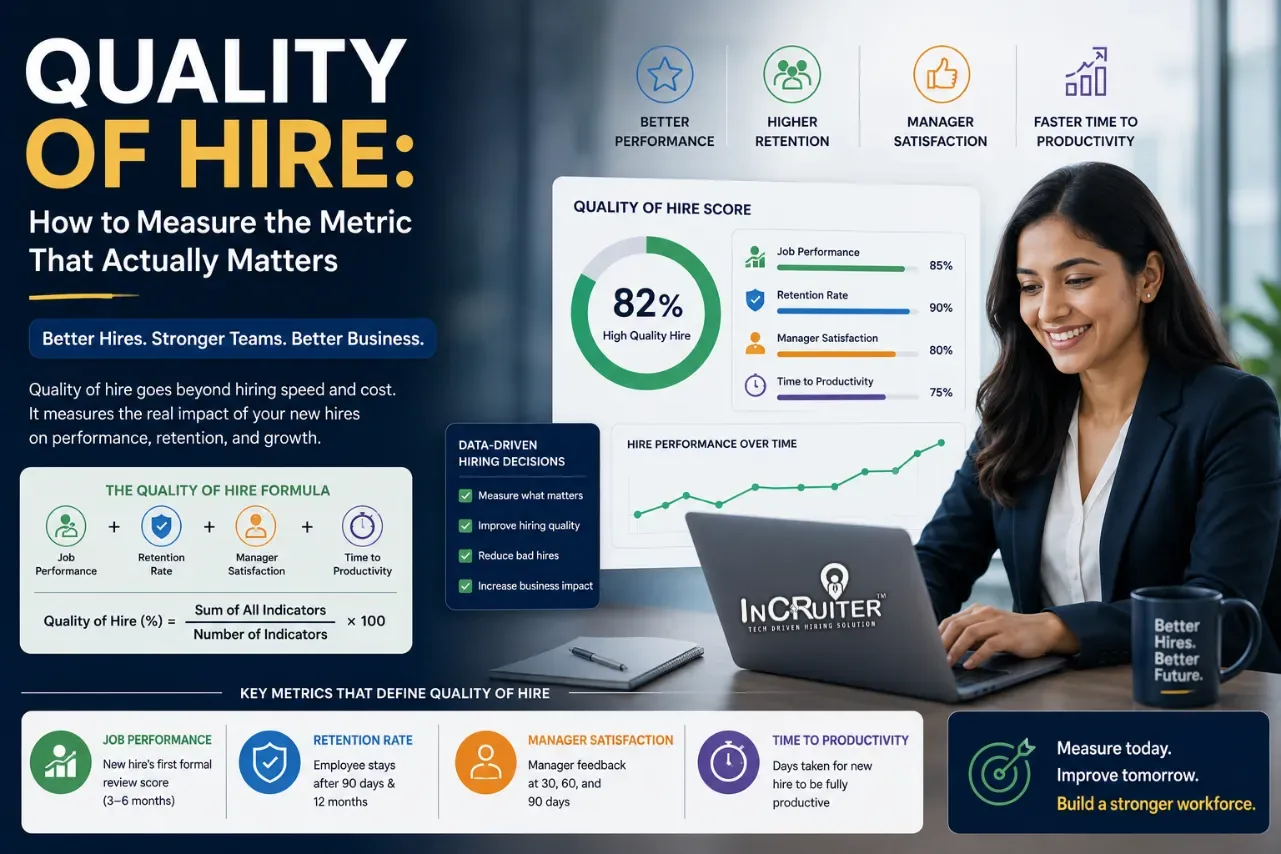
In 2026, if you ask any HR or TA team about the top metrics related to hiring, the answer will be more or less the same, i.e., time to fill and cost per hire. While these recruitment metrics hold value, neither of them will be able to give you clarity if you’re able to acquire good candidates from your hiring cycles. That’s when you need to track the quality of hire as well.
In simple words, the time to fill recruitment metrics measures how quickly the role gets filled. On the other hand, the cost per hire tells you the budget invested in acquiring good candidates. The quality of hire metric gives you a clear idea about the performing candidates out of the total hires. Additionally, it helps in evaluating how many stayed long enough to contribute and added value to the expected job roles.
According to LinkedIn’s Future of Recruiting 2025 report, around 89% hiring professionals are choosing the quality of hire metric along with others. It also highlights the fact that only 25% are able to actually measure it in the right manner.
In this guide, we’re going to address this gap with the proven ways and frameworks to actually get a practical number associated with recruitment quality.
What Quality of Hire Actually Means
In simple terms, the quality of hire metric measures the contribution of every new employee to the organization’s or product’s success. Instead of calculation from a single source, the quality of hire combines multiple indicators into a single percentage that gives the much-needed clarity.
On a high-level overview, the inputs like job performance, employee retention rates, hiring manager satisfaction, and productivity timeline hold the maximum value in signifying the quality of hire. Apart from these, some organizations even prefer to keep employee engagement scores, promotion rates, and organizational fit. As per the standard, the formula to check the quality of hire is –
Quality of Hire (%) = (Job Performance + Retention Rate + Hiring Manager Satisfaction + Time to
Productivity) ÷ Number of Indicators
In this, the hiring teams put in each parameter as a percentage and calculate the weightage separately for every employee. The final outcome related to the talent quality measurement also differs for organizations, departments, and hiring teams. In general, here are some of the essential things to consider based on the various metrics.
| **Quality of Hire Metrics** | **What It Is** | **Source** |
| Job Performance | The employee’s first formal review score around 3 to 6 months. | Performance review system |
| Retention Rate | Checking if the employee is still working after 90 days and 12 months | HR system or attrition tracking |
| Hiring Manager Satisfaction | Ratings from the manager at 30, 60, and 90 days | Post-hire surveys |
| Time to Productivity | The number of days it takes for a new hire to work completely on their own | Manager notes and HR records |
Why Quality of Hire Is So Hard to Track
The Data Lives in Different Systems
The major problem with the HR and TA teams is that the performance data has the least visibility to everyone. For example, the employee retention data remains in the HRIS, while the hiring manager satisfaction has no structured format to review. Similarly, the quality of hire metric, like productivity time, is tracked informally and does not give enough data clarity to get a clear idea about the candidate standards.
The Post-Hire Survey Gets Skipped
Hiring manager satisfaction is one of the best hire metrics that adds more value to the recruitment processes. Sending the 30-day and 90-day surveys to every hiring manager can give valuable insights to the management about the new employees and ongoing hiring practices. Without this, one of the four core quality metric input leads to nil, making the feedback assessment more critical and difficult for everyone.
No Ownership of Metrics
Normally, the recruitment team has the time to fill metric data in the hiring journeys. Similarly, the cost per hire data remains under the finance and HR team members. Quality of hire metric data relies on the recruitment team, HR managers, and more. And, on top of everything, all this remains without any structure, making it tough to collect and account for the data.
How to Start Measuring Quality of Hire in Your Hiring Cycles
Step 1: Set Your Metric Inputs & Weightage Before the Next Wire
The very first thing that HR & TA teams need to do is to keep an eye on the input metrics as explained above. Further, you need to set some weightage to each quality of hire metric as per the organizational priorities. This priority metric needs to be arranged according to the employee groups to ensure hiring success.
Step 2: Build the 30-Day and 90-Day Survey
Next, you need to create an organized survey for the hiring managers on the basis of a numerical rating scale. It needs to roll out automatically within a period of 30 days and 90 days after the hiring starts. This ensures that the hiring manager’s satisfaction is there to evaluate the candidate and the hiring cycle.
Step 3: Connect Pre-Hire Screening Data to Post-Hire Outcomes
The third step in the process of how to measure quality of hire focuses on making a predictive outcome for the recruitment journey. Once you start tracking the interview scores, candidate assessment, and scorecards against the defined time period, it’ll start giving the right signals for hiring optimization.
Step 4: Review by Group, Role, and Source
Overall, the quality of hire scoring throughout the hiring stages of the organization is not as useful as it seems. You need to segment it on the basis of department, role type, hiring manager, and sourcing. It is to be noted as well that the strong score might be because of missed areas where hiring is consistently poor.
How to Make the Quality of Hire Metric Work for Your Team
Link New Hire Progress to Actual Business Goals
In order to ensure that the quality of hire metric serves the purpose, try to connect with the real business results. A lot of HR teams only check the basic data like attendance, general ratings, etc. Instead, try to match the new employee’s progress with actual work goals.
For sales, this means keeping an eye on the first few months. On the other hand, for the support worker team, it means checking the ways to solve customer issues. Once you’re able to connect the hiring data with business growth, the recruitment can be a real assistance.
Set Up Regular Check-ins During the First Three Months
The first three months are very important for any new employee. Hence, the candidate onboarding needs to be smooth and error-free. To solve this, the companies need to implement a feedback process that can keep the right check on the employee and manager. Instead of waiting for the big review at the end of three months, try to keep short and quick check-ins to solve the minor issues before they become major ones.
Share the Responsibility Between HR and Managers
Quality of hire metrics usually fail because of mismanagement related to data ownership. The recruitment team considers that the candidate signing the contract is the final step. On the other hand, department managers think of it as just a job for the hiring team. To solve this, smart companies put the ownership in the right people for the first 90 days if they’ve really chosen the right person. This will ensure that the entire hiring process succeeds in the long run.
Use Your Best Data to Find the Right Hiring Channels
Once you have a few months of clean data, this is your chance to improve the chances of hiring the new talent. Check your top-performing workers and channels that were able to deliver them. You might find the technical individuals from a specific group and sales team coming from job boards. Once you are aware of all patterns, you will be set to spend the hiring budget in the right manner.
How AI-Powered Interviews Improve Quality of Hire Metric
No one can ignore the connection between the hiring quality and interview quality in a recruitment process. More planned and structured interviews help in filtering the right talent for that specific job role. While manual interviews become highly difficult, AI-powered interviews assist with consistent candidate evaluation and scoring.
Consistency That Manual Processes Fail to Bring
An AI-powered interview software maintains the same scale of questions, evaluations, and scoring mechanisms. This gets applied to every single candidate without any chance of interviewer bias. Further, this leads to more reliable data that can be useful in evaluating the talent quality measurement.
Candidate Scoring with Seamless Tracking
An AI interview software like InCruiter IncBot offers proper scoring for every candidate on the basis of skill ratings, performance, and responses. These results can be checked against the 90-day performance and 12-month retention data for the same candidate. This creates a predictive process that ensures only the ideal talent gets onboarded in the specific roles.
Expert Evaluation Throughout The Hiring Rounds
Mid and senior roles are very critical for any organization, making it highly essential to rely on interview-as-a-service platforms like InCruiter IncServe. It comes with the flexibility to get on-demand experts for interviews and further assessments. Your internal team can be fully free while the heavy lifting is done by our third-party experts.
Do you want to connect your interview data to quality of hire outcomes? Experience how InCruiter’s AI recruitment platform offers the candidate scorecard to ensure your hiring quality remains at the top.
Frequently asked questions
What is the quality of hire?
Quality of hire is a comprehensive metric that determines the contribution of new employees towards the organization’s growth. It includes job performance, retention rates, hiring manager satisfaction, and productivity timeline. It offers clarity on the return on investment in terms of hiring processes and outcomes.
How do you calculate quality of hire?
As per the talent quality measurement metric, the formula combined the percentage score for input metrics and divided the same by the number of indicators. However, for every organization, the metric priority and weightage also play a key role in the connection to the business impact.
What is a good quality of hire score?
The measurement of quality of hire metrics varies from organization to organization as well. While some keep the bar at 80%, others move a little higher to 85%. This number is a clear indicator that the hiring process is able to bring the best quality talent and retain employees.
Why do so few HR teams measure quality of hire?
Majorly, the HR and TA teams lack the necessary input details to keep an eye on the quality of candidates from the hiring processes. Some of these can be data fragmentation, performance reviews, employee retention, and more. The lack of connectivity between the live data and systems creates a gap that makes tracking next to impossible.
How does AI improve the quality of hire?
The usage of Artificial Intelligence solves the tracking and measurement of the hiring quality to a huge extent. It applies consistent evaluation to every candidate, shares scoring data, and connects the tracking to 90-day or 12-month performance. On a high-level overview, the patterns in the same candidate groups help in predicting success in the specific roles.
Ready to Transform Your Hiring Process?
Discover how our AI-powered interview platform can streamline your recruitment and find the best candidates faster.
Make Your Hiring Process Smart and Fast