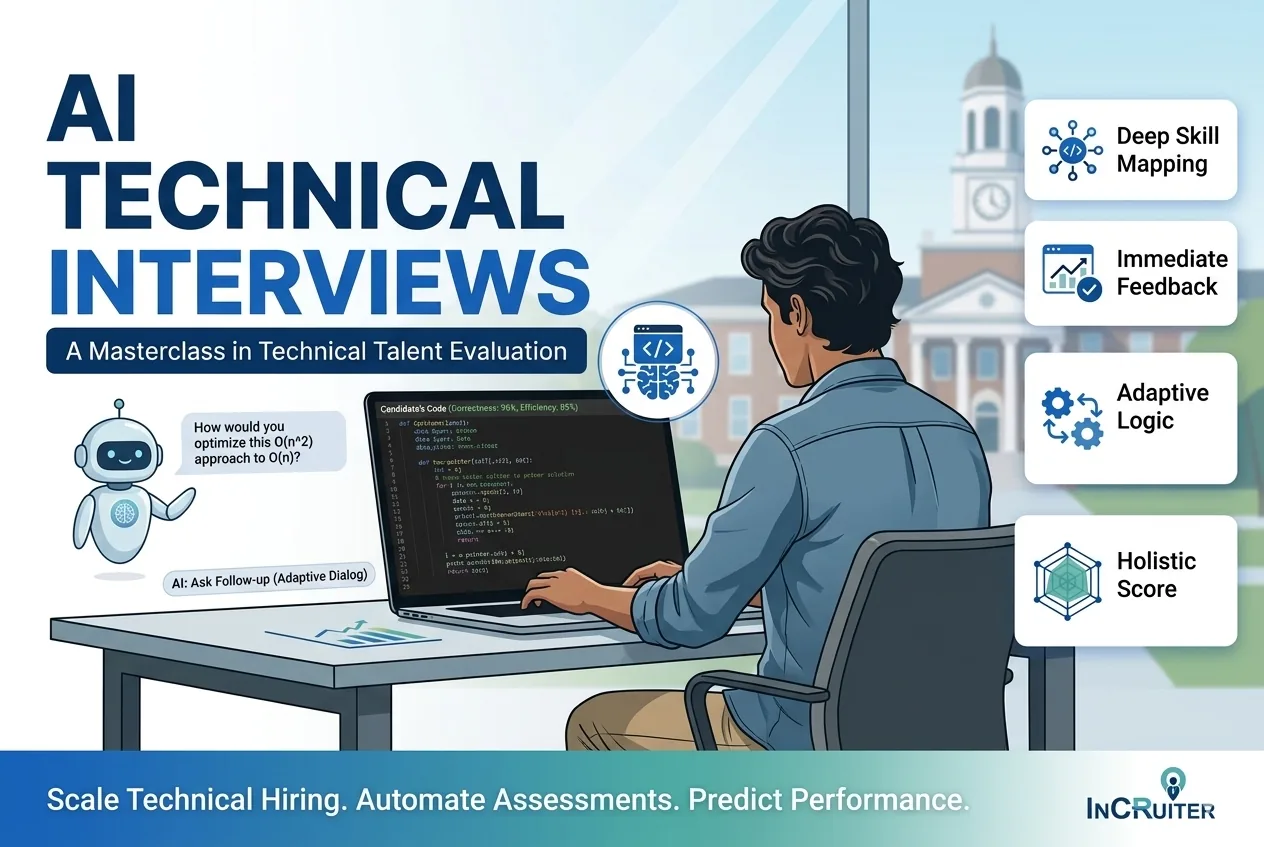
AI technical interviews are becoming industry standard (78% Fortune 500 adoption in 2026). They solve hiring consistency, speed, and scale problems while maintaining quality. This isn’t a complete solution but a significant shift in how companies evaluate developer talent.
In the past 18 months, something fundamental shifted in tech hiring. According to TalentBoard’s 2026 Hiring Technology Report, 78% of Fortune 500 tech companies now use or are piloting AI-powered technical assessments. Just two years ago, adoption was only 23%.
The question isn’t whether AI technical interviews are coming; they’re already here. The real question is: what does this mean for your hiring, and why should you understand it now?
This guide answers that. We’ve analyzed 2026 market data, reviewed the latest research, and talked to hiring leaders at Meta, Google, and Stripe. Whether you’re curious about industry trends or evaluating implementation, here’s what you need to know.
What exactly are AI technical interviews?
AI technical interviews are nothing but the evaluation of technical, coding, and production-level problem-solving skills with the help of artificial intelligence technology.
AI automatically conducts the technical interviews in place of human interviewers, asks technical conceptual questions, tests with coding challenges, analyzes responses, and generates a detailed performance report with skill scores.
The Shift From Manual to Automated Interviews
For the last 50 years, candidates have been evaluated using the same old manual interview format. The problem with this format was the multiple rounds of interviews.
To check candidate qualifications: 1st round; to assess hard skills: 2nd round; to evaluate core skill set: 3rd round; and to check culture fit, another one again, and many more if the recruiter is not satisfied.
These were old hiring days. But with AI, it’s already changed. One round is equivalent to a technical, coding, aptitude, communication, and culture-fit assessment without involving an internal team.
Everything is automated with AI talent screening software, AI asks questions, analyzes responses, triggers dynamic follow-ups, and provides detailed insights on skills.
What changed?
Without relying on anyone’s availability, the recruitment level 1 round screening can run on its own using AI.
Means thousands of parallel interviews in the same instance of time, no manual scheduling, no requesting others, just pure interviews with intelligence.
And feedback with more than 12 skill dimensions, such as correctness, efficiency, security, readability, approach, and communication.
What is the same?
The interviewee is still writing code, solving code problems, and final decisions are still dependent on humans. AI is just giving data so that referring that human can make a wise decision.
What the AI Actually Evaluates?
- Code correctness (does it solve the problem): The system’s generative AI technology matches the candidate-written program against the expected program to compute the correctness scores.
Real output: correctness score – 77%
- Algorithmic efficiency (optimal for constraints): The AI technical skill evaluation tool automatically measures the code and algorithm efficiency on memory and space utilization during the execution of operations.
Real output: efficiency score – 82%
- Code quality (readability, maintainability): The system checks how graceful candidate formate the code, name variables, add comments, and maintain code documents for long-term modifications. Basically, AI scores code readability & maintainability.
Real output: efficiency score – 82%
- Security awareness (handling edge cases, vulnerabilities): The system vets the code on its capacity to predict and prevent potential threats, validate inputs, catch errors, and resist common security exploits.
Real output: security score – 60%
- Problem-solving approach (systematic breakdown): AI judges how the candidate logically and systematically decomposed the long problems into small chunks of tasks, before writing the actual code.
Real output: Problem-solving approach – 60%
Also read: Top 10 Best AI interview Software for Hiring in 2026
Why does an AI coding interview platform matter?
Same candidate but different evaluation output with two different interviewers. This is nothing but a traditional interview consistency breakdown because of non-professional interviewers.
But the AI technical skill assessment platform cut this with consistent automated interviews, in which every candidate is evaluated against a standard, predefined skill set and framework.
So, for those who asked why a coding skill assessment platform matters, the answer is its structured, automated, and consistent interviews, which are also valued by enterprises, SMEs, Startups, and large organizations.
Why are companies adopting a developer assessment platform now?
For companies, 2026 is the year to either adopt AI or fall behind competitors who already have. The AI trend is everywhere, even in interviews.
Currently, 23% to 45% of tech-first companies use AI-based technical skills evaluation tools and have achieved 75% faster hiring, 70% better consistency, and the ability to scale without hiring an extra recruiter.
The Hiring Speed Problem
According to the LinkedIn 2026 jobs report, the average time for many companies to fill a position is 45 to 50 days, though some positions may take longer. Quality candidates don’t wait; they move to the competitors.
Here, AI not only automate treditional interviewing framework but also speeds up this process. AI does not take 4 to 5 days to review candidates’ assessments one by one; it provides feedback immediately just after the session ends.
Impact: Now with an AI-driven technology assessment platform, companies are conducting 1000s of interviews daily.
The Consistency Challenge
From application to interview, candidates must wait 4 to 10 days for their first interaction with the company. This is huge.
Even though there is no consistency in the candidates’ evaluations, two interviewers with the same candidates provide different technical evaluations.
This is something companies don’t love to talk about, 73% companies are dealing with a hiring consistency problem.
Whether they want to or not, in the meantime, they always end up making subjective decisions as the location and time zone change.
To deal with bias, AI simply follows a standardized hiring workflow. The Conversational AI technical interview bot doesn’t ask generic questions; it analyzes responses, then adapts and asks follow-up questions, digging deeper into the candidate’s core skills.
Impact: No question is left, the Conversational AI engine asks every possible question necessary for the job.
The Scale Problem
The big giants like Google, Meta, and Amazon always deal with volume hiring. Handling such a volume is not a task that can be handled with traditional recruitment methods. Old methods are not flexible enough to scale up or down as per changed requirements.
But AI could have done it better, especially in the technical interview process. An AI technical interview runs on a cloud-based system, which makes it very easy to scale up or down as demand changes.
Impact: With an AI technical-skill interview platform, companies can scale 10x at any time, per company requirements.
Market Adoption Trajectory
- 2023: 23% of big IT-hubs across the nation adopt some kind of AI assessment
- 2024: 42% using
- 2025: 59% using
- 2026: 75% Fortune 500, 54% mid-market, 31% startups adopt some kind of developer interview software powered by AI
Growth rate: 25% year-over-year increase in AI interview adoption.
How does AI Developer Interview Software Actually Work?
The flow of AI developer interview software is very simple. Read below to know that,
-
Resume Scanning: Recruiter uploads candidate resumes in bulk or in batches, the system performs automatic resume parsing by matching mention skill with required skills for job roles, and then shortlisted candidates move forward to the phone screening round.
-
Automated tele-calling: An AI telephonic interview bot automates the level-0 round of the recruitment process by automatically reaching out to the shortlisted candidates via an AI call. Evaluates with the qualifications, experience, job location, and salary expectations, types of questions, prepares the detailed report card, and provides the fitment scores.
-
Automated Interview Invitation: The system sends a calendar invitation with the option to complete the interview or assessment at any time, as per their comfort.
-
AI interviews & assessments: The candidate starts by tapping into the assessment link. Reads the interview instructions guide. Click “Start Interview”. Then they redirect to the AI interview interface, where the AI interviewer appears to ask role-specific technical questions, analyzes them in real time, and then evaluates them with follow-up questions.
-
Feedback and report: As the session ends, the system automatically generates a detailed feedback report covering code quality, correctness, optimization, and overall performance score. It also consist transcript, time-stamped session snapshots, and proctoring logs.
What Makes the 2026 Best AI Technical Interview Platform Different From 2023-2024?
The 2026 best AI technical interview platform fundamentally operates on high-class technology, which is far better than the 2023-24 one-way technical interview platform.
The old system was built to provide either a fail or a pass type of answer. That’s so static.
But today’s platforms evaluate problem-solving, system design, debugging, and communication.
The 2026 Shift in Technical Interviews
Initially, in the year 2023-24, the AI-driven technical skill evaluation platform aggressively utilizes static AI technology to interview candidates. Where AI records candidates’ responses on pre-set questions.
In the name of an AI interview, it’s the same as a candidate using their own mobile camera, but on the screen, questions appear to answer.
However, the 2026 technical AI interviewer comes with several distinct features for complete job interview interrogation of candidates:
- Adaptive Conversations: The industry’s top AI tool for interviews is using Conversational AI technology for deep skill evaluation. This tech asks role-related questions, analyzes candidates’ answers, and triggers follow-up dynamic questions to assess everything needed for a particular technical role.
This system doesn’t just ask “Does it work?” It asks:
- Does it work efficiently?
- Is the code readable by teammates?
- Did the candidate consider security?
- How did they approach the problem systematically?
- Can they explain their solution?
-
“AI literacy” Assessment: A modern AI evaluator, rather than banning AI use in interviews, evaluates how the interviewee instructs Generative AI to perform tasks such as coding. This provides insight into candidate AI competence and knowledge.
-
System Design Visualizer: With the system-embedded digital diagram-creator whiteboard, evaluate candidates’ system architecture and flowchart design skills, not just coding.
-
Code-in-the-Blanks: Along with a complete programming skills test, the system evaluates candidates’ other code understanding with fill-in-the-blank coding questions. Means the candidate has to write the code in only unfilled or unwritten sections.
-
Deepfake detection: An interview automation tool like InCruiter IncBot is equipped with deepfake detection technology that flags candidates secretly using an invisible AI tool to cheat (synthetic audio/videos, AI-assisted responses, and proxy interviews)
Also read: Technical Hiring Challenges in 2026 and How AI Solves Them
2023 – 24 Static technical interview Platform vs. 2026 AI technical interview ecosystems
| **Core Shift** | **2023–24 AI technical interview Platform** | **2026 AI technical interview Platform** | **Impact on interviewing** |
| **Interaction Mode** | Screening questions appear on the screen to be solved or answered | Conversational AI voice and digital avatars conduct interviews (human-like) | Deeper candidate evaluation with pre-set role-specific questions, with a human interviewer, feels |
| **Interview integrity** | Simple browser tab activity tracking with screen sharing | Eye movement, dual voice/face, tracking with a deepfake invisible AI tool detection | Stops AI-generated visual and audio interview fraud during the interview cheating |
| **Evaluation Focus** | Correct syntax and basic edge-cases | System engineering, algorithmic logic, problem solving, and communication | Measures conceptual engineering over rote memorization |
| **AI literacy** | Complete ban on AI assistant usage | Evaluate AI skills as per the modern role requirement | Evaluates candidates’ AI know-how to adapt to modern-day code writing |
| **Speed** | 4-second delays (Laggy) | <500ms native audio stream | Creates natural human-to-human interview rhythm |
| **Logic** | Fixed templates and static scripts | Dynamic live adaptive skill mapping | Challenges candidates based on precise real-time performance |
| **Embedded tool** | Standalone third-party software tools are used to evaluate candidates | Native internal code compiler, whiteboard, & deepfake detection tech | Benchmark talent using the company’s actual production code |
Important: The 2026 modern technical interview system is not a recruiter’s replacement; it is an interview tool only, with the goodness of AI to automate repetitive tasks in the hiring process. It recommends top talent to hire, but the final decision is still in humans’ hands.
What Results Do Companies Get From AI Coding Interview Platforms? (100 Candidates Estimation)
| **Process Component** | **Traditional Manual Process** | **AI-Powered Intelligent Process** | **Engineering Time Freed** |
| Resume Screening & Prioritization | 10 minutes (manual code/stack sorting) | 1 minute (AI-ranked instantly) | 9 minutes |
| Quick Qualification & Pre-Assessment | 15 minutes (scheduling + brief tech call) | 0 minutes (AI pre-qualifies via voice) | 15 minutes |
| Technical Assessment Setup | 10 minutes (manual test/sandbox config) | 0 minutes (auto-deployed instantly) | 10 minutes |
| Code Review & Report Generation | 30 minutes (manual logic & architecture check) | 2 minutes (automated report ready) | 28 minutes |
| Initial Feedback Documentation | 10 minutes (manual performance write-up) | 0 minutes (included in auto-report) | 10 minutes |
| TOTAL TIME PER DEVELOPER | 65 minutes | 3 minutes | 62 minutes saved |
| FOR 100 DEVELOPERS (Total) | 6,500 minutes | 300 minutes | 6,200 minutes saved |
TIME SAVINGS CALCULATION:
Time Saved = (108 hours – 5 hours) ÷ 108 hours × 100
Time Saved = 103 ÷ 108 × 100 = 95.4%
REALISTIC ANNUAL SAVINGS ≈ 80%+ (Accounting for interview variations, edge cases, quality reviews)
What’s actually changing in developer hiring?
With the developer assessment and interview platform, the result is very much visible across the industry. In technical recruitment, companies are moving from,
- Subjective to structured evaluation
- single-signal to multi-dimensional
- Manual to asynchronous.
From Subjective to Structured
-
Evaluation method changed a log. In 2020, manual interviewing with a home interviewer was very inconsistent (highly dependent on developer availability).
-
2020-2023 online automated interviews evaluate tech talent with pre-organized coding questions.
-
From 2024 to 2026, the AI layer was introduced to the assessment process, conducting complete automated interviews with follow-up questions. This isn’t just about AI. It’s about hiring becoming data-driven instead of gut-driven.
From Single Signal to Multi-Dimensional
- Old: Pass technical interview = hire decision.
- New: Technical assessment + portfolio + behavioral + culture fit = Data-driven hire decision.
Better outcomes when you combine multiple signals instead of relying on one interview.
The Async Hiring Reality
Globally, 25% of companies have implemented AI interview automation in their recruitment process, compared to 2 or 3% back in 2022.
- Timezone challenge: Live interviews don’t work.
- AI assessment works: Interview as per the candidate’s comfort, as the interview finishes, the system auto-generates a report with AI recommendations.
What companies should understand before adopting AI technical interviews?
Clarify your evaluation model and hiring objectives
Before selecting a platform, you need internal alignment on what you’re actually testing. Are you assessing pure coding ability or a candidate’s ability to work effectively with AI tools? This decision shapes everything.
Key Considerations:
- Define whether AI tool usage is allowed during assessments
- Decide if you’re measuring raw problem-solving or AI-augmented problem-solving
- Clarify communication expectations (candidates need to know the rules upfront)
- Rewrite your evaluation rubrics to match your philosophy, not the platform’s defaults
Conduct systematic bias audits and fairness testing
AI coding assessment platforms aren’t bias-free. They can systematically disadvantage neurodivergent candidates, non-native English speakers, and unconventional thinkers. You need bias auditing as part of your due diligence.
Key Considerations:
- Request platform bias audit reports from vendors
- Test platform consistency across diverse candidate demographics
- Review scoring patterns for systematic outliers
- Establish ongoing monitoring protocols post-implementation
- Understand legal exposure and compliance requirements
Evaluate vendor governance and data management practices
AI technical interview platforms don’t exist in isolation. They must integrate with your ATS, interview scheduling systems, and HR infrastructure. Poor integration creates friction that undermines efficiency gains.
Key Considerations:
- Verify ATS compatibility before purchasing
- Assess deployment timeline and setup complexity
- Evaluate customization capabilities for your tech stack
- Confirm data flow between systems
- Plan for training your team on new workflows
Plan organizational change management and team readiness
Treat your platform provider as a critical business partner, not a set-and-forget vendor. Active governance prevents data breaches, ensures accuracy, and protects hiring integrity.
Key Considerations:
- Establish formal data-handling agreements
- Define service level agreements (SLAs) and performance metrics
- Create security and compliance protocols
- Schedule regular accuracy audits with the vendor
- Maintain escalation procedures for platform issues
- Monitor for model hallucinations and system errors
Also read: Discover the Leading AI Powered Interview Platforms Today
What does the next generation of technical hiring look like?
Technical hiring is moving from “did you go to the right school” to “can you actually solve problems.” Companies now evaluate real problem-solving ability, adaptability with emerging tools, and cross-functional thinking instead of narrow specialization.
The credentials-to-competency shift
For decades, a computer science degree from a prestigious university was your golden ticket. Companies filtered resumes by school name, certification, and years of experience.
Here’s what’s changing: None of that predicts job performance anymore.
What companies discovered: Someone without a degree who can architect scalable systems beats someone with three degrees who can’t think critically. A self-taught developer who understands data infrastructure and business impact beats someone who only knows one programming language perfectly.
The hiring philosophy is flipping. Instead of asking “where did you study,” companies now ask “what can you actually build?”
From resume screening to interactive problem-solving
Traditional hiring: HR scans resumes, passes promising ones to engineers, who conduct interviews.
Future hiring: Candidates demonstrate skills through real-world scenarios, building actual features in sandbox environments, solving problems similar to your company’s real challenges, and showing work in progress.
What this enables: You see how candidates think, how they handle edge cases, how they communicate about technical decisions. You get a signal that resumes are never provided.
The bias reduction is significant, too. Someone’s university name doesn’t matter when you’re evaluating actual code and actual thinking.
AI fluency is now table stakes
Here’s the reality: developers who can’t work with AI tools are becoming less competitive.
But it’s not about prompting. It’s about judgment.
Companies now look for developers who:
- Understand when to use AI and when not to
- Catch hallucinations and errors in AI-generated solutions
- Leverage AI to move faster while maintaining quality
- Think critically about AI limitations
Tool mastery (the ability to direct AI effectively) is as important as raw coding ability now.
Hybrid skillsets are the new requirement
The old model: “We need a Python developer” or “We need a DevOps engineer.”
New reality: Companies want engineers who wear multiple hats.
What’s in demand:
- Backend engineer who understands data infrastructure and analytics
- Frontend engineer who grasps performance optimization and backend tradeoffs
- DevOps engineer who understands security, cost optimization, and business impact
- Full-stack engineer who can think about system design, not just features
Specialists still exist. But generalists with deep thinking ability are more valuable.
Geographic boundaries are disappearing
Remote work has normalized distributed hiring. Now companies aren’t limited to local talent pools.
What’s happening:
- A startup in San Francisco hires a senior architect from Buenos Aires
- A company in London sources specialists from India at significantly better value
- Teams span 8 time zones and collaborate asynchronously
The benefit: Access to global talent. The challenge: Time zone coordination and cultural differences.
For companies: You can now compete for talent worldwide. For candidates: Geography matters less, skills matter more.
Adaptability matters more than specialization
Five years ago: “I’m an expert in React with 10 years of experience.”
Today: The tools change constantly. React matters less than understanding component architecture principles.
What forward-thinking companies evaluate:
- Can you learn new frameworks quickly?
- Do you understand underlying principles, not just current tools?
- Can you adapt when your tech stack evolves?
- How do you approach problems you’ve never solved before?
Specialization in outdated technologies becomes a liability. Adaptability becomes your most valuable asset.
The portfolio replaces the resume
Your GitHub is now your resume.
Companies increasingly ask: “Show me what you’ve built. Walk me through your architectural decisions. Explain why you chose this approach.”
What this means:
- Your contributions to open source matter
- Side projects demonstrate capability and passion
- Code quality and decision-making are visible
- You can’t fake experience. Code doesn’t lie
This levels the playing field for self-taught developers and creates transparency about actual skills.
Behavioral and cultural fit still matter (but differently)
Technical skills are necessary, not sufficient.
Companies now evaluate:
- Can you communicate technical complexity clearly?
- Do you take ownership or wait for direction?
- How do you handle ambiguity and incomplete information?
- Can you collaborate effectively with non-technical stakeholders?
The difference: These aren’t vague personality traits. They’re observable during technical assessments and problem-solving sessions.
Speed of learning is the new IQ
The pace of change in technology is accelerating.
What companies really care about:
- How quickly can you pick up new frameworks?
- How fast do you go from “I don’t know this” to “I shipped with this”?
- Can you learn from mistakes and adjust?
Learning velocity predicts long-term success better than current skill depth.
Diversity of thought becomes a competitive advantage
Companies are recognizing that hiring from diverse backgrounds, different geographies, educational paths, and career trajectories creates stronger teams.
Why: Different perspectives solve problems better. Teams of people who all think the same way miss things.
What’s changing: Hiring practices now intentionally source from non-traditional backgrounds. Self-taught developers, career-switchers, international candidates, and neurodivergent thinkers are recognized as assets, not exceptions.
Conclusion
AI technical interviews are no longer a futuristic concept in 2026; they are the gold standard for scaling engineering teams. By automating early-stage screening, eliminating human bias, and accurately mapping real-world coding skills, AI tools have transformed hiring from a time-consuming gamble into a precise, data-driven science.
For companies aiming to secure top talent ahead of the competition, legacy recruiting methods are no longer an option.
Don’t let manual tech screenings slow your engineering growth. InCruiter’s AI-powered technical interview solution automates your initial tech rounds, validates coding proficiency in real-time, and delivers deep talent analytics, all while cutting your time-to-hire by 75%.
Ready to transform your hiring workflow? Book a Free Live Demo with InCruiter Today and experience the future of tech recruitment.
Frequently asked questions
Can AI accurately evaluate complex coding and system design skills?
Yes. In 2026, advanced AI interview tools like inCruiter go beyond simple syntax checking. They evaluate live code quality, logic efficiency, edge-case handling, and algorithmic thinking in real-time. For system design, AI analyzes architectural choices, scalability logic, and trade-offs just as effectively as a human lead engineer.
How do AI technical interviews prevent candidate cheating and plagiarism?
Modern AI hiring platforms use multi-layered proctoring and behavioral tracking. This includes real-time webcam and audio monitoring, screen-lock mechanisms, tab-switch detection, and AI-powered code plagiarism checks. The system flags suspicious activity instantly, ensuring a 100% fair and authentic evaluation.
Will AI completely replace human recruiters in the tech hiring process?
No. AI is designed to replace tedious technical screening, not human decision-making. It automates top-of-funnel filtering and code validation so recruiters can skip grading tests. This allows human interviewers to focus exclusively on final rounds, cultural fitment, and onboarding top talent.
Are AI technical interviews biased against certain types of candidates?
Actually, they reduce bias. Human interviewers often fall prey to unconscious bias based on a candidate’s university name, past employers, or background. AI screening tools evaluate candidates strictly on their code performance, problem-solving skills, and technical merit, creating a highly objective and merit-based hiring funnel.
Ready to Transform Your Hiring Process?
Discover how our AI-powered interview platform can streamline your recruitment and find the best candidates faster.
Make Your Hiring Process Smart and Fast