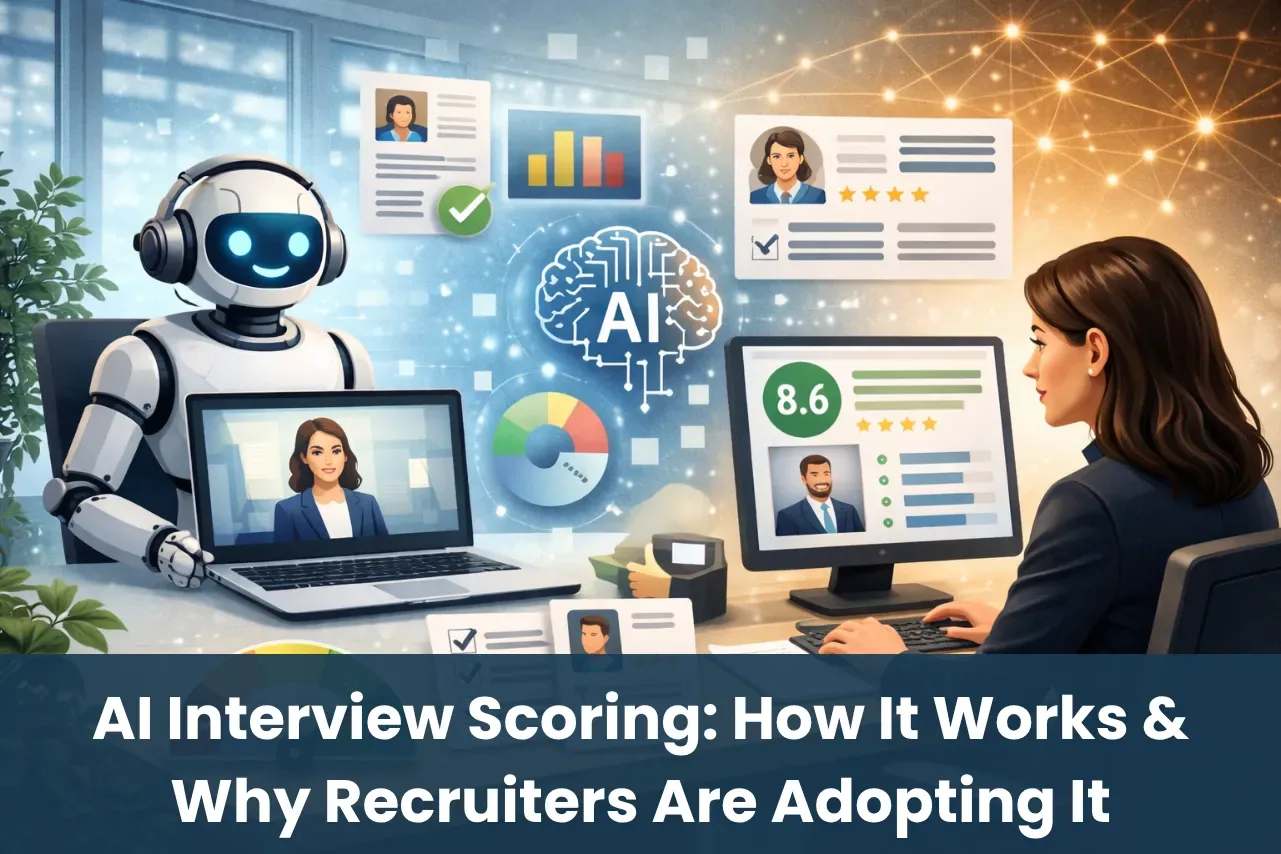
Interviewing at scale has always been one of the messiest parts of recruitment. Two interviewers sit in on the same session, walk away with completely different impressions, and somehow both feel confident. AI interview scoring doesn’t eliminate that problem overnight, but it brings a level of structure and consistency that most manual processes simply can’t match.
What Is AI Interview Scoring?
AI interview scoring is a technology-driven method of evaluating candidate responses during structured interviews, often built into AI-powered interview platforms that automate candidate evaluation and generate structured scorecards for recruiters. Instead of relying on a single recruiter’s notes and gut feeling, the system captures what candidates say, through video, voice, or text, converts it into analyzable data, and applies consistent, predefined criteria to produce a score.
The result is a structured output: a score or set of scores tied to the competencies that matter for the role, along with the evidence behind those scores. Every candidate gets measured against the same standard, on the same criteria, at the same stage of the process.
Think of it as a very thorough, very consistent interview panel, one that never has a bad day, never zones out, and never unconsciously favors candidates who remind it of someone it already hired.
Why traditional interview scoring falls short
The uncomfortable truth about unstructured interviews is that they’re poor predictors of job performance. Interviewers form strong impressions quickly, often within the first few minutes, and spend the rest of the conversation confirming those impressions rather than genuinely evaluating competencies. Different interviewers weigh things differently, remember different parts of the conversation, and score inconsistently even when using the same rubric.
At scale, this creates real problems. When a recruiter is screening 80 candidates a week, fatigue sets in. Scoring drifts. The tenth candidate of the day gets evaluated differently than the first, not because their answers were worse, but because the process isn’t built for that kind of consistency.
AI interview scoring addresses this directly. The system applies the same logic to candidate number one as it does to candidate eighty.
How AI Interview Scoring Works
There’s no single architecture behind all AI scoring platforms, but the core mechanism follows a consistent pattern across modern tools.
- Interview setup: Recruiters define the role requirements, select or build a question set aligned to specific competencies, and configure the scoring rubric. This is where human judgment does most of its work, setting the criteria the system will measure against.
- Candidate response capture: The candidate answers questions via video, audio, or written input. The system records the session and transcribes verbal responses in real time.
- Natural language processing (NLP) analysis: The transcript is fed through NLP models trained on large datasets of structured interviews. These models break down responses by linguistic patterns, content relevance, vocabulary complexity, and logical coherence.
- Competency matching: The system compares what the candidate said against the competency definitions and success criteria for the role. Did the response demonstrate problem-solving? Did it address the actual question? Was the reasoning structured?
- Score generation: Each competency is scored independently, and an overall score is generated. The recruiter receives a structured report — usually with scores, key evidence pulled from the transcript, and a recommended next step.
- Human review: The score is an input to a decision, not the decision itself. Recruiters review flagged responses, compare candidates, and apply final judgment before shortlisting.
- Well-designed AI scoring systems score interview responses based on transcripts alone, not on audio tone, facial appearance, or video quality, to reduce sources of demographic bias that have nothing to do with job performance.
What AI Interview Scoring Measures
Understanding what gets measured is important, both for recruiters configuring these tools and for candidates preparing for them. The signals vary by platform, but most enterprise-grade systems evaluate across several dimensions.
Communication clarity: How clearly and concisely a candidate expresses their ideas. The system flags rambling, circular answers, poor sentence structure, or responses that fail to address the core of the question.
Relevance and content depth: Whether the response actually addresses the competency being tested. A polished, fluent answer that says nothing substantive will score lower than a rougher answer with genuine insight.
Reasoning structure: How logically the candidate builds their argument. Structured frameworks like Situation-Task-Action-Result (STAR) are recognized and scored for completeness.
Vocabulary and linguistic complexity: The sophistication and specificity of language used, particularly for roles requiring strong written or verbal communication.
Role-specific keyword alignment: Whether responses reference the concepts, terminology, and knowledge areas relevant to the job. Used carefully, keyword stuffing without depth is caught by context analysis.
Behavioral indicators: For behavioral interview questions, the system checks whether the candidate described a real situation, their specific role, concrete actions they took, and measurable outcomes.
Types of AI interview scoring systems
Not every AI scoring platform works the same way, and recruiters should understand the different approaches before choosing one.
Asynchronous video interview scoring
Candidates record responses to pre-set questions on their own time using AI video interview platforms that allow recruiters to evaluate responses asynchronously and generate automated interview scorecards. The AI scores each answer after submission. This model is ideal for high-volume hiring where scheduling dozens of live interviews isn’t realistic. Platforms analyze transcripts and, depending on the tool, may also assess pacing, response length, and vocabulary.
Live interview augmentation
In live interviews, either video or in-person, the AI works in the background, transcribing the conversation in real time and generating structured notes and competency scores after the session ends. The interviewer isn’t replaced; they’re supported. The system captures what happened so the recruiter doesn’t have to rely purely on memory.
Fully automated AI interview agents
These platforms conduct the interview without a human present, using AI-driven interview agents that ask questions, analyze responses, and score candidates automatically during early hiring stages. The AI agent asks questions, listens to answers, generates follow-ups based on what the candidate says, and scores the entire session. These are most common in early screening rounds for high-volume technical and customer-facing roles. Platforms like BrightHire Screen and InterWiz operate in this space, integrating directly with applicant tracking systems.
Specialized technical interview scoring
For software engineering and data roles, technical interview platforms evaluate not just whether code runs correctly, but also how candidates approach problem solving and explain their reasoning. But how the candidate approached the problem, their reasoning, edge case handling, and ability to explain their decisions under the kind of follow-up questioning that separates genuine understanding from memorized patterns.
How AI scoring fits into the broader hiring process
AI interview scoring isn’t a replacement for the entire hiring process it’s a more reliable signal at one stage of it. Understanding where it fits helps recruiters use it effectively.
| **Where AI scoring adds the most value** | **Where human judgment remains essential** |
| Early screening rounds with high volume | Final-round hiring decisions |
| Asynchronous pre-interview stages | Evaluating cultural fit and interpersonal dynamics |
| Roles with clearly defined competency frameworks | Edge cases the model flags for review |
| Situations where multiple interviewers need to align on scoring criteria | Roles requiring nuanced senior judgment |
| High-volume technical assessments where consistency matters | Any decision with significant impact on the candidate’s career |
The strongest hiring processes don’t choose between AI and human judgment, they use each where it works best. AI handles the volume and consistency; humans handle the nuance and accountability.
Fairness and bias in AI interview scoring
This is where the conversation gets complicated and where it needs to be had honestly. AI scoring systems can reduce certain types of human bias, but they can also introduce new ones if they’re not designed and monitored carefully.
Where AI scoring can reduce bias
Human interviewers are susceptible to affinity bias (favoring candidates similar to themselves), halo effects (letting one strong answer color their perception of the whole interview), and simple inconsistency driven by fatigue. Structured AI scoring applies the same criteria to every candidate, which removes those particular distortions from the process.
Research has found that AI scoring systems tend to rate candidates from underrepresented groups more fairly than human interviewers in structured evaluations, suggesting that removing human subjectivity from scoring can actually level the playing field in some contexts.
Where AI scoring can introduce new bias
The risk doesn’t disappear, it shifts. If an AI scoring model is trained on data that reflects historical hiring patterns, it can encode those patterns and reproduce them at scale. A model trained predominantly on interview data from a narrow demographic group may score responses from other groups differently, not because those responses are weaker, but because they don’t fit the patterns the model was trained on.
NLP models can also carry linguistic bias. A response written in a non-dominant English dialect, or structured according to different cultural communication norms, may score lower even if the underlying competency demonstration is strong. Research has documented cases where widely used language models carry embedded gender and racial biases sourced from their training data.
What responsible AI scoring looks like
Platforms serious about fairness build several safeguards into their systems:
- Transcript-only scoring – evaluating what candidates say, not how they look or sound, removes appearance-based and accent-based bias from the equation.
- Independent bias audits – testing whether scoring outcomes vary systematically by demographic group, and correcting for disparities when found.
- Diverse training data – building models on representative datasets rather than narrow historical hiring records.
- Human-in-the-loop workflows – making AI recommendations reviewable and overridable, with full audit logs of every score and every override.
- Candidate transparency – informing candidates when AI is used in their evaluation, how it works, and what rights they have under applicable law.
Regulations are catching up. GDPR in Europe, the EU AI Act, and emerging state-level legislation in the US increasingly require explicit candidate consent
AI Interview Calibration: Why It Matters
Deploying an AI scoring system and walking away is a mistake. The most consistent theme across well-run AI hiring programs is that calibration, the ongoing process of aligning AI outputs with human judgment, is what makes the system trustworthy over time.
Practical calibration looks like this: recruiters regularly pull a sample of scored transcripts and compare their own assessments to what the AI produced. When the system disagrees with experienced human judgment, that’s a signal to investigate. Was the rubric too vague? Is the model misinterpreting certain response structures? Are there patterns in where it diverges?
Calibration sessions, where team members discuss borderline cases and define what “strong” looks like in plain language, also improve scoring consistency among the human reviewers themselves. The act of calibrating the AI tends to sharpen human judgment as a side effect.
Organizations that treat calibration as a routine part of the hiring process see better outcomes: more consistent shortlists, more defensible decisions, and models that actually improve over time because misscores are caught and corrected rather than allowed to compound.
Challenges of Implementing AI Interview Scoring
Defining competencies clearly enough for the system to use
AI scoring is only as good as the rubric it operates from. Vague criteria like “good communicator” or “strong problem-solver” don’t give the model anything concrete to measure. The setup process, defining specific, observable behaviors for each competency, is more rigorous than many teams expect, but it’s also where the real value gets built.
Candidate trust and perception
Not every candidate is comfortable being evaluated by an algorithm. Some find it alienating or impersonal; others worry, not always without reason, about whether the system is truly fair. Transparent communication about how the system works, what it evaluates, and how candidates can raise concerns goes a long way toward building trust. Research consistently shows that candidates accept AI involvement in evaluation more readily when the process is explained clearly.
Legal and compliance complexity
Regulatory requirements for AI-assisted hiring vary significantly by jurisdiction. Before rolling out AI scoring, HR and legal teams need to align on consent requirements, data retention policies, bias audit obligations, and candidate rights. Getting this wrong carries real risk, both reputational and legal.
Integration with existing workflows
An AI scoring tool that doesn’t connect cleanly to an existing applicant tracking system creates friction rather than removing it. Many modern AI recruitment platforms integrate interview scoring directly with ATS workflows to streamline candidate evaluation. The best implementations slot into the workflow, candidates receive invitations automatically, scores flow into the ATS, and recruiters see results in the same place they manage everything else.
Best Practices for AI Interview Scoring Implementation
- Start with one role or department. A phased rollout lets teams test the system, refine rubrics, and build internal confidence before scaling organization-wide.
- Build rubrics around observable behavior. Define what a strong, acceptable, and weak response looks like for each competency in concrete, specific terms, not abstract descriptors.
- Keep humans accountable for final decisions. AI scores should inform shortlisting, not replace it. Every hiring decision should have a named human who owns it.
- Be transparent with candidates. Tell applicants when AI is involved, what it evaluates, and how to raise concerns. Transparency builds trust and reduces legal risk.
- Calibrate regularly. Build spot-checking and calibration sessions into the weekly or monthly hiring cadence. Treat the model as something to maintain, not a tool you set once.
- Run bias audits before and after deployment. Check whether scoring outcomes vary by demographic group. Correct for disparities found. Document the process.
- Pair AI scoring with structured follow-up questions. AI scores signal where to probe deeper interviewers who know a candidate scored weakly on problem-solving can focus the live conversation there.
AI interview scoring vs traditional interview evaluation
| **AI interview scoring** | **Traditional interview evaluation** |
| Consistent criteria applied to every candidate | Flexible, adaptive, and conversational |
| Scores tied to transcript evidence | Captures nuance and interpersonal dynamics |
| Scales to hundreds of candidates simultaneously | Subject to inconsistency, fatigue, and bias |
| Removes interviewer fatigue from the equation | Difficult to audit or justify objectively |
| Generates auditable records of every evaluation | Resource-intensive at scale |
| Generates auditable records of every evaluation | Human accountability is clearer |
The answer isn’t to choose one over the other. The most effective hiring programs use AI scoring to handle volume, consistency, and early screening, then use human interviewing to evaluate the depth, nuance, and interpersonal qualities that algorithms aren’t built to measure.
The future of AI interview scoring
The technology is moving quickly, and a few trends are shaping where this goes next.
Adaptive question generation
Rather than asking every candidate a fixed set of questions, next-generation systems generate follow-up questions based on what the candidate actually said. If a candidate’s answer is vague on a key competency, the system probes deeper. If they demonstrate strong expertise early, the questions adjust accordingly. This produces richer signal without requiring a human to be present.
Multimodal scoring with stronger bias controls
Some platforms are exploring scoring that combines text, tone, and behavioral signals — while simultaneously building stronger controls to prevent appearance and accent from influencing scores. The challenge is significant, but the research direction is toward richer signal with tighter fairness constraints.
Predictive validity at scale
The most ambitious use of AI scoring isn’t just evaluating interviews consistently — it’s linking interview scores to post-hire performance data and continuously improving the model’s predictive accuracy. Companies with enough hiring volume are beginning to close this loop, building systems that get measurably better at predicting job success over time.
Regulatory alignment becoming standard
As legislation around automated hiring decisions tightens globally, the platforms that survive and scale will be the ones that bake compliance in from the start, candidate consent, audit trails, bias documentation, and clear explainability of scoring rationale will shift from differentiators to table stakes.
Conclusion
AI interview scoring solves a real problem. Traditional interview evaluation is inconsistent, hard to scale, and difficult to defend. When it’s done well, with clear rubrics, diverse training data, regular calibration, and genuine human oversight, AI scoring brings structure and fairness to a process that has historically had too little of both.
But the technology is only as good as the people running it. Tools built without bias audits, deployed without candidate transparency, or used to make final decisions without human review create new problems while solving old ones. The companies getting the most value from AI interview scoring treat it as a discipline, not a shortcut, and the results show in both hiring speed and hiring quality.
The best AI scoring platforms combine NLP-driven evaluation with human oversight, transparent candidate communication, and regular calibration, creating a process that’s faster and more consistent than traditional interviewing without sacrificing the accountability that hiring decisions require.
Also Read:
AI For Interviews: How Artificial Intelligence Enhances the Job Interview Process
Autonomous Virtual Interviewer: A Game-Changer in Online Interviewing
Frequently asked questions
What is AI interview scoring and how is it different from traditional scoring?
AI interview scoring uses natural language processing models to evaluate candidate responses against predefined competency criteria, generating structured scores with transcript-backed evidence. Unlike traditional scoring, which depends on an individual interviewer’s notes and impressions, AI scoring applies the same criteria to every candidate, making the process consistent and auditable at scale.
Is AI interview scoring fair and unbiased?
It depends heavily on how the system is designed and maintained. AI scoring can reduce certain human biases, like affinity bias and inconsistency driven by fatigue ,but it can also encode biases present in its training data. Well-built platforms mitigate this through transcript-only scoring, independent bias audits, and diverse training datasets. No system is perfectly bias-free, which is why regular auditing and human oversight remain essential.
What does AI interview scoring actually measure?
Most platforms evaluate communication clarity, response relevance, reasoning structure, vocabulary sophistication, and alignment with role-specific competencies. For behavioral interviews, systems check whether answers cover the full STAR structure, situation, task, action, and result, with measurable outcomes. Technical interview scoring tools also evaluate problem-solving logic and the ability to explain decisions.
Can AI scoring replace human interviewers entirely?
Not for most roles, and not for final decisions. AI scoring works best in early screening stages where volume is high and consistency matters most. Final hiring decisions benefit from human judgment, particularly for evaluating cultural fit, interpersonal dynamics, and the kind of nuanced qualities that structured competency scoring doesn’t fully capture. Most leading frameworks treat AI as a tool that supports human decision-making, not one that replaces it.
What legal requirements apply to AI interview scoring?
Requirements vary by location. In the European Union, GDPR and the AI Act impose obligations around candidate consent, transparency, and explainability. In the United States, state-level legislation, including Illinois’ Artificial Intelligence Video Interview Act, requires disclosure when AI analyzes video interviews. Globally, EEOC guidelines apply to anything that could constitute an employment test. HR and legal teams should review applicable requirements before deployment and consult legal counsel for compliance planning.
How should candidates prepare for an AI-scored interview?
Structure your answers clearly and address the actual question being asked. For behavioral questions, use the STAR framework and include specific, measurable outcomes. Speak at a natural pace, avoid rambling, and reference relevant skills and terminology from the job description. Most AI scoring systems evaluate the substance and structure of what you say, preparation that would impress a skilled human interviewer will generally serve you well with AI scoring too.
Ready to Transform Your Hiring Process?
Discover how our AI-powered interview platform can streamline your recruitment and find the best candidates faster.
Make Your Hiring Process Smart and Fast