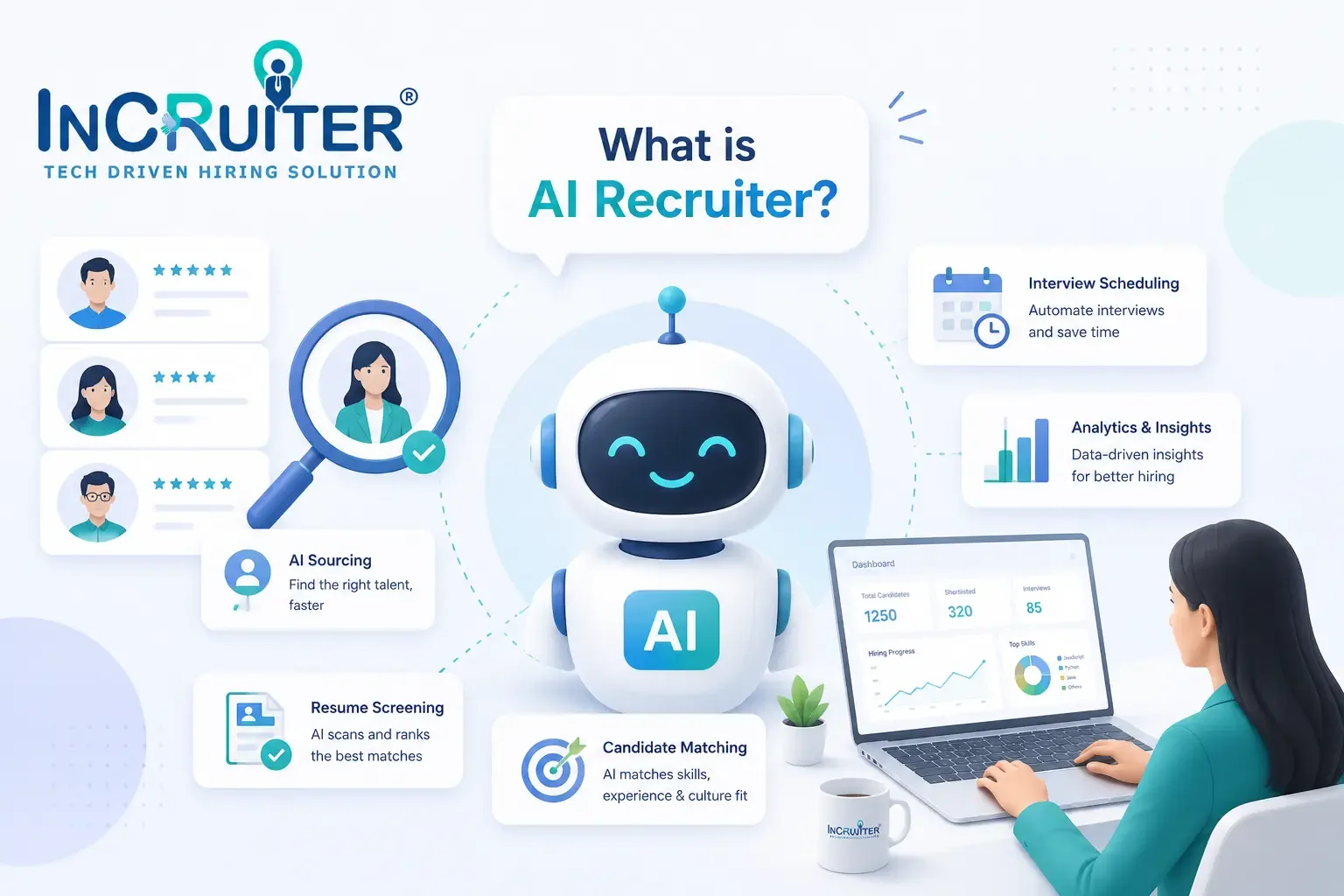
“What is an AI recruiter?” An AI Recruiter refers to the autonomous virtual team member that performs the initial phases of the recruiting process autonomously. Designed as autonomous recruiting software, it screens candidates, evaluates resumes, conducts telephone screening and competence assessment, sets up interviews, and ranks applicants, but the final decision of hiring is always made by humans.
Unlike a chatbot or an applicant tracking system, it is not just a helper for a recruiter but works as a partner that does the recruiting job autonomously.
That’s why the distinction between an AI recruiter tool and something else is so important. There are plenty of tools out there that use the term “recruiter” for things that they clearly aren’t. Let’s look more closely at what makes up an AI recruiter by starting right with this co-pilot concept.
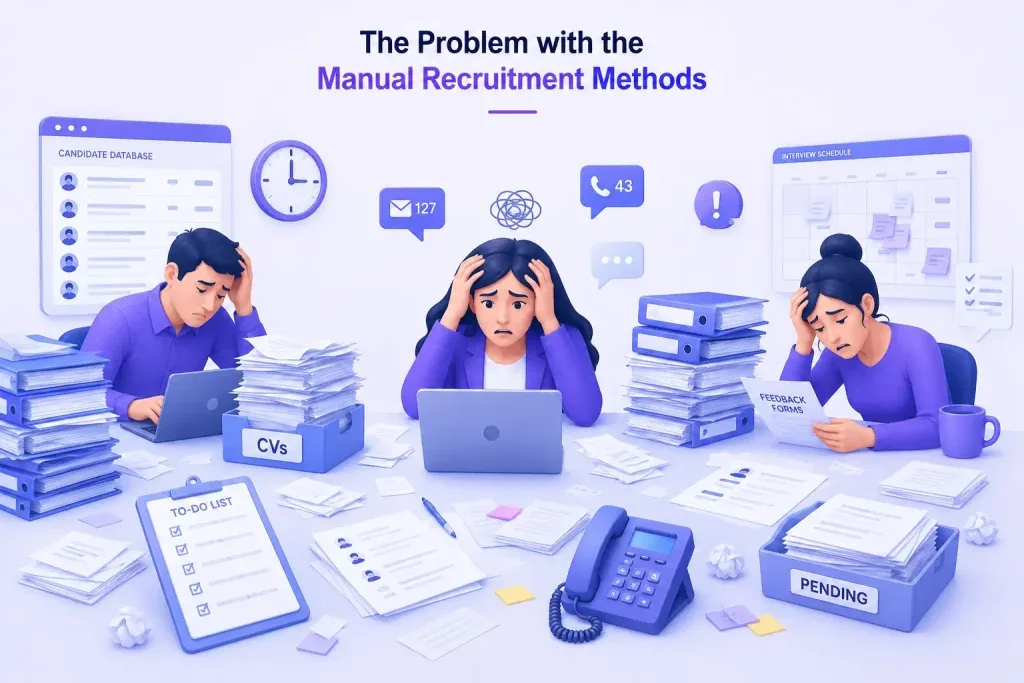
The Problem with the Manual Recruitment Methods
The Greenhouse study found that the average time-to-fill for an open role (fresher to leadership) is between 45 and 85 days, with an average cost per hire in thousands of dollars.
Meanwhile, a well-posted ad can garner hundreds of applicants in days, far more than any recruiter can seriously consider in that same time span.
The result is a system in which quality recruiters spend most of their week stuck in administrative tasks, skimming resumes in six-second intervals, getting no return on the calls they make, and battling scheduling conflicts between three interviewers and one candidate.
Every wasted hour here reduces the chances of your candidate saying “yes” to you and saying “no” to a competitor that wastes no time in swooping in on the best talent. The best applicants are typically gone in about ten days.
An AI hiring agent takes on these challenges, not by helping recruiters become more productive, but by eliminating the need for human recruiters altogether.
AI Recruiter Tool vs. ATS vs. Recruitment Chatbot: Three Very Different Machines
The easiest way to understand this class of software is to begin by exploring what it isn’t. People often confuse all of these tools, but at a foundational level, their abilities and purposes vary in many ways.
| **Capability** | **Applicant Tracking System (ATS)** | **Recruitment Chatbot** | **AI Recruiter Tool** |
| **Core function** | Load, store, and manage candidates’ data and applications | Based on pre-uploaded answers, respond to the applicant’s query | Covers sourcing, screening, scheduling, and reporting with AI |
| **Resume evaluation** | Match the skill keywords with the resume | None | AI JD-to-CV matches a resume semantically, shortlists the best candidate only |
| **Interviews** | No | Test with preset Q&A type questions | Automated interview & assessment engine conducts tech or non-tech interviews |
| **Scheduling** | Human manually schedules interviews | Limited handoffs of the scheduling process | Fully automated scheduling, multi-channel coordination |
| **Decision support** | Basic resume scoring | None | Provides scores, rank, and AI summary after each session |
| **Human role** | Does the work | Does the work | Humans come only in the final decision |
How an AI-Powered Recruitment Tool Works: The Step-By-Step Hiring Journey
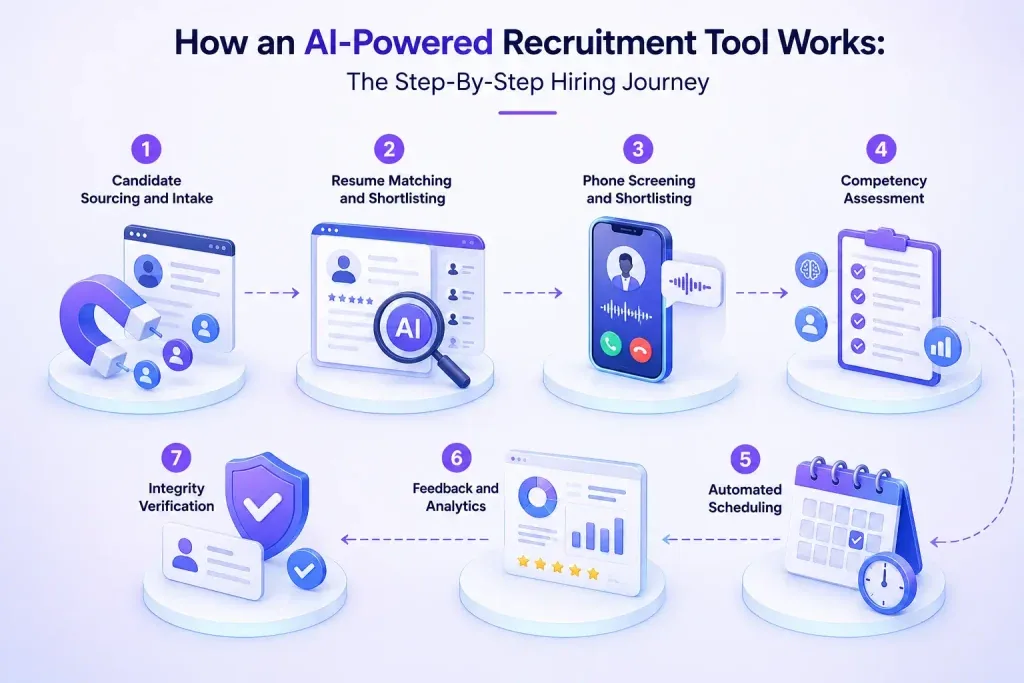
The inner workings of the AI-powered recruitment engine are organized in 7 key stages that follow the logic of the hiring funnel.
1. Candidate Sourcing and Intake
The tool scans through job boards, LinkedIn, GitHub, and other portfolio sites, as well as the company’s existing talent pool. It prioritizes hard skills showcased through code and projects over what the candidate promised on their resume.
2. Resume Matching and Shortlisting
The recruitment AI bot computer algorithm extracts hidden requirements from the job description and, for each candidate, scores their resume on a comparable metric, subsequently outputting a shortlist of prospects. The tool eliminates the guesswork from the resume screening process by standardizing the shortlisting and reducing human bias, solving two problems at once.
3. Phone Screening and Shortlisting
The shortlisted candidates are contacted via AI phone call to gauge their fit according to the job’s requirements, overall working experience, salary, present location, and other hard requirements. Whereas a human recruiter can handle roughly forty screening calls per week, an AI tool can manage hundreds of candidates in a batch, applying the same baseline filters to each candidate and shortlisting those who meet the requirements.
4. Competency Assessment
Built-in Conversational AI conducts an interview-like assessment with follow-up questions to gauge the candidate’s responses. This step helps the companies to dig deeper into the candidate’s knowledge and expertise.
Coding tests, situational assessments, and role-specific inquiries, depending on the position’s requirements, are assigned to candidates on their schedule.
5. Automated Scheduling
Candidates who pass the current stage are automatically assigned a scheduling for the following round of interviews or stage interviews. This tool acts according to the availability of both parties involved, the recruiter and candidate, suggesting interview dates and times, sending reminders, and allowing for rescheduling without the need for a coordinator.
6. Feedback and Analytics
The hiring agent goes through all the information and data gathered during this process, takes required actions depending on commands and analyzes responses from candidates regarding their qualification statements for the position in question. After that, the performance of each candidate is scored.
Then this tool generates analytic reports, including efficiency rate percentage, skills and strengths and weaknesses of talents, funnel rate per stage.
7. Integrity Verification
In remote hiring process, there are possibilities for remote cheating and thus the problem needs to be solved. The AI-powered proctoring is conducted during interviews, tracking any activity, checking if any unauthorized materials were used and using deepfake prevention technologies, which makes talent suspicious right away rather than after three months.
Hiring With and Without an AI Recruiter: A Timeline Comparison
Theory is fine. Here is what the difference actually looks like. Imagine two companies opening the same senior sales role on the same Monday, with 800 applications each.
| **Stage** | **Traditional Hiring Funnel** | **AI Recruiter Funnel** |
| Resume review | Week 1 goes into manual review. About 200 profiles get a real read, the rest get a skim | All 1000s of resumes are scored and ranked within seconds |
| Screening calls | Week 2 is phone screening: 60 calls attempted, 25 completed, each with different questions and quality | 100s of candidates finish their phone screens round at the same time in different time zones |
| Skills assessment | Squeezed in wherever calendars allow, often skipped under time pressure | Volume assessment of the candidates on their own schedule |
| Interview scheduling | Internal team sends 6 emails, 3 to 6 calls, and WhatsApp confirmation just to schedule 1 slot | The automated calendar system auto-books the slots for the final human interviews |
| Final interviews | Begin in week 4 | Hiring manager meets five fully vetted finalists on the first 3 days only |
| Offer | Day 38: The team agrees on their favorite. Day 52: role closes with the second choice, because the top pick accepted another offer on day 19 | Day 5th: offer goes out. The strongest candidate is still available, because nobody gave her three weeks to leave |
| Total time | 52 days, second-choice hire | 6th day, first-choice hire |
Key Benefits of Adopting an AI Recruiter
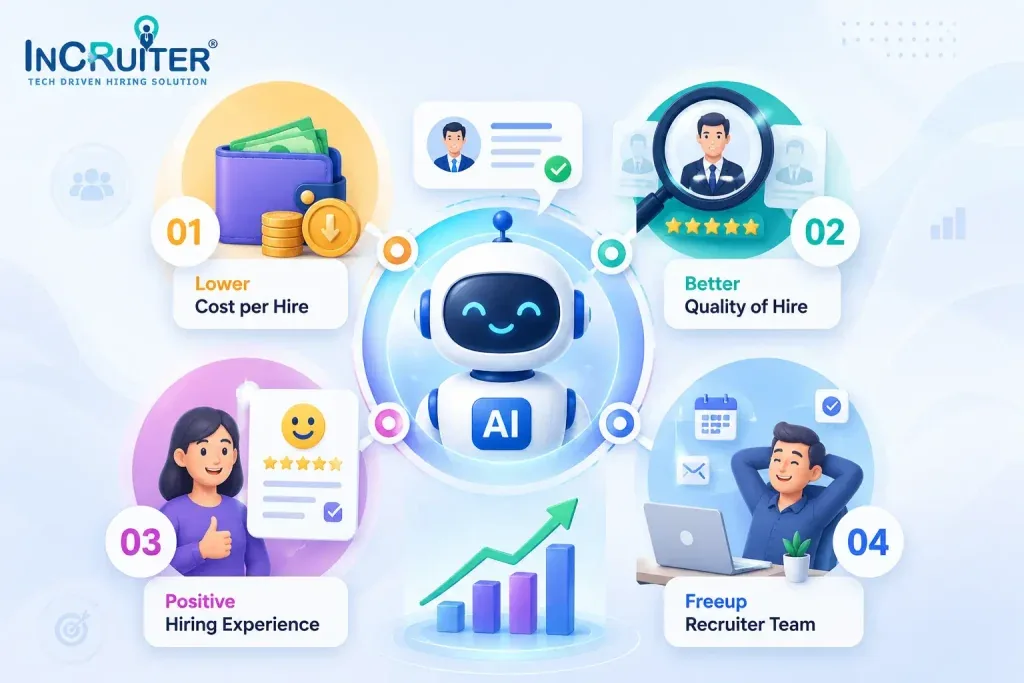
Apart from the funnel implementation and management process, the application of the software will add four more advantages that the vendor will not mention on their website. The software will lower the cost per hire, increase recruitment quality, provide better candidate experience, and prevent the talent team from burnout.
Lower Cost per Hire
Screening, scheduling, and interviewing of candidates take most of the hiring costs spent on headhunters. By shifting these responsibilities onto the software, a single recruiter’s job replaces a team of five, eliminates costs for external firms, and eliminates the need for additional vacancies in the talent team. For large companies, these costs are usually measured in thousands of dollars per fill.
Better Quality of Hire
The majority of unsuccessful recruitments occur because of the recruiter’s inability to comprehend what is needed by the business. With the help of skills validated matching, one would be capable of ensuring that the recruited individual is qualified enough to do the tasks of the respective job. Thus, there will be a lower number of expensive re-hires.
Positive Hiring Experience
Applicants usually never receive any response about their application, and remember this moment. AI recruiting offers an instant and interesting response that would reply even during late nights, such as midnight or 2 o’clock AM for the applicant. Everyone engaged in the recruitment process is updated on everything all the time, and people who get rejected feel respected in order to encourage them to apply again later.
Freeup Recruiter Team
Recruiters have to deal with a lot of screening and coordination work that makes them burnt out and dissatisfied with their jobs, causing them to quit. Letting an AI hiring agent do this monotonous work for them means recruiters can spend more time doing what they enjoy while improving their retention in the industry.
The Current Limit of AI Recruiters: No AGI Yet
At present, an agent that is designed to manage monotonous tasks handles all the steps involved in the recruitment process. It offers ranks, scores, and makes the whole procedure data-driven. However, the reality is that the world has not yet achieved Artificial General Intelligence. The process described above is run by an extremely skilled narrow AI model.
The recent market research conducted by Forbes concluded that approximately 72% of top-layer organizations utilize AI for at least one business task, like automating the first half of the recruiting process. While the other 28% are planning to implement this in their workplace hiring.
However, the line between fully automated and human-driven hiring will be blurred in the near future. Soon, 100% AI interviews that are able to provide accuracy close to 100% will be available.
Business Case Studies: How Industries Use AI in Talent Acquisition?
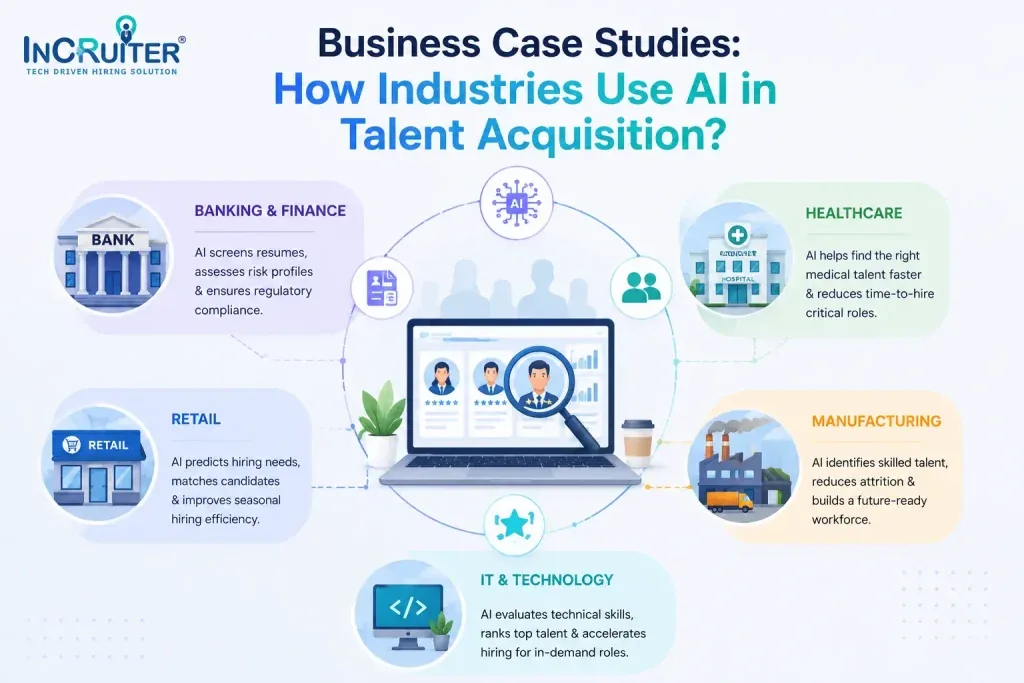
E-commerce: Speed at Seasonal Scale
An e-commerce organization that was surging in growth needed to fill 300 warehouse worker positions ahead of the holiday season. The company tried using traditional means to screen these candidates but found the process excruciatingly slow, taking eleven weeks in total for the entire cycle.
By contrast, the AI recruiter managed to score, screen, and schedule these applicants in only a single day, accelerating the hiring process greatly.
Moreover, the quality of applicants improved since those who had applied could hear back from the company within a couple of hours after submitting their applications, as opposed to almost two weeks in the previous case.
BPO: Cutting Costs by Over Fifty Percent
A business process outsourcing company that operated twelve months a year had to continuously recruit new staff in six different locations. However, the task was extremely hard for the small team of fifteen recruiters who had to handle the entire end-to-end hiring process.
After implementing an autonomous recruiting system, the company managed to offload most of the monotonous work to an AI agent. Consequently, only five human recruiters remained in the loop, while the others transitioned to client-facing positions.
Additionally, the organization reduced its cost per hire by over eighty percent within two quarters as it no longer had to rely on expensive external agencies for screening and scheduling.
Financial Services: Ensuring Uniformity During Audits
A financial service was confronted by challenges in compliance due to inconsistencies in recruitment practices across its branches. The solution was the development of an AI hiring tool that performed standardized interviews in the same way.
The company was thus able to present virtually the same interview transcripts when questioned by the regulators about its hiring practices.
The uniform hiring process ensured that only the best candidates were shortlisted at the forty company-owned branches.
Logistics: Growing with Intelligence
A logistics company that decided to open three new distribution centers in one quarter had to hire two hundred new staff members in different locations. In the past, such a recruitment drive would have required the company to rely on different staffing agencies for each location while also putting extra pressure on its existing recruitment team.
However, the company’s AI-powered virtual recruiter effortlessly onboarded all these new hires by scaling up the screening process. The software handled the increased number of screening requests without the company having to hire additional recruiters.
At the same time, the logistics company maintained the quality of its hiring processes since every new hire went through the same procedure as their counterparts in other locations. The entire recruitment process was monitored from a central dashboard where the company executives could track the progress of all three new facilities’ recruitments.
Insurance: Opening Talent Pools English Left Behind
An insurance company faced challenges with regard to hiring field-sales representatives for small offices in less-populated areas. Indeed, most of the candidates were not proficient or even unwilling to take a standard English proficiency test
However, after implementing multiple-language and self-sufficient interviews, the company witnessed an increase in both recruitment rates and improved quality of recruitment.
Therefore, the company was able to attract and hire new applicants that would be unreachable in the previous system.
The Future of Hiring Is Autonomous
And what precisely is AI recruiting? It is a sophisticated software known as autonomous recruitment software that manages to conduct the whole hiring process on its own, ranging from attracting and selecting individuals who are qualified for the vacant positions to assessing their skills, arranging interviews, and even narrowing down the choices to the most suitable candidates.
This is not an application tracking system that helps with filing job applications, or a simple chatbot that gives answers to questions – it’s a full-fledged software solution that does the recruiting work.
This is how autonomous recruiting agents are transforming hiring. The hiring process, previously taking 52 days, will take only six days with the help of an AI recruiter. The candidates presented in the shortlist will be categorized objectively rather than based on subjective human judgment.
AI recruitment is already used in talent acquisition rather than being a concept of the future.
Frequently asked questions
Can an AI recruiter interview candidates in their regional language or multiple languages?
An AI recruiter is designed to converse with candidates in multiple languages, including Hindi and English. The choice of language depends on the comfort level of each candidate. Thus, by being multilingual, the software helps in tapping into language-specific talent pools that would otherwise be inaccessible to human recruiters.
Does an organization need human recruiters if it uses an AI-powered candidate screener?
Human recruiters are needed even if one has an advanced AI software to screen candidates. This is because while the AI software can do everything from sourcing to scheduling, final decisions regarding job offers, salaries, and human interventions, such as closing deals, remain the responsibility of human recruiters.
Can an AI recruiter assist with bulk hiring campaigns?
This is where the solution is at its best. A campaign with two thousand applications that would overwhelm any human recruiter is child’s play to the AI. It will review and call each candidate, determining their suitability for the post. The turnout for such a drive would be much better than a human recruiter could manage on their own.
Do companies still need human recruiters after adopting an AI recruiter?
Yes. The AI handles sourcing, screening, calling, and scheduling. Humans make the final judgment, salary negotiation, and the relationship-building that convince a strong candidate to say yes. The role shifts from coordinator to closer.
What roles suit autonomous hiring best?
Such types of roles that have a defined checklist of requirements: engineering, sales, customer support, operations, BPO, and also frontline staff. However, positions regarding leadership and specific niche specialists must remain dependent on humans’ judgments, while initial interview steps can already be conducted by AI.
Will AI ever replace the final interview?
It seems so. Nowadays, the majority of companies use automated systems for the first half of the hiring process and make decisions based on human-led systems. With the improvement of machine learning, AI interviews will be common soon.
Ready to Transform Your Hiring Process?
Discover how our AI-powered interview platform can streamline your recruitment and find the best candidates faster.
Make Your Hiring Process Smart and Fast