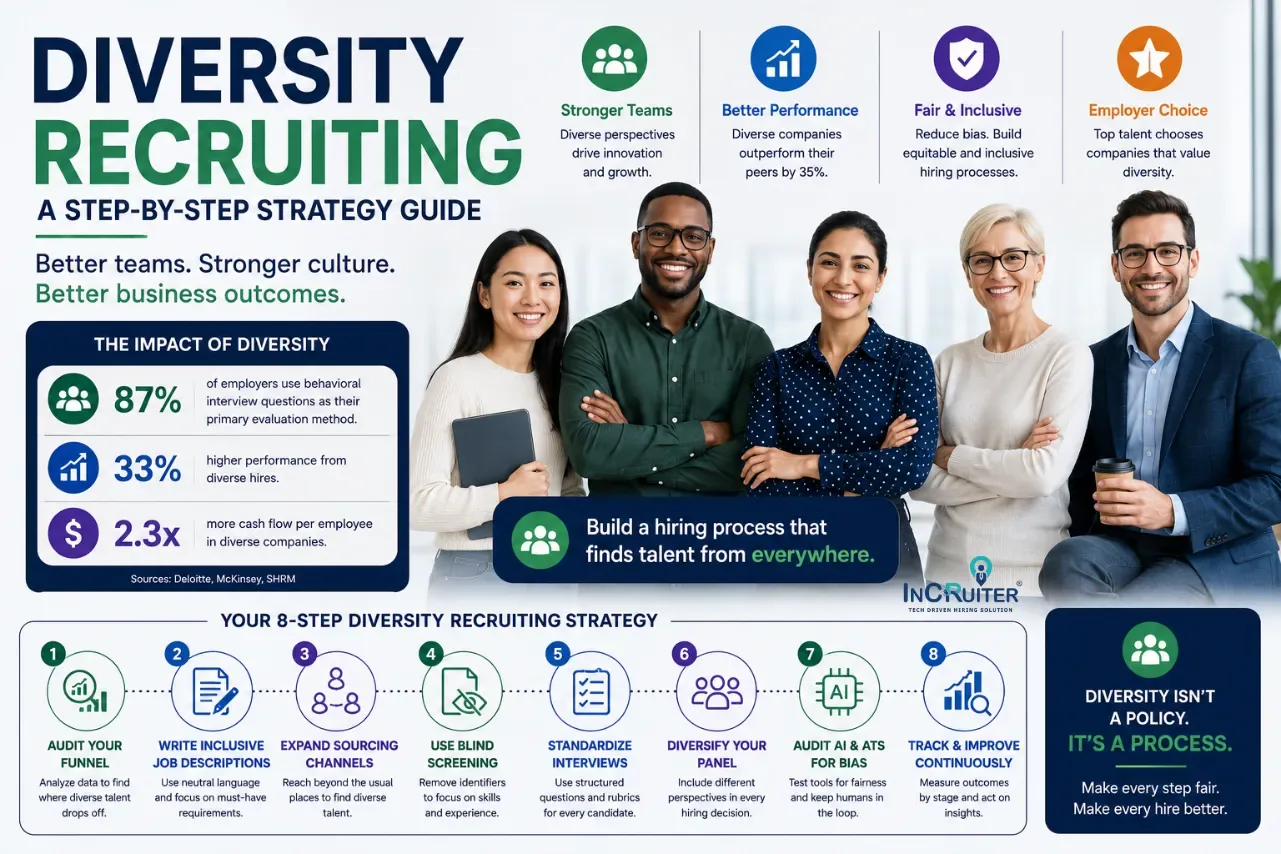
In 2026, most of the companies fail when it comes to diversity recruiting, even after having the right intentions. The problem is the processes and systems that they rely on for hiring diverse-scale candidates. Just consider one example where new sales targets are set without changing the older approach of prospecting, qualification, and deal closure. That’s a similar thing with the diversity hiring approach, where expecting the goal does not matter if you don’t have the structured mechanisms in place. The organizations need to redesign the processes in order to ensure that the company is ready to implement inclusive hiring practices.
As per the data, the organizations having the best hiring culture from an ethnic perspective outperform those that do not focus on the diversity-based hiring practices. Not just the companies, even the employers evaluate the employer based on the diverse hiring practices. The same gets carried in the performance too, as homogeneous hiring panels are likely to get the same kind of candidates and profiles that seem to like their own.
In reality, the diversity hiring strategy has changed a lot over the past couple of years. Both legal and political scope are also impacting this shift & companies using it in the right manner have scaled beyond the reach. In this guide, we’ll focus on diversity-based recruitment that remains the same for institutions regardless of policies and environment. You need to have a recruitment funnel that screens every candidate fairly without the chance of interviewer bias at every stage. Let’s also explore how it widens the scope of getting a consistent flow of the right candidates in inclusive hiring practices.
What Diversity Recruiting Actually Means
Diversity recruiting is the practice of identifying and correcting the loopholes in the hiring process that lead to intentional or unintentional bias. This helps in solving the favoritism in the hiring process based on factors like gender, ethnicity, age, disability, background, or educational qualifications. As per the diversity hiring strategy, the problems should not bring any kind of bias in the job role, and hiring should be based on performance and skill sets.
Inclusive hiring is different from inclusion, as the latter is about how a candidate aligns well with the organizational operations and team workflows. Diversity recruiting is about the right candidate getting into the job in the fairest manner. Inclusion is about whether the candidate will stay, but diverse, inclusive hiring is about maintaining hiring that is fair and without any bias. Whether conscious or unconscious, the interview process has bias at any stage of the hiring journey. A diversity recruiting strategy is the proven approach of replacing the chances of bias with structure and mechanisms.
Where Bias Actually Enters the Hiring Funnel
| **Hiring Stage** | **How Interviewer Bias Enters** | **The Real Impact** |
| Job Description | Using aggressive, gendered words (like rockstar or ninja) and listing too many optional skills as strict requirements | Diverse candidates and qualified women often choose not to apply at all, filtering themselves out before you ever see them. |
| Resume Screening | Quick & unchecked pattern-matching by recruiters based on names, locations, or backgrounds | Candidates with diverse-sounding names receive significantly fewer callbacks, even when their qualifications are identical to others |
| Interview Assessment | Relying on informal chats on the basis of gut feelings and personal chemistry, without a set list of questions | First impressions dominate. Interviewers get more flexible toward candidates who share a similar background rather than those who can do the job best |
| Hiring Panel | Using a panel of interviewers who all share the same background, department, or viewpoint | The team naturally favors candidates who feel familiar to them, which accidentally leads to hiring the exact same types of people. |
A Step-by-Step Approach To Diversity Recruiting Strategy
The strategy of diversity recruiting in an organization addresses each stage of the hiring funnel in the correct order. Here, every step is designed separately based on the current trends and systems that lead to a better hiring journey and measurable change.
Step 1: Audit the Funnel Before Changing Anything
The first and foremost thing is to start checking which candidates from different backgrounds are leaving your hiring journey. Check the data from different demographies, the shortlisted pool of candidates, and final hiring decisions. This will give clarity on where the problem is, and candidates are going away because of biased hiring. Without this first step, every other change in the diverse hiring journey is merely guesswork.
Step 2: Rewrite Job Descriptions for Inclusive Language and Real Requirements
Your job descriptions should have the human element and wording that actually relate to the candidates. For example, instead of using words like rockstar or dominant, go with ones like collaborative, initiatives, and drives results. The JDs should keep both genuine requirements and preferences separately while checking if all the requirements are aligned with the candidate’s success. Many job descriptions try to keep the requirements just for the sake of habit instead of necessity.
Step 3: Expand Candidate Sourcing Channels Instead of Basic Ones
Usually, the referral-based candidate sourcing offers efficient candidates, but they’re going to be the same as the people referring them. To find different talent with a diversity hiring strategy, you need to partner with the professional groups, post the job on different channels, and keep looking for the right applicants rather than just waiting for anyone to come over. Additionally, it is also important to keep track of which channels are actually bringing qualified candidates.
Step 4: Implement Blind or Structured Resume Screening
Try to get the resumes corrected in terms of names, dates, photos, graduation dates, etc., before anyone actually reviews them. This will change the organisational hiring culture that leaves the scope of interviewer bias. The candidates will be judged on the basis of their skills only, instead of their appearance or academic records. A good standard of blind candidate screening avoids any sort of indirect clues to the interviewers that can bring in bias.
Step 5: Standardize Interviews With Structured Questions and Rubrics
As per the diversity hiring strategy, every candidate for the same job roles needs to go through the same level of skill-based questions. The scoring and assessments should be done on the basis of the same sort of pre-defined guidelines shared with the interviewees. This simple yet powerful step removes the personal favorite options and selects candidates from different skill sets and ethnicities. The candidate scoring should be done independently by the interviewers before even talking as a group.
Step 6: Diversify the Hiring Panel Itself
Not just the candidates, the interviewer panel needs to be from different demographics as well. They should be from different backgrounds, departments, and job levels to evaluate the candidates from a diverse and open mindset. Although this step doesn’t ensure the removal of interviewer bias completely, it puts a check on the narrow opinions to make the ideal hiring choices for a specific role. In case your organization is small and cannot afford a diverse panel, the best backup plan can be to train the current team to highlight the bias in hiring.
Step 7: Audit AI and ATS Tools for Bias, Not Just Speed
If you’re checking the candidate resumes using AI, check it for the interviewer bias rather than just trusting the platform blindly. As per the data, around 93.7% of untested AI resume readers led to racial and demographic bias. The AI platforms need to be checked from all aspects and should be from a reliable company to ensure fair hiring. The final selection of AI tools should be based on the training data, regular checks, and keeping people in charge of final decisions.
Step 8: Track Outcomes by Stage, Not Just at the Finish Line
If you take a look at just the final “percentage of diverse hires”, it becomes quite hard to visualize where the hiring journey gets collapsed. There needs to be an audit based on the diversity hiring strategy stages, like application, shortlisting, interview, and final job offer. The same case is with the hiring journey, where leaving the small gaps at multiple stages leads to a significant gap while you make the final offer.
Building Inclusive Hiring Into the Process, Not Just the Policy
A diversity recruiting strategy is only relevant if it can produce long-lasting results when the structural changes are implemented in the hiring workflow. However, additionally, the same needs to be in a separate policy document that recruiters end up consulting occasionally. An AI interview platform like InCruiter IncBot offers the same level of essential structure and competency-based screening in the interview process. The best part of AI recruitment software leads to an automated structure that ensures consistent evaluation remains from the first stage of diversity recruiting practices.
If your organization needs to hire mid and senior candidates, the interview-as-a-service platform like InCruiter IncServe brings the team of experts on behalf of your internal team and resources. These experts will follow the pre-defined screening standards and candidate scoring patterns to ensure a fair and honest hiring culture. In simple words, this AI-based solution ensures that the candidate evaluation remains consistent irrespective of which internal panel is taking the interview.
Do you want a hiring process built for structure and fairness in your organizational-scale hiring journey? Book a demo with InCruiter, one of the best AI recruitment software, to see how InCruiter standardizes screening and interviews across every candidate.
Frequently asked questions
What is diversity recruiting in the hiring journey?
Diversity recruiting involves the practice of finding and resolving the areas where there is a chance of bias (intentional ot unintentional) bias. The major reason behind the importance of diversity recruitment is that bias narrows the candidate pool that gets a fair evaluation. The cause of the bias can be based on gender, ethnicity, age, disability, economic background, and more. The bias remains completely independent of candidate skill-sets and their ability to do the job. The diversity-based hiring culture focuses on candidate sourcing, screening, interviewing, and hiring decisions.
What are the most effective inclusive hiring practices?
The most effective inclusive hiring practices include rewriting job descriptions to remove any sort of generic language and requirements. Implement good blind screening practices that can get rid of names and other personal details, which could lead to interviewer bias. Additionally, the interviews need to have a structured process and scoring mechanisms for every candidate, along with diversifying hiring panels, and more.
How do you build a diversity hiring strategy from scratch?
Begin with a hiring funnel audit to figure out where the hiring process has an exact problem with candidate drop-offs. Keep a track of the candidate sourcing, screening, interview, and offer stages to get clarity on diverse hiring patterns. Once you’re able to figure out the exact issue, solve it with an inclusive job description, expanded candidate sourcing channels, blind resume screening, structured interview processes, and more.
How can AI help reduce hiring bias?
AI systems and platforms reduce the chances of hiring bias but only when implemented with proper safeguards. Start with the removal of the candidate’s personal information or photos from the resumes before any human actually reviews them. This needs to be strictly in the process, irrespective of application volume or other burdening tasks. The Artificial Intelligence-powered platforms can solve the interviewer bias, but only if they are designed and trained to remove any sort of bias before making the hiring decisions.
What metrics should companies track for diversity recruiting?
Organizations should keep a check on the hiring stages differently, instead of relying on a single hiring number review. Check the diverse recruiting ratio, shortlist conversion rate by demographic group, interview-to-offer rate, final hiring rate, etc. Tracking stage-wise reveals exactly where the funnel is at fault and needs efforts from the human loop and automated systems.
Ready to Transform Your Hiring Process?
Discover how our AI-powered interview platform can streamline your recruitment and find the best candidates faster.
Make Your Hiring Process Smart and Fast