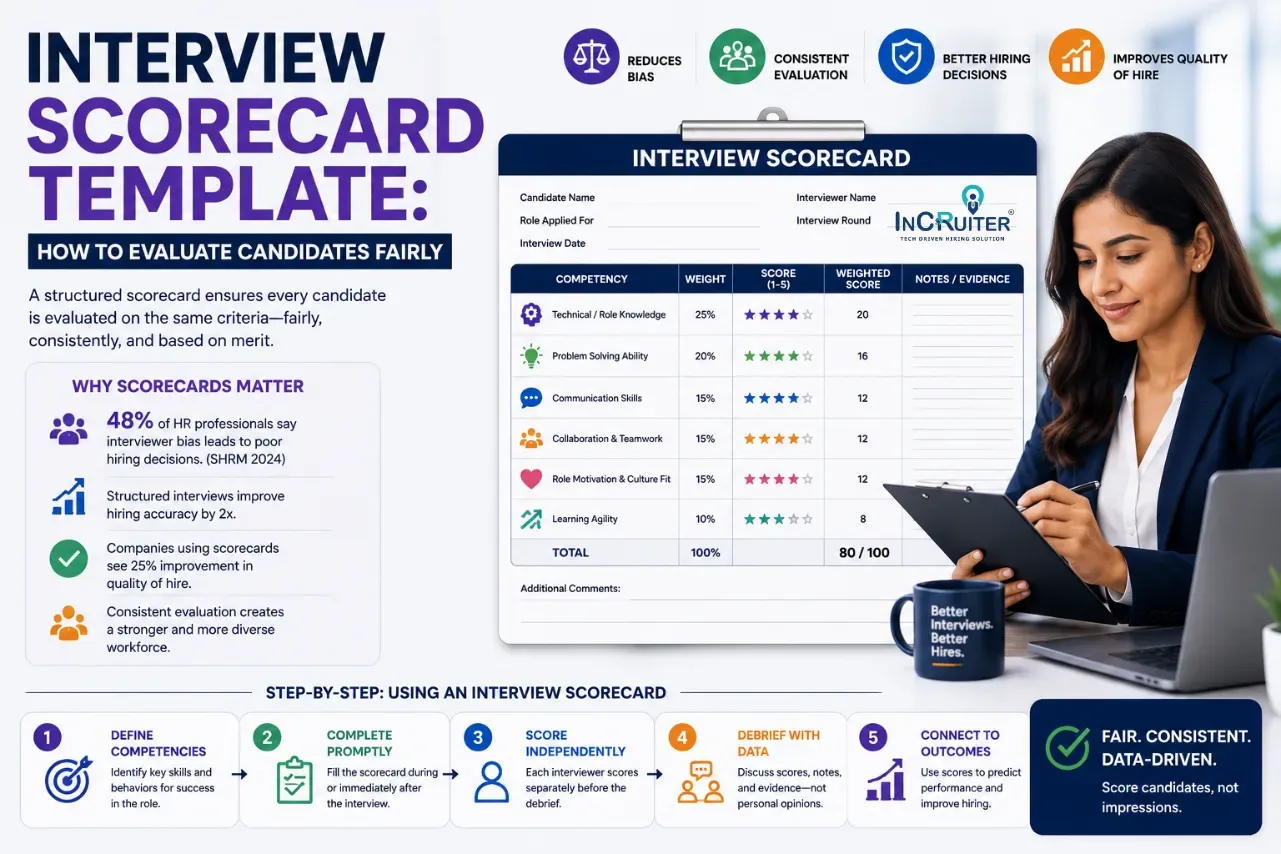
Did you know that around 46% of new hires end up leaving the organization within one or one and a half years? It may sound surprising, but this is not only because of hiring quality, but the processes themselves have a lot of inconsistency. A single candidate being judged by different interviewers will have multiple hiring scorecards based on person-to-person. It’s because every person asks different questions, checks answers or responses from their limited perspective, and makes final decisions based on the poor hiring culture instead of proof of work or evidence.
According to the SHRM 2024 reports, around 48% of HR managers & TA teams believe that interviewer bias is behind the poor recruitment decisions. When interviews are conducted without a defined interview scorecard template, that’s just a random selection of candidates for various job roles in an organization. It can be highly improved if we bring in the organized scoring of candidates with behavioural filters. It will ensure that all interviewers (whether in-house or external) will have the same level of queries and criteria to evaluate candidates. The end candidate score data remains credible and easy to compare. defensible, and connected to the job role.
What Is an Interview Scorecard or Hiring Scorecard?
An interview scorecard template can serve as an organized candidate evaluation form that HR teams or interviewers need to fill out after every interview. This template includes the role responsibilities, competencies, and a proven scale to rate every candidate out there. For every score, this also has blank spaces to enter the essential notes that could justify the score.
As per the data reports, organizations implementing a scoring system can remove the chances of interviewer bias & even avoid the chances of a candidate dropping early after the successful onboarding. Rather than being a general feedback form, the hiring scorecard serves as a predefined framework that ensures every candidate is evaluated on similar criteria. This also remains the same for different interviewers hiring for a similar job role.
Interview Scorecard Template Example
To make it clearer visually, here is a ready-to-use interview scorecard template for your reference. It will clarify candidate caliber and competencies using clear data and a framework for the specific job openings.
| **INTERVIEW SCORECARD** | |
| **Candidate Name** | <br> |
| **Role Applied For** | |
| **Interview Date** | |
| **Interviewer Name** | |
| **Interview Round** |
| **Competency** | **Weight** | **Score (1-5)** | **Weighted Score** | **Notes/Evidence** |
| **Technical/Role Knowledge** | 25% | |||
| **Problem Solving Ability** | 20% | |||
| **Communication Skills** | 15% | |||
| **Collaboration & Teamwork** | 15% | |||
| **Role Motivation & Culture Fit** | 15% | |||
| **Learning Agility** | 10% | |||
| **Total** | **100%** |
Additional Comments:
Step-By-Step Process To Use Interview Scorecard Template
Step 1: Define Competencies Before the Interview
When you’re about to take the candidate interview, make sure to fill in competencies during the call itself. The competencies should come from a pre-interview conversation with the hiring manager. These should be around two major questions, like what does success look like in the first 90 days? Another thing could be what specific behaviors and skills ensure your success in the new job role. You should keep the competencies to five or seven in order to ensure that the interviewer’s focus remains intact throughout the evaluation.
Step 2: Complete the Scorecard During or Immediately After
One thing is sure: interviewers tend to lose specific details in case of late hiring scorecard submission. Hence, the experts need to fill in the candidate’s details within 24 hours of the interview. This will avoid any chances of interviewer bias throughout the interview process. Make it a mandatory rule to complete the candidate scorecard within the same day of the touchbase.
Step 3: Score Independently Before the Debrief
In case of panel interviews, the interviewer needs to submit their completed scorecards even before the debrief begins. In case one expert submits their opinion or score first, others also adjust their scores to match the same. This is a clear problem that makes the availability of multiple evaluators useless. Independent candidate scoring based on the pre-defined rules will definitely bring in a reality check before even opening discussions about the candidature.
Step 4: Start the Debrief With Data, Not Opinions
During the start of the debrief, all independent scores should be clearly visible side by side. This will also allow having specific notes and examples from the interviewers, along with the positive and negative pointers. You can even flag the candidate scores that are either too low or need re-evaluation at some point in time.
Step 5: Connect Scores to Post-Hire Outcomes Over Time
The candidate evaluation scorecard offers organized data during the candidate evaluation stage itself. Once that data is put against the 90-day performance reviews and 12-month retention rates, it will give clear patterns to HR & TA teams. In simple words, this will give a clear idea of which candidates can be successful in different roles, which questions help in the right screening, and which scoring metric is very helpful.
Common Mistakes That Make Scorecards Useless
| **The Mistake** | **Why It Happens** | **The Quick Fix** |
| Using vague terms in scorecards (like culture fit, etc.) | They are easier to write but very hard to define | Instead of generic terms, use specific role-based behavioral goals |
| Filling scorecards very late ( many days after the interview) | Interviewers get busy and delay the task of submitting feedback | Set a strict deadline or let AI handle it on the spot |
| Talking before voting (discussing candidate scores too early) | Humans have a natural tendency to start debriefing quickly | Require everyone to submit candidate scores even before discussing the candidature |
| Treating the candidate scoring as a formal paperwork job | The hiring decisions are already made on an informal basis | Candidate scoring should be done during the interview itself |
| Using a one template for all job opening and different candidates | It saves time to setup everything but lacks role relevance | Customize candidate capabilities and weightage for each role |
How AI-Powered Software Improves the Interview Scorecard Process
One of the major problems with the manual candidate scoring is the dependency on humans. Also, having different people interview for the same role leads to the chances of interviewer bias in the hiring culture. On top of these, there can be concerns around the accuracy level of evaluation with manual processes in place. While the manual candidate evaluation scorecard can be possible for a few interviews, the same becomes a burden for bulk volume hiring campaigns. For example, an interviewer who is conducting six interviews daily will rarely be able to fill the manual hiring scorecards correctly. That’s where the automation with Artificial Intelligence solves the complete roadmap for your hiring processes.
AI interview platforms generate automated evaluation data during or after the interview. An AI interview software will conduct the candidate interview based on the pre-vetted questions and provide a scorecard based on the responses. This data remains evidence-focused with no need to rely on the interviewer, who will document everything manually. For the enterprises hiring at scale, this AI interview feedback form can be no less than a boon for recruitment across multiple roles and locations. In reality, this removes the gap between what was expected to be in the feedback and what actually got submitted.
An interview-as-a-service platform like InCruiter IncServe allows having expert interviewers at your disposal to screen candidates with pre-defined approaches and generate scorecards. Additionally, this will also provide the screen recordings to ensure hiring managers have the appropriate data to act on. This saves the senior management from going through a bulk of generic or random details about the low-level interviews.
Do you want to try this automated approach of candidate evaluation scorecards? Book a demo with team InCruiter to experience how to score interviews at scale without the manual burden.
Frequently asked questions
What is a candidate interview scorecard?
An interview scorecard evaluation is a defined process for interviewers to screen candidates during or after the interview process. It sets a consistent approach to judge the candidates on the basis of various skill sets and competencies related to the job roles. The hiring scorecard is very much like a rating scale for the candidates, including written notes and details. The major goal of this scoring is to replace the guesswork and rely on evidence-backed data across every candidate for the same job role.
How many competencies should an interview scorecard include?
For the majority of the job roles in an organization, around five to seven competencies remain in the candidate scoring evaluation. In case there are fewer than five, there is a chance of missing important candidate evaluation criteria. On the other hand, more than seven competencies make the process difficult for interviewers. The key with the ideal interview feedback form remains more than generic, but personalized as per the technical skills and aligned with the job roles.
What rating scale works best for interview scorecards?
Normally, the institutions rely on a rating scale of 1 to 5 for reviewing the interview scorecards of candidates. Every level of the candidate score should be based on the behavioral skills instead of vague or generic labels. For example, a score of 5 means that the candidate was able to provide specific and evidence-backed data for the job role. This gives more credible data instead of general statements, as the interviewer was impressed. The pre-defined behavioral skills at each level of scoring can remove the guesswork across different interviewers.
How do interview scorecards reduce hiring bias?
Interview scorecards are a worthy solution to avoid any kind of interviewer bias in the hiring journey. It can ensure that the candidate evaluation is based on the job roles & specific criteria instead of general impressions. In any organization’s hiring culture, every candidate is scored on the same competencies at the same scale. Some of the older factors, like appearance, communication style, and educational background, become irrelevant. The interview rating scale should be based on evidence-backed data and performance during interviews to remove any chance of bias.
When should an interviewer complete the scorecard?
The interviewer needs to submit the interview scorecard template during the interview or within 30 minutes of its completion. In any case of delay, the interviewer needs to submit all the essential details on the same day itself. Delaying the process of candidate scoring may lead to interviewers missing the specific or relevant details. Instead of a general overview, the scorecards are designed to automate the process and streamline the hiring workflows.
Ready to Transform Your Hiring Process?
Discover how our AI-powered interview platform can streamline your recruitment and find the best candidates faster.
Make Your Hiring Process Smart and Fast