


Key Takeaways
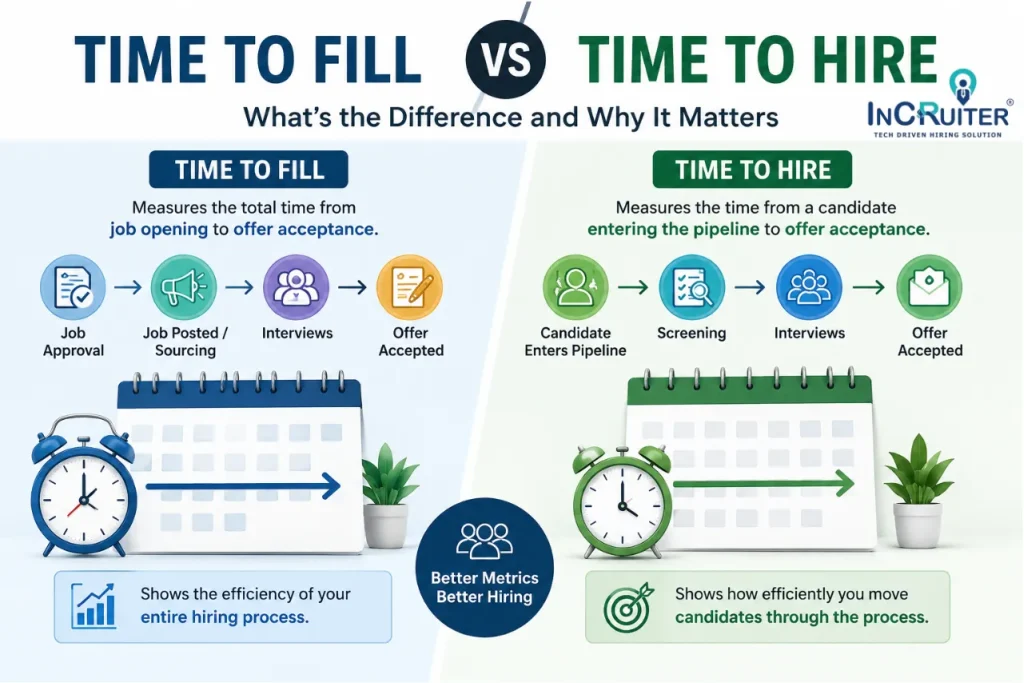
- Time to fill measures the entire hiring cycle from job opening approval to offer acceptance.
- Time to hire measures how quickly a candidate moves through the recruitment process after entering the hiring pipeline.
- A long time to fill often indicates sourcing, approval, or job marketing challenges.
- A long time to hire typically points to interview scheduling, feedback, or internal process delays.
- Tracking both metrics separately helps identify hiring bottlenecks more accurately.
- Automation tools such as AI interviews and interview scheduling software can significantly reduce both metrics.
- Industry benchmarks vary, with average time to fill ranging from 10 days in hospitality to 67 days in defense.
- Optimizing these metrics improves candidate experience and reduces the risk of losing top talent.
In 2026, most recruiters have heard of terms time-to-fill and time-to-hire, but lack the fundamental clarity about the time to fill vs time to hire. The most surprising factor is that HR teams and TA teams swap them without actually ensuring it’s correct. This leads to incorrect conclusions in their hiring data and brings more loopholes in the entire recruitment journey.
In reality, time to fill & time to hire are not the same metric to assess the different aspects of the hiring processes. They both mean different things about your recruitment pipeline and help in figuring out the major issues with action steps to resolve them. Whoever treats these two metrics as the same creates a reporting and strategy problem that results in losing the top talent in the process.
In this guide, we’ll try to understand these metrics separately, along with the difference between time to fill and time to hire. It will clarify what each metric means, calculation aspects, and expected benchmarks as per various sectors. By the end of the in-depth tutorial, you’ll be able to figure out which one you should fix in the recruitment process and when.
Time to Fill: Definition and What It Actually Measures
Time to fill definition covers the entire recruitment cycle of an organization, including job approval to candidate acceptance. It starts from the moment a job opening is opened and approved internally. It stops when the candidate accepts an offer for the same opening.
Whatever happens in between this falls under the time to fill recruitment metric. In simple words, the time to fill includes the time to write & post the job description, the candidate sourcing period before application, candidate screening, interview stages, and more.
Formula:
Time to fill = Date candidate accepts offer – Date job opening is live
Time to fill measures the organization’s hiring capacity, but an increase in this doesn’t always mean that your interviews are slow. The delay could be because of a confusing job description, slow candidate sourcing, and late approvals for the job opening. Since all of these issues seem exactly the same in your total time to fill data, you need to check the time to hire separately to identify the real bottlenecks.
Time to Hire: Definition and What It Actually Measures
The time to hire definition starts when a specific candidate comes into the hiring journey of the institution and ends when they accept the right offer. It calculates the decision speed, about how quickly you move from finding someone to getting them to say yes for the specific job role. It doesn’t start with the job opening, but when a specific candidate submits the application.
Since then, the time to hire includes the first screening, the time between interview rounds, and how long the offer remains until it goes out.
Formula:
Time to hire = Date candidate accepts offer – Date candidate enters hiring pipeline
The time to hire recruitment metric is a clear signal of an efficient hiring process once the good candidates enter the cycle. A high number highlights the slow hiring journey once the candidate sourcing problem is solved. That’s exactly when the delays because of interview scheduling, feedback loopholes, and the lengthy offer approval process are highlighted clearly.
2025 and 2026 Benchmarks: What Good Looks Like
According to SHRM’s 2025 Benchmarking Report, the average time to fill a position in the United States remains around 44 days (greater than one month). This figure has increased to 24% since 2021. The report also highlighted that around 60% of companies reported longer hiring timelines in 2024, while around 12% were able to reduce and optimize them.
| Industry | Average Time to Fill (2025) | Notes |
| Energy and Defense | 67 days (Approx) | Longest of any major sector |
| Healthcare | 49 days (Approx) | Timelines getting bigger because of specialist shortages |
| Finance & Professional Services | 46-47 days (Approx) | Compliance requirements add multiple additional stages to the hiring processes |
| Information & Technology | 33 days (Approx) | Competitive market & faster movement |
| Manufacturing | 31 days (Approx) | Among the fastest major sectors |
| Restaurants & Hospitality | 10 days (Approx) | Highest volume & least complex roles |
Why Both Metrics Slow Down: The Real Bottlenecks
In order to fix the potential hiring journey bottlenecks, it is essential to understand where the time is actually going.
Where Time to Fill Gets Stuck
The majority of the reasons behind the slow time to fill recruitment metrics remain poor job descriptions, pay misalignment, and long interval approval processes. As of 2025, the biggest time to fill loopholes remains fewer candidates for skilled roles, market competition, pay mismatch, multi-step interview processes, and seasonal hiring surges.
Where Time to Hire Gets Stuck
Once the candidate comes into the hiring funnel, the delays are mostly because of the process. On one hand, the recruiters end up spending most of their time scheduling interviews alone. On the other hand, administrative management consumes the candidate sourcing, screening, and ATS updates.
Interview scheduling coordination delays impact the overall time to hire to a huge extent. A single interview round requires multiple back-and-forth email coordination among the interviewer, HR teams, candidate, and decision makers.
Which One Should You Optimise First?
Well, now, once you have the answer to the difference between time to fill and time to hire, another question is which one needs optimization. The answer depends mainly on the data you get from the AI recruitment platform regarding the problems.
Start with Time to Fill if:
- Your job offer acceptance rate is good, and still, there are plenty of new openings that don’t get many applications after weeks.
- Your candidate sourcing process is inconsistent or is not giving the desired outcomes.
- Internal job role review and posting takes more than a week’s time.
- Your recruitment cycle is losing candidates because of the lengthy process.
Start with Time to Hire if:
- Candidates apply to the open roles at a good pace, but end up dropping somewhere in between stages.
- Interview scheduling takes more than 2 days to confirm for any interview round.
- You get the interviewer or hiring manager’s feedback regarding the interviews after a 2-3 day timeline.
- Your offer acceptance rate is low, and competitors are taking away the top talent.
How Automation Specifically Impacts Each Metric
| Automation Tool | Impacts Time to Fill | Impacts Time to Hire | How |
| AI interview software | Yes | Yes | Automate initial rounds of interview & shortens candidate sourcing to screening timeline |
| Automated scheduling | Marginal | Directly | Removes email or other slow channel coordination delays between the hiring rounds |
| Conversational AI recruiter | Yes | Yes | Keep the candidates engaged while reducing any kind of drop-offs |
| Coding assessment platform | Marginal | Directly | Removes manual candidate evaluation for technical & complex job roles |
| Real-time pipeline dashboards | Yes | Yes | Highlights any sort of bottlenecks in between both recruitment metrics (if any) |
A Practical Starting Point for HR Teams
If HR teams are not tracking time to fill vs time to hire effectively & separately, that’s just the first step to start with, which will tell you very little about the area that needs attention. To solve this, you need to divide the hiring funnel into two different measurements –
- Calculate days from the job opening to the initial qualified candidate in the hiring journey. This will show your candidate sourcing efficiency and increase the time to fill the recruitment metric.
- Calculate days from the initial qualified candidates in the hiring journey to accepted offers. This will highlight the process efficiency and contribute to the time-to-hire metric.
Once you’ve both the number comparison, try to compare with the industry benchmarks. In case your candidate sourcing timeline remains short, but the process window remains long, the problem is internal coordination & management. If your candidate sourcing remains long but the process is short, the problem remains pipeline quality or market positioning.
How Does InCruiter Help Reduce Both Metrics?
An AI-based recruitment platform like InCruiter helps in solving the challenges related to these recruiting metrics. With an inbuilt AI-interview software like IncBot, it reduces the time to fill positions by automating the initial round of interviews. As an outcome, it moves the candidates from application to evaluated shortlistings in days instead of weeks. On the same lines, the automated scheduling tool like IncFeed cuts out the time to hire with seamless coordination across interviewers and candidates automatically. Say goodbye to back-and-forth, slow email communication that keeps adding more days to every interview round.
InCruiter offers a conversational AI recruiter like IncScreen that engages candidates right after they send an application. The communication channels remain AI-powered phone calls or WhatsApp to ensure quick responses and cut down the time to hire and time to fill aspects. For HR teams and professionals who need real-time visibility into both metric performance and blockers, InCruiter’s enterprise recruitment platform offers the same in both sourcing and process dashboards.
Are you ready to cut down the time to fill and the time to hire candidates? Book a demo with InCruiter to experience how the platform serves to address hiring bottlenecks.
Frequently Asked Questions
What is the difference between time to fill and time to hire?
Time to fill recruitment metric counts the total number of days from when a job posting goes out to when the candidate accepts the offer. This period includes the candidate sourcing period before applicants become part of a pipeline. In simple words, it highlights how long the role remains open for the candidates. On the other hand, the time to hire measures the period from the candidate coming into the hiring pipeline to the offer acceptance. This gives clarity on how effective the hiring process is there once the right candidate is found.
What is a good time to fill the benchmark in 2025?
As per SHRM’s 2025 Benchmarking Report, the average time in the U.S. to fill a candidate is around 44 days. However, the metric remains variable on the basis of industries and other factors. Some companies in different industries remain less than or greater than this timeline, too.
Which metric should HR teams focus on reducing first?
HR teams need to have a clear idea of which metric, between time to fill vs time to hire, is creating the bottleneck in the hiring processes. If the job roles remain open for weeks before candidates appear, the major problem remains with the sourcing window and time to fill. At the same time, if the candidates are coming quickly in the recruitment journey but drop in between, there is a problem with the process window & time to hire. Usually, in enterprises, the time to hire metric is directly impacted by the internal coordination & process automation.
How does AI reduce time to hire specifically?
AI cuts out the time to hire candidates by bringing automation to the hiring stages that are mostly about manual coordination or redundant work. With this, the HR & TA teams can avoid the unintentional delay in the hiring journey. The AI-powered initial round screening avoids any chance of a manual resume review process. Similarly, the automated interview scheduling eliminates email communication exchanges between the interviewer and candidates. With inbuilt conversational AI recruiters, the tools can keep the applicants engaged throughout the multiple rounds of the hiring process.
Can you have a short time to fill but a long time to hire?
For a single job opening, the time to hire always remains shorter than the time to fill candidates. It is because the former one remains a part of the total time to fill the recruitment metric. However, a company can have different results in terms of measuring both time to fill vs time to hire comparison. The HR team can find candidates quickly for one job role, but the interview process takes months. On the other hand, another job opening can have a delay in candidate sourcing, but a few days for interviews.
Ready to Transform Your Hiring Process?
Discover how our AI-powered interview platform can streamline your recruitment and find the best candidates faster.

Related Blogs

AI Interview Scoring: How It Works, What It Measures, and Why Recruiters Are Adopting It
Interviewing at scale has always been one of the messiest parts of recruitment. Two interviewers sit in on the same session, walk away with completely...

Best Online Proctoring Software for Remote Assessment in 2026
What Is Online Proctoring Software? As remote work and hybrid education become permanent fixtures, organizations face a critical challenge: how do you ensure that a candidate...

InCruiter vs Eightfold AI vs Mettl (2026): Which AI Interview Platform Actually Wins?
Introduction Choosing the right AI interview platform is not just a software decision. It directly affects how fast you hire, how much you spend, and...
AI in Recruitment 2026: Trends, Stats & What’s Actually Working
AI is no longer knocking at recruitment’s door – it has moved in, rearranged the furniture, and started paying rent. In 2026, 87% of companies...

Top 10 Best AI interview Software for Hiring in 2026
Work will become optional, we agree entirely with Elon Musk’s words, owner of xAI (Artificial Intelligence). Having witnessed in 2025 that 88% of white-collar jobs,...
AI Recruitment Metrics Every HR Leader Should Track
Why Most HR Teams Are Measuring the Wrong Things Let’s start with a question: what if the recruiting team hit its time-to-fill target last quarter,...


