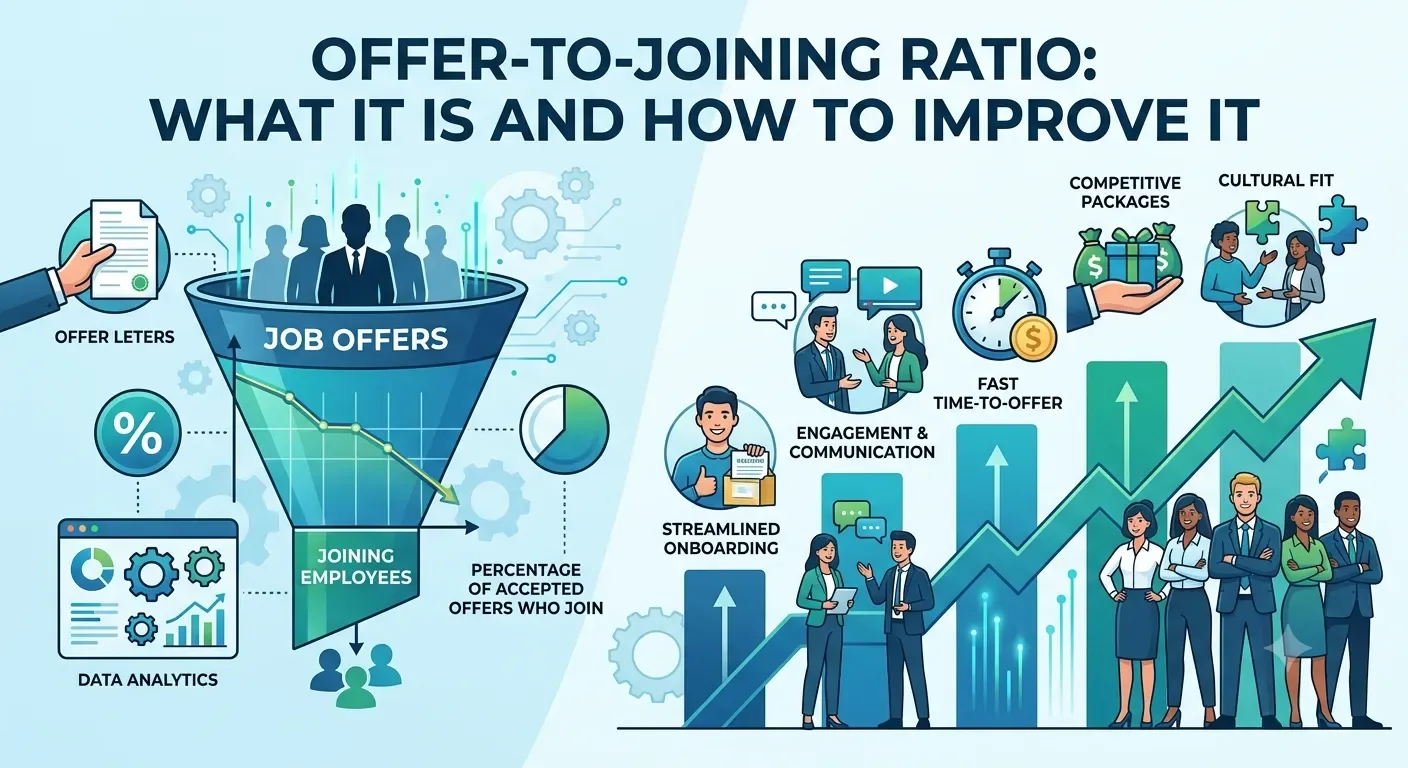
A candidate says yes. They sign the offer letter. Then, on day one, they don’t show up no call, no email, nothing. Most teams lump this in with “offer acceptance problems.” It isn’t the same problem. Offer-to-joining ratio measures something acceptance rate doesn’t: whether the people who said yes actually follow through. It’s a narrower, quieter drop-off. It deserves its own diagnosis, not the same generic fix applied to every stage of hiring.
What Offer-to-Joining Ratio Actually Measures
The formula is straightforward: divide the number of candidates who actually joined by the number who accepted an offer, then multiply by 100. If 10 candidates accepted and 8 showed up, your ratio is 80%.
That’s a different calculation from offer acceptance rate, which only tracks how many candidates said yes out of how many offers you extended. A team can have a strong 85% acceptance rate and still lose a meaningful share of those candidates before day one.
Want the cost side of this too? InCruiter’s guide to calculating your cost per hire covers a related piece of the same puzzle. Every candidate who accepts and then doesn’t join effectively resets part of your cost. You’re often back to sourcing, screening, or re-opening the requisition, with nothing gained for the time already spent.
Treating these two metrics as one blurs the diagnosis. A low acceptance rate points to problems earlier in the process compensation, competing offers, slow timelines. A low offer-to-joining ratio points to problems in the gap between “yes” and “day one,” which is a narrower window with its own specific causes.
Why Candidates Accept an Offer and Then Don’t Join
A 2023 study published in the International Journal of Research Publication and Reviews surveyed 134 IT-sector job seekers. All had at least two years of experience, and the survey asked what actually mattered to their decision to accept and follow through on an offer.
Role fit and work culture ranked highest 58 to 60% of respondents strongly agreed these mattered. Around half said the same about working with advanced technology or strong projects, career growth opportunities, and joining a product-based company in a permanent role. Salary mattered too, but less universally: only 48.5% called it an important factor.
That ordering matters. It suggests candidates who accept and then vanish aren’t usually chasing a bigger paycheck elsewhere. More often, something about the role, the culture, or the growth path didn’t hold up once they had time to think it over. Sometimes that’s a counteroffer from their current employer. Sometimes it’s just a slow gap between acceptance and start date, long enough to let doubt creep in. Long delays compound this risk, which is one more reason time-to-fill and time-to-hire matters beyond the obvious speed argument.
Segment the ratio before you try to fix it
A single company-wide offer-to-joining number can hide where the real problem sits. Track it separately by department and by role seniority, the same way you would with offer acceptance rate. A technical team with a long notice-period norm behaves differently than a sales team hiring people who can start in two weeks. If one department’s ratio is dragging the average down, a company-wide fix wastes effort on teams that don’t have the problem. Segmenting first tells you where to actually spend the effort.
What a Healthy Ratio Looks Like
Here’s an honest limitation. There’s no single, well-established benchmark for what a “good” offer-to-joining ratio looks like across industries, unlike offer acceptance rate. The research for this piece didn’t turn up a reliable segmented figure. Presenting one anyway would mean inventing a number, which this piece’s own standards don’t allow.
What’s more useful than a fake benchmark: track your own ratio over time. Treat a downward trend as the real signal, rather than comparing yourself to an industry figure that doesn’t actually exist yet in verified form.
How to Close the Gap
Stay in contact after “yes,” not just up to it. The gap between acceptance and start date is exactly where doubt and counteroffers take hold. A short check-in during that window costs little.
Shorten the gap itself where you can. The less time between acceptance and joining, the less time competing opportunities have to intervene.
Set realistic expectations about the role early. Role fit and culture matter more to candidates than salary alone, per the survey data above. Overselling the role just to get a “yes” tends to backfire once the candidate has time to reconsider what they actually signed up for.
Make onboarding feel real before day one. Small touches make the offer feel more concrete during the wait: a welcome email, an introduction to the team, early access to a starter guide. A candidate who’s already met their future manager has more reason to show up than one who’s heard nothing since signing.
Watch the segmented numbers, not just the average. If the earlier department-level breakdown shows one team consistently losing more candidates, that’s the team to investigate first. A company-wide policy change that treats every department the same wastes effort on teams that don’t have the problem.
A signed offer letter isn’t the finish line it’s the start of a shorter, quieter race that a lot of hiring teams forget to watch. The candidates who disappear in that gap are rarely chasing more money. More often, something about the role or the wait itself gave them a reason to reconsider.
Frequently asked questions
What is offer-to-joining ratio?
It’s the percentage of candidates who actually joined out of those who accepted an offer. It measures follow-through, not just agreement.
How do you calculate offer-to-joining ratio?
Divide the number of candidates who joined by the number who accepted the offer, then multiply by 100.
Is offer-to-joining ratio the same as offer acceptance rate?
No. Acceptance rate measures whether a candidate says yes to an offer. Offer-to-joining ratio measures whether they actually show up afterward. A team can score well on one and poorly on the other.
What’s a good offer-to-joining ratio?
There’s no single reliable industry benchmark for this metric yet. Track your own ratio over time and watch for a declining trend, rather than comparing against an unverified external number.
How is offer-to-joining ratio different from an interview no-show rate?
They’re related but not the same. An interview no-show is a candidate skipping a scheduled interview earlier in the process. InCruiter’s guide to reducing scheduling-related no-shows covers that specific problem. Offer-to-joining ratio tracks a later-stage failure a candidate who made it all the way through, accepted, and still didn’t show up on day one.
Ready to Transform Your Hiring Process?
Discover how our AI-powered interview platform can streamline your recruitment and find the best candidates faster.
Make Your Hiring Process Smart and Fast