




Key Takeaways
- Video interviewing software helps recruiters streamline hiring by replacing scheduling and in-person interviews with efficient live or pre-recorded sessions, improving candidate screening and recruiter productivity.
- When choosing a video interview platform, recruiters should define their hiring needs, assess key features like live and one-way interviews, ATS integration, and user interface usability, and consider scalability before committing.
- A user-friendly interface and seamless integration with existing systems such as applicant tracking systems (ATS) make recruitment workflows smoother and reduce manual coordination tasks.
- To fully benefit from video interviewing software, recruiters need to train their teams to use its features effectively, such as interview scheduling, AI-assisted assessments, and analytics tools for candidate evaluation.
- Investing in a platform that meets organizational requirements can save time and resources by enabling standardized evaluations, faster shortlisting, and improved collaboration among hiring stakeholders.
- Understanding the capabilities and limitations of video interview tools ensures recruiters maximize their return on investment and stand out in a competitive talent market by selecting the right solution for their hiring goals.
What Is Video Interview Software?
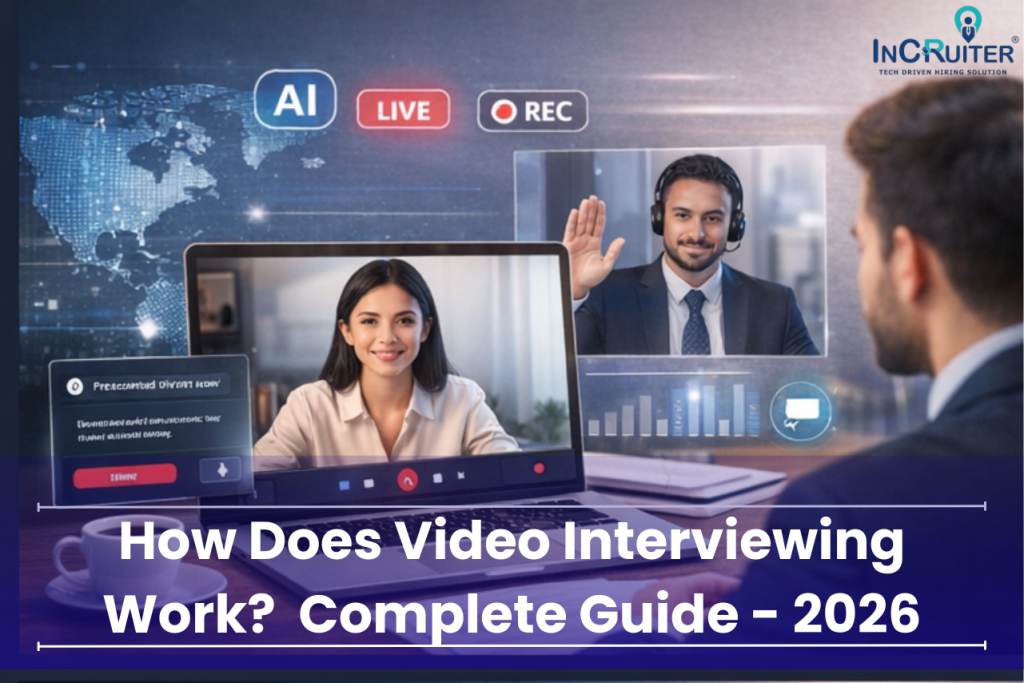
Video interview software is a technology solution designed to facilitate remote job interviews through online video. It encompasses tools for live, synchronous conversations between interviewers and candidates, as well as pre-recorded formats where candidates record responses to predefined questions on their own time.
Its modern platforms go far beyond basic video conferencing. it includes automated scheduling, AI-powered candidate evaluation, structured interview guides, collaboration tools, and seamless integration with applicant tracking systems (ATS). The result is a hiring pipeline that is faster, more consistent, and accessible to a global talent pool.
The State of Video Interviewing in 2026: Key Statistics
81% of recruiters now use video interviews as part of their hiring process – 4 Corner Resources, 2025
Video interviews are used in 86% of hiring processes globally – Vouch, 2025
93% of companies that use video interviews plan to continue doing so – Adaface, 2025
One-way video interviews have increased by 67% since 2020 – 4 Corner Resources, 2025
Video interview tools result in a 75% faster shortlisting process vs traditional methods – 9CV9 Blog, 2025
Video interviews are twice as predictive of candidate success vs conventional techniques – 9CV9 Blog, 2025
74% of recruiters report video interviews simplify candidate screening – Adaface, 2025
45% of recruiters say video interviews cut hiring costs significantly – StandOut CV, 2025
98% of candidates view companies using video interviews as innovative – ModernHire21% of employers say video is the most effective interview method – up from just 11% in 2020 – SHRM
Types of Video Interview Software: Which Format Is Best for You?
Not all video interview platforms are built with same features. Understanding the three main types helps you select the right tool for your hiring goals.
1. Live Video Interview Platforms
Live video interviews replicate the in-person interview experience in a virtual environment. Both the interviewer and candidate join a session at the same scheduled time, allowing for real-time conversation, dynamic follow-up questions, and nuanced assessment of communication and personality.
Live platforms are ideal for mid-to-senior level roles, cultural fit assessments, technical interviews with coding collaboration, and final round evaluations. InCruiter’s IncVid platform is purpose-built for live video interviews with features like code collaboration, AI-generated feedback, built-in evaluations, and anti-cheating proctoring – a significant upgrade over generic tools like Zoom or Google Meet.
- Best for: Senior roles, technical interviews, final-round evaluations, panel interviews
- Key features: Real-time conversation, screen sharing, collaborative coding environments, AI feedback
- Limitation: Scheduling coordination required – both parties must be available simultaneously
2. Pre-Recorded (Asynchronous / One-Way) Video Interview Software
Pre-recorded video interviews, also known as asynchronous or one-way video interview, allow candidates to record responses to a predefined set of questions at their own convenience. Recruiters then review these recordings at their own pace – often at 1.5x or 2x speed – without needing to match schedules.
This format is particularly powerful for high-volume hiring, early-stage screening, campus recruitment, and global hiring across time zones. InCruiter’s IncBot uses conversational AI to conduct asynchronous interviews with dynamic follow-up questions, generating detailed evaluation reports automatically.
- Best for: High-volume roles, early-stage screening, campus hiring, global recruitment
- Key features: Time-flexibility, bulk review, consistent evaluation criteria, automated scoring
- Advantage: Screen 10 candidates in the time it takes to conduct one phone interview
3. AI-Powered Video Interview Platforms
AI-powered video interview platforms represent the frontier of recruitment technology. These systems go beyond recording responses they analyze the content, structure, and language of candidate answers using natural language processing (NLP). Importantly, leading platforms like InCruiter evaluate transcript content rather than facial expressions or voice tone, avoiding bias and ensuring fair assessment.
According to a survey, 60% of organizations currently use AI for talent management and AI-driven video interview tools are at the center of this transformation. InCruiter’s AI interview suite, including IncBot and IncScreen (our conversational AI recruiter), automates early-stage screening with intelligent question generation, dynamic follow-ups, and instant candidate scoring.
- Best for: Scale hiring, bias reduction, consistent evaluation across large candidate pools
- Key features: NLP analysis, automated scoring, dynamic question generation, instant reports
- Advantage: Eliminates human subjectivity in early-stage screening
4. Hybrid Platforms (Live + Async + AI Combined)
The most powerful platforms today offer all three formats in one unified system. This allows recruiting teams to use asynchronous screening for initial filtering, live interviews for shortlisted candidates, and AI-powered analysis throughout the pipeline. InCruiter’s complete suite – IncBot, IncVid, IncServe, IncScreen, and IncProctor delivers this end-to-end capability with seamless workflow integration.
How Video Interview Software Works: Step-by-Step
Understanding the mechanics of video interview software helps recruiting teams configure and use it effectively.
Step 1: Job Setup and Question Design
Recruiters define the role requirements and create an interview structure — either a standardized question bank or a custom set of role-specific questions. For one-way formats, time limits per question, retake allowances, and practice question options are configured. For live interviews, scoring rubrics and evaluation guides are set up in advance.
Step 2: Candidate Invitation and Scheduling
Candidates receive automated invitations with clear instructions and access links. For asynchronous interviews, no scheduling is required, candidates can complete the interview within a defined window (typically 24–72 hours decided by recruiter). For live interviews, automated scheduling tools sync with both interviewer and candidate calendars to find mutually available slots, eliminating the back-and-forth coordination that consumes up to 2 hours per hire in traditional processes.
Step 3: Live Video Interviews
With the live video interview portal, candidates and interviewers connect in real time through a secure browser-based platform. These sessions often include collaboration features such as shared coding environments, whiteboards, screen sharing, and document collaboration. Interviewers can assess communication skills, problem-solving ability, and cultural alignment instantly while maintaining structured evaluation standards. Built-in recording options allow teams to revisit the discussion for further review or stakeholder feedback.
Step 4: Interview Completion
For asynchronous formats, candidates record their responses on any device – desktop, tablet, or mobile – with no download required on leading platforms. For live interviews, all participants join through a dedicated link with collaboration features like shared coding environments, whiteboards, and document sharing.
Step 5: Evaluation and Scoring
After interviews are completed, hiring teams review recordings, apply structured scorecards, and leave time-stamped comments. AI-powered platforms automatically generate transcripts, highlight key responses, and assign predictive scores. Collaboration tools allow multiple stakeholders to review and rate candidates independently before a consensus decision.
Step 6: ATS Integration and Pipeline Management
Completed interviews, scores, and evaluations sync automatically with the organization’s applicant tracking system (ATS). This eliminates duplicate data entry, keeps all candidate information in one place, and ensures interview outcomes are connected to the full hiring workflow – from sourcing to offer.
Why Video Interview Software Is Essential for Modern Recruitment?
The adoption of video interview software is driven by a range of interconnected benefits that directly address the pain points of modern talent acquisition teams. Here is a comprehensive look at why it has become non-negotiable:
1. Dramatically Reduced Time-to-Hire
Traditional hiring processes involve scheduling delays, travel coordination, and sequential interview rounds. Video interview software eliminates most of these bottlenecks. Studies show that 67% of recruiters spend 30 minutes to 2 hours scheduling a single interview – time that is almost entirely eliminated with automated scheduling tools. Recruiters using one-way video interviews can screen 10 candidates in the time it previously took to evaluate one, resulting in hiring cycles that are weeks shorter.
2. Significant Cost Savings
Virtual interviews save an average of 80% in recruitment costs compared to traditional in-person interviews. These savings come from eliminating travel expenses for both candidates and interviewers, reducing administrative overhead, using fewer scheduling resources, and the ability to scale hiring without proportionally scaling headcount.
3. Access to a Global Talent Pool
Geographic location is no longer a constraint when hiring. Video interview software allows organizations to source and evaluate candidates from anywhere in the world. For remote roles, 90% of employers no longer require any in-person interview, which means your talent pool expands from your city to your entire country – or the entire world. This is especially powerful for technical roles where specialized skills are scarce locally.
4. Consistency and Reduced Bias
Unstructured interviews are notoriously inconsistent and subject to unconscious bias. Video interview software enables structured evaluation through standardized questions, predefined scoring rubrics, and documented evaluation criteria. Structured interviews increase the predictive validity of hires by up to 65% (The Structured Employment Interview: Narrative and Quantitative Review of the Research Literature). Every candidate is assessed on the same criteria, at the same stage, creating a fairer and more legally defensible hiring process.
5. Improved Candidate Experience
Nearly 92% of candidates say they prefer video interviews to in-person interviews due to the convenience and reduced stress they offer. Platforms with mobile-optimized interfaces, practice opportunities, and clear instructions make the process accessible and candidate-friendly. However, one-third of candidates have dropped out of interview processes due to poor video interview experiences -which is why platform choice matters enormously.
6. Enhanced Collaboration Across Hiring Teams
Hiring decisions are rarely made by one person. Video interview software enables distributed hiring teams to collaborate effectively by sharing recordings, leaving timestamped comments, completing independent scorecards, and discussing candidates in a single platform – regardless of their geographic location.
7. Data-Driven Hiring Decisions
Modern video interview platforms provide analytics dashboards that track metrics like time-to-hire, candidate completion rates, interview-to-offer ratios, and evaluation consistency across interviewers. These insights help recruiting teams continuously improve their hiring strategy rather than relying on gut feel and anecdotal experience.
8. Scalability for High-Volume Hiring
Campus hiring drives, volume recruitment campaigns, and enterprise-scale hiring present challenges that traditional interview processes simply cannot handle. Video interview software scales seamlessly – you can invite 500 candidates to a two-way video interview simultaneously and review them all in a fraction of the time manual screening would require.
9. Stronger Employer Brand
98% of candidates view companies that use video interview technology as innovative. In a competitive talent market, using modern, professional interview tools sends a clear signal about your organization’s culture, values, and investment in a quality candidate experience. Branded interview portals that showcase your company’s identity reinforce this perception at every touchpoint.
Key Features to Look for in Video Interview Software
Not all platforms are created equal. When evaluating video interview software, use this comprehensive feature checklist:
Non-Negotiable Core Features
- Live and asynchronous (one-way) interview capabilities in the same platform
- Automated interview scheduling with calendar integration (Google, Outlook)
- Recorded interviews with secure storage and easy sharing
- Mobile-optimized candidate experience, no downloads required
- ATS/HRIS integration for seamless workflow continuity
- Structured scorecards and evaluation guides built into the interview flow
- GDPR, CCPA, and EEOC compliance with encryption and data privacy controls
Advanced Features That Differentiate Great Platforms
- AI-powered candidate evaluation based on response transcripts (not facial expressions)
- Real-time AI feedback for interviewers and automated evaluation reports
- Online proctoring to prevent cheating in assessment-integrated interviews
- Collaborative coding environments for technical interviews
- White-labeling and custom branding options
- Multilingual support for global hiring
- Analytics dashboard with time-to-hire, completion rate, and interviewer calibration data
- Interview question banks with role-specific templates
- Candidate self-scheduling and rescheduling capabilities
- Bulk invitation and bulk review capabilities for high-volume hiring
Enterprise & Security Features
- SOC 2 Type II or ISO 27001 certification for regulated industries
- Single sign-on (SSO) and role-based access controls
- Audit trails and compliance documentation
- API access for custom integrations
- Dedicated account management and SLA-backed support
Video Interview Software vs Video Conferencing Tools: What Is the Difference?
A common misconception is that Zoom, Microsoft Teams, or Google Meet are video interview software. They are not, and using general-purpose conferencing tools for hiring introduces significant limitations:
| Feature | Video Interview Software | Generic Video Conferencing |
| Asynchronous / One-Way Interviews | Yes | No |
| Structured Scorecards & Rubrics | Built-in | Manual workaround |
| Automated Candidate Scheduling | Yes | No |
| AI Evaluation & Scoring | Yes | No |
| ATS Integration | Native | Limited |
| Online Proctoring | Yes | No |
| Collaborative Coding Environment | Yes (IncVid) | No |
| Candidate Completion Analytics | Yes | No |
| GDPR / EEOC Compliance Tools | Built-in | Partial |
| Employer Branding / White Label | Yes | No |
How to Choose the Right Video Interview Software: A Buyer’s Guide
With dozens of platforms available, selecting the right video interview software requires a structured evaluation process. Follow these five steps:
Step 1: Define Your Hiring Requirements
Before evaluating any vendor, answer these questions: What volume of interviews do you conduct monthly? Are you hiring for technical, non-technical, or both roles? Do you need high-volume asynchronous screening, structured live interviews, or both? Which ATS do you use, and is integration non-negotiable? What is your budget per seat, per interview, or annual subscription?
Step 2: Build Your Must-Have Feature Checklist
Use the feature checklist in the previous section to define your non-negotiables. Distinguish between must-have features (ATS integration, compliance, mobile access) and nice-to-have features (VR environments, sentiment analysis). Eliminate any vendor that cannot meet your core requirements before spending time on demos.
Step 3: Shortlist 3–5 Vendors and Request Demos
Research platforms on review sites like G2, Capterra, and GetApp. Look at recent reviews (within the last 12 months) from organizations similar to yours in size and industry. Schedule demos and experience the platform from both an interviewer’s and a candidate’s perspective. How quickly can you create an interview flow? Is the candidate experience intuitive on mobile?
Step 4: Evaluate Integration Depth
ATS integration is not binary; some platforms offer basic data sync while others provide native, bi-directional integration that automatically updates candidate records, triggers next-stage actions, and flows evaluation scores into your recruiting workflow. If your organization relies heavily on your ATS, integration depth should be a primary evaluation criterion.
Step 5: Assess Security, Compliance, and Support
Candidates submit sensitive personal data during video interviews. Ensure the platform is compliant with relevant data protection regulations (GDPR for European candidates, CCPA for California residents, EEOC guidelines for US hiring). Look for encryption at rest and in transit, data retention controls, and privacy-focused AI that evaluates transcript content rather than physical characteristics. Verify the quality of customer support through reference checks with existing customers.
Common Challenges with Video Interview Software and How to Solve Them
Challenge 1: Candidate Drop-Off and Incomplete Interviews
One-third of candidates have dropped out of interview processes due to poor video interview experiences. Common causes include confusing interfaces, mandatory downloads, technical failures, and unclear instructions.
Solution: Choose platforms that require no software downloads, are mobile-optimized, provide practice questions before the real interview, and offer clear setup instructions. InCruiter’s IncVid and IncBot are designed with candidate experience as a priority no downloads, intuitive interfaces, and instant technical support.
Challenge 2: Bias in AI Evaluation
Early AI video interview tools analyzed facial expressions, voice tone, and non-verbal cues, raising valid concerns about bias against candidates with accents, disabilities, or different cultural communication styles. Modern, responsible platforms evaluate only transcript content against structured rubrics.
Solution: When evaluating AI-powered platforms, ask specifically how the AI evaluates candidates transcript-based or multi-modal (including video/audio signals). Prioritize platforms that use transcript-only evaluation and have been validated by IO psychology experts.
Challenge 3: Technical Connectivity Issues
Poor internet connectivity can disadvantage candidates, particularly in developing markets or remote areas, creating unintentional bias against qualified talent.
Solution: Choose platforms that are optimized for low-bandwidth environments, allow pre-recorded responses with retry options, and provide technical support to candidates. Offer candidates clear troubleshooting guidance before their interview window opens.
Challenge 4: Interviewer Inconsistency
Without structured guidance, different interviewers evaluate candidates on different criteria, making comparison difficult and introducing subjectivity.
Solution: Use platforms with built-in structured interview guides, standardized question sets, and calibrated scorecards. Provide interviewer training on the platform and on structured evaluation techniques. Analytics that track interviewer calibration help identify and address inconsistency over time.
Challenge 5: Integration Complexity
Poor ATS integration creates duplicate data entry, fragmented candidate records, and broken evaluation workflows, frustrating both recruiters and hiring managers.
Solution: Before committing to a platform, test the integration in a simulated environment. Understand whether integration is native or webhook-based, how frequently data syncs, and what happens to candidate records when they progress between stages.
Video Interview Software and the Candidate Experience: What Candidates Think
82.4% of job candidates express satisfaction with video interviews as a recruitment method, but that satisfaction depends on platform quality, process clarity, and theflexibility offered.
Candidates value flexibility above all else, the ability to complete interviews on their own schedule, from any device, without the stress of commuting or taking time off work. They also value transparency: clear instructions, practice opportunities, and fast feedback after completion.
What candidates dislike: mandatory downloads, unclear time expectations, repetitive or poorly designed questions, technical failures with no support, and long delays between interview completion and recruiter feedback. These friction points lead to drop-off and damage your employer brand.
The best video interview software addresses candidate experience as a first-class design requirement – not an afterthought. Platforms that offer practice questions, no-download access, mobile optimization, and branded, professional interfaces consistently outperform those that treat candidate experience as secondary.
The Future of Video Interview Software: Trends to Watch in 2026 and Beyond
1. AI Interview Intelligence (Beyond Scoring)
The next generation of AI in video interviewing moves beyond pass/fail scoring to genuine predictive intelligence – identifying patterns in successful hires and applying those models to future candidate evaluation. Leading platforms like InCruiter IncVid and IncBot are training their models on thousands of structured, human-scored interviews to create role-specific predictive assessments.
2. Agentic AI Recruiters
Conversational AI tools like InCruiter’s IncBot, the AI interview software, are expanding beyond screening to become full agentic recruiters – scheduling interviews, answering candidate questions, providing status updates, and conducting pre-screening via phone or chat, all without human intervention. This reduces recruiter workload on routine tasks by up to 70%.
3. Virtual Reality (VR) Interview Environments
Experimental platforms are exploring VR-based interview environments that simulate real workplace settings – allowing candidates to demonstrate job-relevant behaviors in simulated scenarios. While still early-stage, this technology is likely to play a role in assessment-heavy hiring for high-stakes roles.
4. Deeper ATS and HRIS Ecosystem Integration
Future platforms will move beyond basic data sync to genuine workflow automation – where video interview outcomes automatically trigger compensation modeling, offer generation, background check initiation, and onboarding workflows, creating a continuous hiring pipeline with minimal human handoffs.
5. Multilingual AI Evaluation
As organizations hire across borders, AI evaluation tools are expanding to support multilingual transcript analysis and to evaluate candidate responses in their native language against structured rubrics. This removes language proficiency as a barrier in roles where the primary competency is not English communication.
6. Skills-Based Hiring Integration
Video interview platforms are increasingly integrating with skills assessment tools to create a unified screening experience where candidates complete a video interview followed immediately by a relevant skills test, providing a holistic picture of both communication ability and technical competency in a single session.
Why InCruiter’s Video Interview Software Is Built for Modern Hiring
InCruiter’s IncVid, the video interview platform, is purpose-designed to solve the problems generic tools cannot and to integrate seamlessly with InCruiter’s complete hiring ecosystem:
- Live Video Interviews with AI Feedback: Real-time evaluation reports generated during and after every interview, eliminating the need for manual debrief notes
- Integrated Code Collaboration: A built-in code compiler lets technical candidates write and run code in real time, with no external IDE required
- AI-Powered Proctoring (IncProctor): Cheat-proof interview sessions with AI monitoring, identity verification, and detailed proctoring reports
- Automated Scheduling (IncFeed): Calendar sync and self-scheduling eliminate scheduling coordination overhead completely
- Access to Expert Interviewers (IncServe): A network of 4,500+ experienced technical and non-technical interviewers conducts interviews on your behalf, solving the expert interviewer capacity problem for specialized roles
- AI Screening (IncBot + IncScreen): Asynchronous AI interviews and conversational AI recruiters handle early-stage screening at scale
- ATS Integration: Seamless connection with leading applicant tracking systems for a unified hiring workflow
- Enterprise Security: SOC 2, ISO 27001, and GDPR-compliant infrastructure protecting candidate data
- White-Labeling: Custom branding options that maintain your employer brand throughout the candidate experience
InCruiter serves 600+ clients across IT, BFSI, healthcare, campus hiring, enterprise, and staffing verticals, delivering measurable improvements in time-to-hire, candidate quality, and recruiter productivity.
Conclusion
Video Interview Software Is the Foundation of Modern Hiring: The question in 2026 is not whether to use video interview software, but which platform best fits your organization’s specific hiring needs, scale, and workflow. With 81% of recruiters already using video interviews, falling behind on adoption means losing top candidates to organizations that offer a faster, smoother, and more modern experience.
The right platform accelerates your hiring pipeline, reduces time-to-hire and cost-per-hire, improves evaluation consistency, and elevates your employer brand, all while expanding your access to global talent. Whether you are hiring 10 or 10,000 candidates, video interview software is no longer optional infrastructure; it is a competitive necessity.
InCruiter’s complete video interview suite, IncVid for live technical interviews, IncBot for AI-powered asynchronous talent screening, IncScreen for conversational AI recruitment means phone screening software, IncServe for expert interviewer access, and IncProctor for cheat-proof proctoring, gives your team everything needed to build a world-class hiring process on a single, integrated platform.
Frequently Asked Questions (FAQs)
What is the difference between live and asynchronous video interviews?
Live video interviews are real-time, synchronous sessions where both the interviewer and candidate are present simultaneously, similar to an in-person interview conducted remotely. Asynchronous (or one-way) video interviews allow candidates to record responses or for an AI bot to interact with them, ask relevant questions, ask follow-up questions based on their responses, and allow candidates to complete interviews on their own time, which recruiters review later. Live interviews are better for conversational assessment and senior roles; async interviews are better for high-volume screening and early-stage evaluation.
Is video interview software secure and GDPR compliant?
Leading video interview platforms offer GDPR, CCPA, and EEOC-compliant data handling, including encrypted data storage, controlled access, candidate consent management, and clear data retention policies. InCruiter is SOC 2, ISO 27001, and GDPR certified. When evaluating any platform, ask specifically about data encryption, retention periods, candidate data deletion rights, and compliance documentation.
Can video interview software reduce hiring bias?
Structured video interviews with standardized questions and predefined scoring rubrics significantly reduce unconscious bias compared to unstructured conversations. Research shows structured interviews increase the predictive validity of hiring decisions by up to 65%. However, AI evaluation tools must be carefully evaluated, as platforms that analyze facial expressions or voice tone can introduce new forms of bias. Choose platforms that evaluate transcript content only and have been independently validated.
How does video interview software integrate with ATS systems?
Most leading video interview platforms offer native or API-based integration with popular ATS systems including Greenhouse, Lever, Workday, SAP SuccessFactors, BambooHR, and others. Integration enables automatic candidate record updates, evaluation score sync, and next-stage triggering without manual data entry. The depth and reliability of integration varies significantly between platforms test integration thoroughly before committing.
What is the average cost of video interview software?
Pricing models vary widely: per-seat subscriptions (typically $150–$500/month for SMBs), per-interview pricing, or annual enterprise licenses that can range from $15,000 to $35,000+ per year for large organizations. Some platforms charge based on number of active positions, others on interview volume. InCruiter offers flexible pricing tiers designed to scale with your hiring needs — contact us for a custom quote based on your requirements.
How long does it take to implement video interview software?
Modern cloud-based platforms can be set up in hours to a few days for basic configurations. ATS integration, custom branding, question bank setup, and interviewer training typically add 1–3 weeks for enterprise deployments. Simpler platforms used by small teams can be fully operational within a day. InCruiter provides dedicated onboarding support to ensure your team is up and running quickly.
Can candidates use any device for video interviews?
Yes, leading platforms including InCruiter’s IncVid and IncBot are fully mobile-optimized and accessible from smartphones, tablets, and desktop computers. No software downloads are required. Candidates interview from any device with a camera and internet connection, significantly reducing technical barriers and candidate drop-off.
What happens if a candidate has technical issues during a video interview?
Good platforms build technical resilience into the candidate experience, including practice rounds before the real interview, clear troubleshooting guides, and the ability to retry or reschedule in case of connectivity issues. InCruiter provides candidate-facing technical support to minimize disruptions. As a recruiter, you can configure retry allowances and extended interview windows for candidates who face legitimate technical challenges.
Also Read:
Top 10 Video Interview Software for Recruiters
Why global hiring strategies fail without adequate Video Interview Software?
Video Interview Software with AI Proctoring to Detect Fraud
Why your hiring funnel fails without the right Video Interview Software?
Video Interview Software That Combines AI Insights with Human Touch
Ready to Transform Your Hiring Process?
Discover how our AI-powered interview platform can streamline your recruitment and find the best candidates faster.

Related Blogs
Interview Management System: How to Choose the Right Tool For Your Business
This guide helps you choose the perfect interview management system for your business by evaluating key features, integrations, and hiring needs.
Top 10 Best AI interview Software for Hiring in 2026
Work will become optional, we agree entirely with Elon Musk’s words, owner of xAI (Artificial Intelligence). Having witnessed in 2025 that 88% of white-collar jobs,...
Virtual Interviews Explained
InCruiter’s AI-powered video interview platform streamlines hiring with live, recorded, and coding interviews, delivering faster, fairer, and more efficient recruitment.
Top 5 Platforms for Live Coding Interviews with Built-In Assessments in 2026
Top companies’ HR inboxes are already full of resume stacks. Every resume is filled with skills; however, when it comes to a real job, everyone...
Structured vs Unstructured Interviews: Complete Hiring Guide
Interviews are not just a one-to-one video conference between two individuals. It’s a traditional decision-making tool used to decide people’s intelligence, abilities, and predict how...
AI For Interviews: How Artificial Intelligence Enhances the Job Interview Process
Explore how AI Interview software is reshaping job interviews with smart screening, real-time feedback, and bias-free evaluations to hire faster and better.


