




Key Takeaways
- Unconscious bias in recruitment refers to automatic assumptions that influence hiring decisions without recruiters realizing it, often affecting how resumes are screened and candidates are evaluated.
- Bias can appear at multiple stages of the hiring process, including job descriptions, CV screening, interviews, and final hiring decisions.
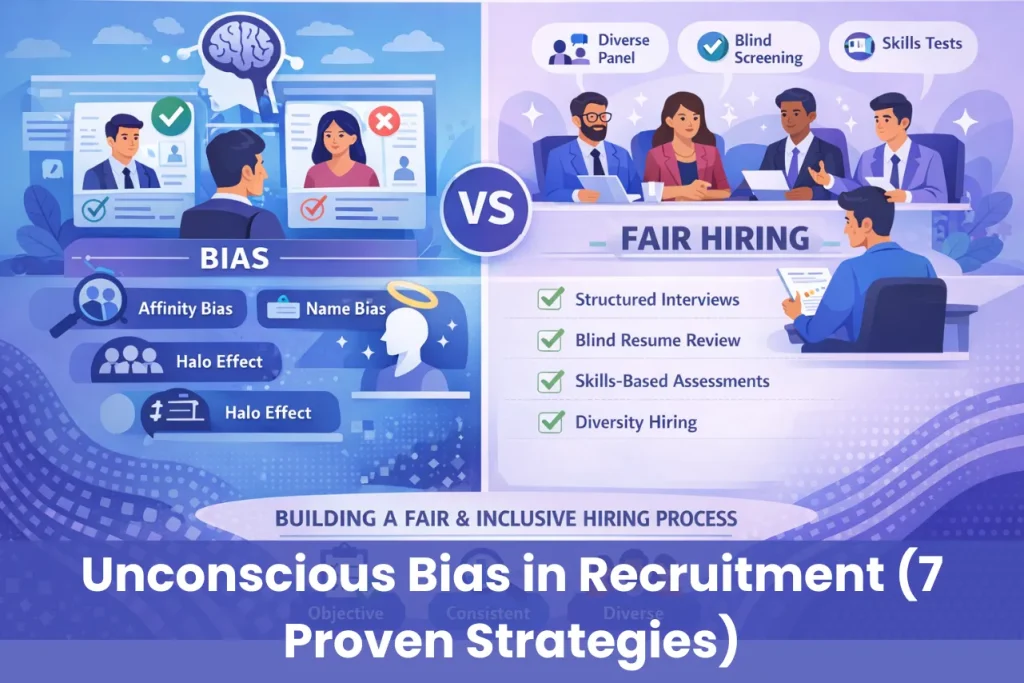
- Common forms of hiring bias include affinity bias, halo effect, confirmation bias, contrast bias, attribution bias, and name or appearance bias.
- To reduce bias, organizations should implement structured interviews, blind resume screening, inclusive job descriptions, and diverse hiring panels.
- Skills-based assessments and work sample tests help evaluate candidates based on real job capabilities rather than personal impressions.
- Structured interview tools and standardized evaluation criteria can improve consistency and ensure all candidates are assessed using the same framework.
- While technology can support fair hiring, organizations should combine technology-assisted screening with human oversight to avoid potential algorithmic bias.
- Building a bias-free hiring process requires structured systems, measurable diversity metrics, and consistent evaluation methods across the recruitment funnel.
Think about the last senior hire your team made. How confident were you that every qualified candidate, regardless of their name, accent, university, or the way they presented on camera , got a completely fair shot?
The honest answer, for most organisations, is: not very. Unconscious bias in recruitment is one of the most persistent and costly problems in hiring today. A SHRM study found that 48% of HR managers admit bias affects who they ultimately choose to hire. And unlike intentional discrimination, unconscious bias is far harder to spot and correct , because neither the recruiter nor the candidate is usually aware it is happening.
This guide breaks down exactly what unconscious bias in recruitment looks like, where it hides in your hiring process, and seven evidence-backed strategies to meaningfully reduce it , including how structured, technology-assisted approaches are helping hiring teams make faster, fairer decisions at scale.
Key Stat
48% of HR managers admit bias influences their hiring decisions. Yet unconscious bias training alone has repeatedly failed to produce lasting change , awareness without process change is not enough. (Source: SHRM)
What Is Unconscious Bias in Recruitment?
Unconscious bias , also called implicit bias , refers to the automatic associations and assumptions we form about people without realising it. In a hiring context, these associations shape how recruiters read resumes, conduct interviews, and ultimately decide who gets the job.
What makes unconscious bias so difficult to address is precisely that it is unconscious. Most hiring managers genuinely want to be fair. The problem is that the human brain takes mental shortcuts to process information quickly, and those shortcuts are shaped by years of social conditioning, personal experience, and pattern recognition , patterns that do not always reflect actual job performance.
A landmark study found that candidates with names perceived as ‘white’ received 50% more interview callbacks than identical candidates with names perceived as belonging to ethnic minorities. The resumes were word-for-word the same. The only variable was the name at the top.
6 Types of Unconscious Bias That Affect Hiring Decisions
Unconscious bias does not show up as a single, obvious prejudice. It manifests in many subtle forms throughout the recruitment process:
1. Affinity bias (the ‘like me’ effect)
Recruiters naturally feel more comfortable with candidates who share their background, interests, or communication style. This is the most documented form of bias in hiring and the primary reason homogeneous teams perpetuate themselves , people unconsciously hire people like themselves.
2. Halo effect
One impressive trait , a prestigious university, a recognisable company name on the CV, or a confident handshake , casts a positive glow over the entire candidate evaluation. Interviewers who have formed an early positive impression tend to seek out evidence that confirms it, while discounting contradictory information.
3. Confirmation bias
Once a recruiter forms an initial impression of a candidate, they unconsciously ask questions and interpret answers in ways that confirm that impression rather than genuinely testing it. This is particularly common in unstructured interviews where question choice is left to the interviewer.
4. Contrast bias
Candidates are not evaluated against a fixed standard , they are compared to whoever came before them. An average candidate interviewed immediately after several weak ones can appear far stronger than they actually are. A strong candidate interviewed after an exceptional one can appear weaker.
5. Attribution bias
The same behaviour is interpreted differently depending on who displays it. A typo on a CV might lead to one candidate being labelled ‘careless’, while another receives the benefit of the doubt. Assertiveness in one candidate reads as ‘leadership potential’; in another it reads as ‘difficult’.
6. Name and appearance bias
Research consistently shows that names, profile photos, and even the visual layout of a CV can trigger bias before a single qualification has been assessed. Bias at the CV screening stage means strong candidates from underrepresented groups are filtered out before they ever reach an interview.

Where Unconscious Bias Hides in Your Hiring Process
Bias does not only happen in the interview room. It can enter the process at every stage:
- Job descriptions: gendered or culturally specific language deters qualified candidates from applying in the first place
- CV screening: name, address, university name, and career gaps all trigger unconscious associations before skills are assessed
- Interview scheduling: rigid timeslots exclude candidates who cannot attend , caregivers, shift workers, candidates in different time zones
- Interview questions: unstructured, varied questions mean different candidates are effectively being assessed on different things
- Scoring and shortlisting: subjective ‘culture fit’ judgements are often unconscious bias given a respectable name
- Reference checks: the interpretation of reference feedback is as susceptible to bias as the interview itself
Worth knowing
Removing identifiers like name, age, and university from CVs at the screening stage , known as blind hiring , has been shown to increase the diversity of candidates who reach the interview stage by up to 46% in some studies
Bias Free Hiring vs Traditional Hiring
| Hiring Stage | Traditional Hiring Process | Bias-Free Hiring Process |
|---|---|---|
| Job Descriptions | Language may unintentionally discourage certain candidates | Gender-neutral and inclusive language attracts diverse applicants |
| Resume Screening | Recruiters may be influenced by names, universities, or backgrounds | Blind screening removes personal identifiers and focuses on skills |
| Interview Format | Unstructured interviews with different questions for each candidate | Structured interviews ensure every candidate answers the same questions |
| Candidate Evaluation | Decisions often rely on gut feeling or personal impressions | Standardized scoring systems evaluate candidates objectively |
| Hiring Panels | Interviewers often share similar backgrounds | Diverse panels bring multiple perspectives to the evaluation |
| Skill Assessment | Limited testing of actual job skills | Work samples and competency assessments measure real capabilities |
| Decision Making | Subjective judgments influence final selection | Data-driven insights and structured scoring support fair decisions |
7 Proven Strategies to Reduce Bias in Hiring
1. Audit and rewrite your job descriptions
Biased language in job descriptions filters out diverse candidates before they even apply. Research shows that masculine-coded words like ‘dominant’, ‘competitive’, and ‘ninja’ significantly reduce applications from women, while overly long ‘required’ qualification lists disproportionately deter candidates from non-traditional backgrounds. Use gender-neutral language, focus on outcomes rather than credentials, and run every JD through a bias-checking lens before publishing.
2. Implement structured interviews
Structured interviews , where every candidate is asked the same questions in the same order and evaluated against the same scoring criteria , are the single most evidence-backed way to reduce bias in the interview stage. Harvard Business School research confirms that standardised interview processes significantly reduce the influence of unconscious bias by keeping evaluators focused on factors that have a direct impact on performance, rather than factors that feel intuitively important but are not.
Unstructured interviews, where question choice is left to the interviewer, are essentially an open invitation for bias to enter the process. Two candidates for the same role can walk away having been tested on completely different things.
3. Use blind hiring at the screening stage
Remove names, photos, addresses, and university names from CVs before they reach the screener. Many applicant tracking systems support this automatically. For roles where this is not feasible end-to-end, even applying it to the initial screening stage meaningfully increases the diversity of who reaches the interview round.
4. Build diverse hiring panels
A hiring panel that is entirely composed of people from similar backgrounds will share similar blind spots. Including interviewers of different genders, cultural backgrounds, seniority levels, and departments creates a broader perspective and a natural check on individual biases. Research cited by Harvard Business Review shows that diverse panels also signal inclusivity to candidates , they see a company that genuinely reflects its values.
5. Introduce work sample and skills-based assessments
Work sample tests ask candidates to complete a task representative of the actual job , a coding challenge, a data analysis exercise, a short written brief. Because every candidate completes the same task and is evaluated on the same output, they directly counteract the influence of affinity bias and the halo effect. Skills-based assessment shifts the focus from who the candidate is to what the candidate can actually do.
6. Use structured interview tools to enforce consistency
Technology can play a significant role in removing the variability that allows bias to enter the interview process. AI-powered structured interview tools , such as InCruiter’s IncBot , deliver the same competency-based questions to every candidate, apply consistent scoring criteria, and produce an auditable record of every evaluation. This is fundamentally different from using AI interview software as a blanket replacement for human judgement , IncBot is designed to inform and support human decision-making, not replace it. Every IncBot shortlist feeds into InCruiter’s human-led Interview as a Service review, where domain experts validate AI-assisted outputs before a hiring decision is made.
The measurable result: companies using structured interview tools report up to a 30% improvement in workforce diversity , because the process is selecting on merit, not familiarity.
7. Track diversity metrics at every stage of the funnel
You cannot fix what you do not measure. Track the demographic breakdown of your candidate pipeline at every stage , applications, CV screen pass rate, interview invitation rate, offer rate, and hire rate. If you see significant drop-off for any group at a specific stage, that is where bias is entering your process. Set targets, review monthly, and hold hiring managers accountable for the data.
Quick win
Start with your job descriptions and interview questions , these are the two highest-leverage changes you can make today, with no budget required. Audit one open role end-to-end this week.

Common Types of Bias in Recruitment
| Type of Bias | Description | Example in Hiring |
|---|---|---|
| Affinity Bias | Favoring candidates who share similar backgrounds | Hiring someone from the same university |
| Halo Effect | One positive trait influences overall judgment | Candidate from a famous company assumed to be highly skilled |
| Confirmation Bias | Seeking information that confirms initial impressions | Asking questions that support a recruiter’s first opinion |
| Contrast Bias | Comparing candidates to each other rather than objective criteria | An average candidate appears stronger after weaker ones |
| Name Bias | Judging candidates based on their names | Candidates with ethnic names receive fewer callbacks |
| Attribution Bias | Interpreting behavior differently depending on the person | Assertiveness seen as leadership in one candidate but arrogance in another |
Why Bias Training Alone Is Not Enough
Most organisations respond to concerns about unconscious bias by rolling out diversity and inclusion training. The intent is right. The evidence, however, is disappointing.
A comprehensive review of unconscious bias training programmes found that while training reliably increases awareness of bias, it rarely produces lasting change in actual hiring decisions. Awareness without process change is not sufficient. If a recruiter returns from a bias training workshop and goes straight back to conducting unstructured interviews with no standardised scoring, the training has achieved very little.
The organisations that make the most meaningful progress on bias-free hiring are those that change their processes and systems , not just their awareness. Structured interviews, blind screening, diverse panels, and measurable diversity KPIs are process-level interventions. They reduce bias whether or not the individual recruiter is ‘trying to be fair’, because they remove the discretionary moments where bias enters.
How InCruiter Helps Build a Bias-Free Hiring Process at Scale
InCruiter’s platform is built around the process-level interventions that the evidence shows actually work:
- IncBot delivers structured, competency-based interviews , identical questions, identical scoring criteria, fully auditable , to every candidate, at a time that suits them
- Interview as a Service pairs IncBot’s structured AI output with experienced human interviewers who validate shortlists before any hiring decision is made
- Flexible scheduling removes the timing barriers that exclude strong candidates who cannot attend traditional interview slots
- Full integration with existing ATS and HR systems ensures the entire process , from application to offer , is documented and auditable
- Candidate feedback is provided after every IncBot interview, building trust and employer brand regardless of the outcome
The combination of structured AI-assisted screening and expert human review creates a hiring process that is both faster and fairer , not a trade-off between the two.
The Honest Caveat: How Technology Can Also Introduce Bias in Hiring
Any honest guide on this topic has to address the risk on the other side. Structured interview tools reduce human bias , but they can introduce algorithmic bias if they are not implemented carefully.
A University of Washington study (2025) found that when AI hiring tools carry even moderate bias in their recommendations, human reviewers tend to follow those recommendations without questioning them. Amazon’s well-documented AI recruitment tool penalised resumes mentioning women’s organisations. HireVue’s speech analysis algorithms disadvantaged non-native English speakers.
The root cause is almost always biased training data , if a system learns from historically biased hiring decisions, it learns to replicate them. The safeguards that matter:
- Choose vendors who provide explainable outputs , you should be able to see why a candidate was scored the way they were
- Conduct regular bias audits , test shortlisting rates across demographic groups quarterly
- Never let technology make final hiring decisions , AI surfaces candidates, humans decide
- Ensure competency frameworks are defined carefully before deployment , the quality of the criteria matters as much as the quality of the tool
IncBot is designed with these safeguards built in , but we would encourage any organisation evaluating interview technology to ask hard questions of every vendor, including us.
Conclusion: Bias-Free Hiring Is a Process Problem, Not a People Problem
The most important mindset shift in tackling unconscious bias in recruitment is this: it is not a character flaw in your hiring managers. It is a systems problem. Human brains are wired to take shortcuts, and traditional hiring processes give those shortcuts enormous influence over life-changing decisions.
The solution is to change the process , to build structure, consistency, and accountability into every stage of hiring, from how you write job descriptions to how you score interview responses. Technology can accelerate and enforce that structure at scale. But it works best when it sits alongside human expertise and oversight, not as a replacement for it.
InCruiter’s platform , combining IncBot’s structured interview delivery with human-led review , is built on exactly that principle. If you would like to see what a bias-free hiring process looks like in practice for your organisation, we would be glad to show you.
Frequently Asked Questions(FAQs)
What is unconscious bias in recruitment?
Unconscious bias in recruitment refers to the automatic assumptions and associations that influence hiring decisions without the recruiter being aware of them. Common examples include affinity bias (favouring candidates similar to yourself), the halo effect (letting one positive trait colour the entire evaluation), and name bias (making assumptions based on how a candidate’s name sounds). These biases affect decisions at every stage of the hiring process, from CV screening to final offer.
How does unconscious bias affect diversity hiring?
Unconscious bias is one of the primary reasons diverse candidates are screened out before they reach the interview stage. When CV screening, interview questioning, and shortlisting are all left to individual discretion, bias compounds at every step , meaning the candidate who reaches the final round is often the one who looked most familiar, not the one who was most qualified. Structured processes that enforce consistency are the most effective way to counteract this.
Does unconscious bias training actually work?
The evidence is mixed. Bias training reliably increases awareness of unconscious bias, but awareness alone does not reliably change behaviour in hiring decisions. The research consistently shows that process-level interventions , structured interviews, blind CV screening, diverse panels, and measurable diversity KPIs , produce more lasting results than awareness training alone. Training works best when it accompanies process change, not instead of it.
What is a structured interview and how does it reduce bias?
A structured interview is one where every candidate is asked the same questions in the same order and evaluated against the same pre-defined scoring criteria. Because there is no variation in what candidates are asked or how they are scored, structured interviews remove many of the discretionary moments where unconscious bias enters an unstructured conversation. Research from Harvard Business School confirms that structured interviews significantly outperform unstructured ones for both predictive validity and fairness.
Can technology help reduce bias in hiring?
Yes , when used correctly. Structured interview tools that deliver consistent questions and competency-based scoring to every candidate help remove the variability that allows human bias to enter the process. However, technology can also introduce algorithmic bias if it is trained on historically biased data or used without human oversight. The most effective approach combines structured technology-assisted screening with expert human review , using AI to enforce consistency and humans to exercise judgement.
How do I measure whether my hiring process is biased?
Track the demographic breakdown of your candidate pipeline at every stage: applications, CV screen pass rate, interview invitation rate, offer rate, and hire rate. If a specific demographic group drops off disproportionately at a particular stage, that is where bias is entering your process. Conducting regular audits of shortlisting decisions , ideally with someone independent of the hiring team , is also valuable. If you use AI-assisted screening tools, ask your vendor for demographic breakdown data on their outputs.
Also Read:
Proxy Interview: AI’s Role in Detecting Proxy Interview Tactics
What Is Interview As A Service, And How Is It Different From Traditional Hiring Methods?
Interview Outsourcing: A Proven Solution for Better Hiring Outcomes
Ready to Transform Your Hiring Process?
Discover how our AI-powered interview platform can streamline your recruitment and find the best candidates faster.

Related Blogs

Why Freelance Interviewing is the Ultimate Side Gig for Experienced Professionals?
Freelance Interviewing is an ideal side hustle for professionals seeking flexible, well-paid work that leverages their expertise.
Guide to Choosing the Right Interview Scheduling Software
Do you even need interview scheduling software? The answer is yes! And more than 51% of recruiters agree. Today, the competition is at its all-time high....
Autonomous Virtual Interviewer: A Game-Changer in Online Interviewing
Hiring teams face delays, fatigue, and uneven reviews. Virtual interviewers fix the early mess by speeding up rounds and keeping things steady.
Pre-Employment Checks: Hiring the Right Candidates
A disastrous hire can adversely affect the business growth levels. Nowadays, there has been a drastic increase in fake candidates in the corporate sector, which...
Benefits of Integrating Interview Intelligence Platforms in Your Hiring Process
Do you want to embrace the power of the interview intelligence platform in your recruitment process? If you’ve heard this term, then this blog is...
HirePro vs. InCruiter: Cracking the Code of Video Interview Software
Have you heard that you can now take an interview from any place in the world, i.e., no need to go to the office? Yes,...


