




Key Takeaways
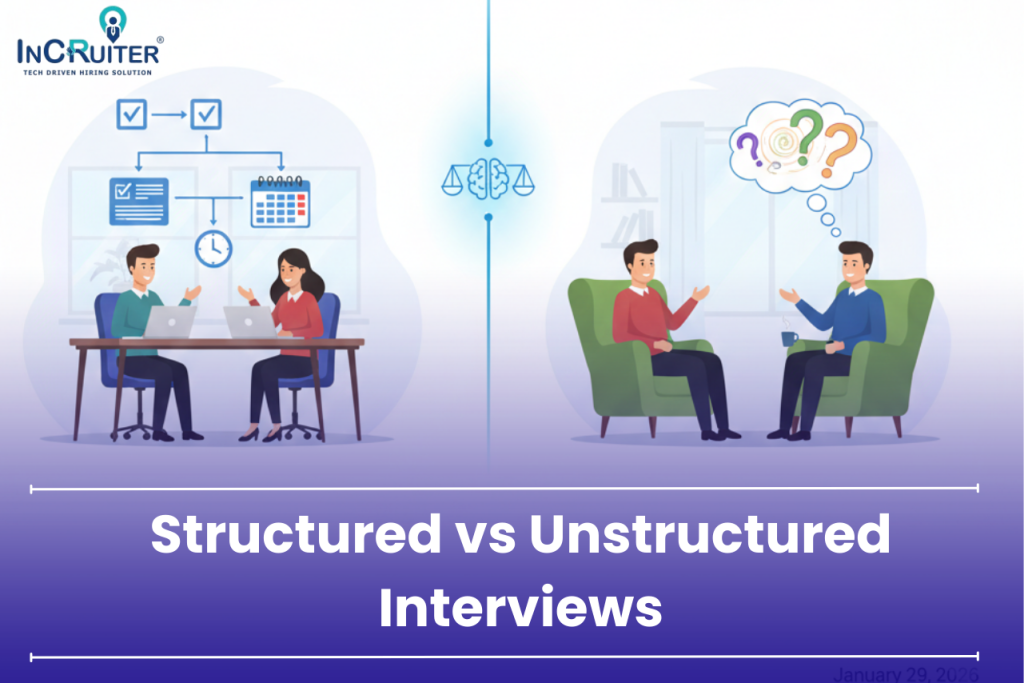
- Structured interviews follow a standardized, pre-planned process with fixed questions and scoring systems, making hiring more consistent, objective, and legally defensible.
- Unstructured interviews are informal and flexible, allowing natural conversations but increasing the risk of bias and inconsistent candidate evaluation.
- Semi-structured interviews combine predefined core questions with flexible follow-ups, offering a balance between consistency and deeper exploration.
- The best interview type depends on the role and hiring goals—structured for high-volume and technical roles, semi-structured for evolving roles, and unstructured for creative or leadership positions.
- AI-driven hiring tools enhance structured interviews by automating screening, evaluation, scheduling, and scoring while improving speed, fairness, and scalability.
Interviews are not just a one-to-one video conference between two individuals. It’s a traditional decision-making tool used to decide people’s intelligence, abilities, and predict how they will perform in real-life situations. However, the quality of the decision lies between the two ways of conducting evaluations, that is, structured vs unstructured interviews.
Choosing the right one can decide everything, including the quality of hiring, the authenticity of the assessment, and the scale of hiring power. To help you with these, in this guide, we are discussing structured vs unstructured interview approaches, their differences, advantages, and disadvantages.
What Is a Structured Interview?
Structured interviews mean a preplanned blueprint of the interviewing process, where every move is thought out in advance. This includes resume shortlisting, phone discussion, pre-screening assessment, live interviews, and final decision steps. Ensuring fairness throughout the process, reducing personal bias, and improving decision-making.
What does a Structured Interview Process typically include?
1. Job Analysis & Competency Mapping
- Role Definition: This step often starts with a discussion with the company’s department head. Discussion mainly focuses on asking them questions to understand the important skills, knowledge areas, and right behavioural attributes for role success.
- Job Description Making: The role definition helps the hiring manager to draft a balanced job description, which is the most decisive step of the recruitment process. If it is over- or under-promised in both positions, companies lose the candidate’s trust, which creates a negative image.
2. Standardized Questioning
- Fixed Question Set: Prepare the list of must-ask questions for the phone interview, pre-assessment round, and live interview. The main motive of this type of questioning is to lay the groundwork for the main question-and-answer round.
- Predefined Order: Pre-planning the flow of questioning saves the interviewers from confusion during the interview, helping them to stay focused on evaluating the skills.
Types of Questions:
- Behavioral: This discusses the candidate’s prior experience.
For example,
- Tell me about a time you handled a difficult customer.
- Describe a situation where you worked under tight pressure.
- Give an example of when you improved a team process.
- Situational: This helps the interviewer assess candidates through hypothetical questioning.
For example,
- How would you prioritize tasks if two deadlines clash?
- What steps would you take with a non-performing team member?
- Imagine a budget cut; how do you adjust your project?
- Competency-based: This is for checking any particular skill that is mentioned in the JD or CV.
For example,
- Show how you demonstrate strong communication skills.
- Provide evidence of your problem-solving ability.
- Explain your approach to building relationships at work.
- Experience verification: This provides a glimpse of the candidate’s past roles and responsibilities during his tenure.
For example,
- Walk me through your role in the last project.
- What achievements match this job’s requirements?
- Describe your daily tasks in your previous position.
- Technical: This question is designed to check the technical skills of the candidate, which are going to be used in the role they are applying for.
For example,
- How do you write a SQL query for data filtering?
- Explain how to debug a Python script error.
- Walk through creating a pivot table in Excel.
3. Objective Evaluation System
- Scoring Rubric (Scorecard): Set a benchmark for rating skills on a scale of 5 points, a scale of 10, or in a percentage. This separates the performance of the top applicant from that of the average or poor one.
- Real-Time Scoring: This removes the ambiguity for interviewers about which scale to use to score candidates.
4. Consistent Interview Logistics
- Interviewer Training: Teach the interviewer to provide a good interviewing experience. This typically includes training in clear communication, a respectful interaction environment, transparency about the process, and fair evaluation criteria.
- Interview Panel: Choosing interviewers from the same domain because they know the norms of the job roles. For this, you can utilize InCruiter interview experts, which means you get an expert for each role.
- Controlled Environment: Use only the specialized tool designed for online interviews to save sanity, because switching between tools disturbs both the interviewer and candidates.
5. Documentation & Compliance
- Meticulous Record-Keeping: Use the specialized tools to record the session, transcribe the interview discussion, and convert them into useful decision-making insight for the recruiter.
- Audit Trail: Standardization in recruitment documentation keeps the companies away from any legal disputes.
Examples of Structured Interviews
Every recruitment process starts by defining a few common items, such as the job title, required skills, required experience, and more. That all helps in curating JD. The recruiter then publishes this JD in various job portals for candidate sourcing.
Below are two sample examples that provide a glimpse of the structured interview process in action.
Example 1: Software Engineer Position (Technical Role)
A structured hiring process for a software developer involves a step-by-step, planned evaluation of technical skills, problem-solving, and collaboration abilities. This typically involves at least five rounds, as explained below.
- Round 1: Resume Shortlisting – This is more like a profile-filtration round, separating the top-ranked candidates’ resumes from those that are not relevant. The hiring team checks the resume for the required technical skills, related software projects, and other competencies.
To save time, companies often use the InCruiter Resume Screening Tool.
- Round 2: Phone Interviews – The talent screening executive dials the numbers of selected resume profiles. This is basically to check the candidate’s communication skills, technical concepts, preferred work environment (hybrid/remote), notice period, and salary expectations.
- Round 3: Talent Screening – Hiring managers conduct this coding assessment to understand the candidate’s coding skills. This involves scoring code quality, correctness, optimization, and overall test performance.
- Round 4: Live Interviews – Departmental head or experts conduct these interviews specifically from the same domain. This involves technical discussion, code collaboration, problem-solving, and more. Interviewers asked candidates to solve the problem, and sometimes they switched roles to assess the candidate’s leadership.
- Round 5: Decision making: This is the final step, where the hiring team sits, analyzes, compares, and chooses the most suitable applicant for the job role.
Example 2: Sales Executive (Sales Role)
The sales interview is designed to evaluate the candidate’s representation, communication, and conflict handling skills.
- Round 1: Resume Shortlisting – Hiring team matches the previous work experience relevance with the job role, educational background, and knowledge of tools used in lead generation.
- Round 2: Phone Interviews – TA team executive interviews candidates to assess their career motivation, sales experience, tenure in their last role, achievement of targets, and industry familiarity.
- Round 3: Talent Screening – Candidates assess their understanding of sales process concepts, covering prospecting, qualifying, closing, etc. Expertise in the use of CRM tools.
- Round 4: Live Interviews – Sales head tests the confidence, active listening, quick thinking, and objection handling skills with scenario-based back-to-back questioning. Often asked to give a sales pitch or demo, considering him as a client.
- Round 5: Final Hiring Decision – In the final stage of recruitment, the team compares each key insight collected during the interview to select the top sales executives who applied.
What Is an Unstructured Interview?
An unstructured interview is also known as a free-flow, non-directive, or informal type of interview. In this, nothing is pre-planned, organized, or set in advance. Everything is spontaneous based on the given answer of the candidate, the provided resume, or the ongoing flow of the discussion.
What does an unstructured interview process include?
Informal Start
The primary goal of informal interviewing is to reveal the true information from the candidate. To achieve this, conversations start with comforting the applicants through regular chit-chat-type questions. This includes questions like
- “How are you?”
- “How was your commute?”
- “What do you enjoy outside work?”
Probing Follow-Ups
This is to uncover the hidden details, stories, or motivations that are not mentioned in resumes. Here, questions feel like spontaneous reactions driven by curiosity instead of scripted ones. The follow-ups look like,
- “What was your role in that situation?”
- “You mentioned travel, tell me more about that project in Europe.”
- “Can you walk me through that process?”
No Scorecards
The applicants are evaluated solely on gut feelings rather than any standardized skill scoring method. Often, the interviewer speaks about their personal opinions, impressions, and observations without documentation of the session.
No doubt, this speeds up the decision-making, but also invites subjectivity without supporting data.
Variable Topics
Instead of focusing on the preplanned skill checklist, the interview conversation revolves around resume highlights, individual hobbies, or career stories.
Means one moment the discussion revolves around the career, and the next moment it shifts to weekend plans. Sometimes it overlooks key competencies required for the role.
One-Way Dominance
The interviewer dominates the session, weaving company tales, achievements, or milestones. Turns the professional interactions into a friendly chat.
For instance, the interviewer talks 70% and the candidate talks 30%. This establishes the connection between them but lacks the balance of an interview.
Quick Gut Decisions
Unlike planned types of interviews, where hiring decisions come after multiple rounds of evaluation, here the interviewer’s decision always falls prey to similarity biases.
Most decisions are made out of gut feeling within the first 90 seconds, based on the applicant’s background, body language, handshake, greeting, or anything that impresses them.
What are Some Examples of Unstructured Interviews?
The examples below are based on real-life interview experiences shared over Quora, LinkedIn, or other social platforms.
Example 1. Developer Role Interview
- Resume shortlisting:
Companies do not spend time shortlisting role-aligned candidate resumes. They do shortlisting like “okay, let’s start with the first 10 resumes out of 100,” a very casual approach often leads to bad profile selection.
- Telephonic round:
Talent acquisition team calls without any script, ask random questions like the location you are staying now, your educational background, and what CTC you want.
- Coding assessment:
The Recruiter sent the coding assignment via email and asked the candidate to submit it before the deadline.
- Video interview:
Interview schedule with the tech team members, assuming a deep evaluation of the candidates’ theoretical, technical, coding, and professional skills. But when it comes to reality, it ends up with team collaboration, the last project discussion, and checking the candidate’s vibe.
- Feedback and reporting:
Rarely does any evaluator record notes on the applicant’s performance in a live session. The decision totally depends on memory.
The outcome: The recruiter decided to conduct this as a technical round that finished as a casual session.
Sales Role Interview
- Resume Shortlisting:
Hiring managers select the resume based on the target achievement. revenue growth, and relevant industry experience.
- Telephonic Screening:
HR checks candidates’ motivation, communication skills, confidence, and salary requirements.
- Role Play Assessment:
For selected candidates in the telephonic round, companies run a mock sales drill to assess how confidently they tackle the dispute.
- Video Interview:
The session begins with an unstructured conversation without any script. This basically covers the discussion of previous closed deals, the strategy applied, and conflicts faced. Often, the session evolves based on the responses of applicant’s answers.
- Feedback & Reporting:
The interviewer shares the feedback completely based on the candidate’s first impression, strategic thinking, and team fit. To make a final decision in-house recruitment team schedules a debate session, all favoring the candidate they like while interviewing.
The result: The interview feels more like a coffee chat with a potential colleague than a formal evaluation.
Structured vs Unstructured Interviews: Key Differences
Understanding the difference between structured and unstructured interviews helps organizations choose the right interview method for their hiring goals.
| Aspect | Structured Interviews | Unstructured Interviews |
| Question Format | Role-specific preprepared questions | Questions are highly dependent on someone’s mood |
| Flexibility | Follows a fixed format of interview | No fixed format is followed; anything can be changed, including round numbers also |
| Consistency | Identical questions for all candidates | Unique to each candidate and dialogue |
| Evaluation Criteria | Standardized scoring rubric | Subjective, based on the interviewer’s impression |
| Preparation Required | Extensive prep for questions and scales | Minimal prep, relies on the interviewer’s expertise |
| Time Management | Fixed duration per question | Variable follows conversation flow |
| Bias Potential | Lower bias due to standardization | Higher risk from gut feelings and first impressions |
| Candidate Comparison | Easy to compare objectively | Difficult due to different questions |
| Legal Defensibility | Strong, well-documented | Weaker, harder to justify |
| Rapport Building | Limited, more formal | Strong, through casual conversation |
| Predictive Validity | Higher reliability for performance prediction | Lower reliability, more subjective |
| Interviewer Training | Requires training on process adherence | Minimal training, relies on interpersonal skills |
| Best For | High-volume hiring, compliance roles | Senior positions, culture fit, startups |
Advantages and Disadvantages of Structured Interviews
Advantages of Structured Interviews
- High Predictive Validity: Top HR tech company, like InCruiter, confirms that the data generated from the structured interview process provides an accurate prediction of how someone performs in real job scenarios.
- Reduced Bias: Standard questioning for all stages, structured interview rounds, and set evaluation criteria remove the personal bias from the process and improve the fairness of evaluation.
- Consistency and Reliability: Probing interview questioning in a predetermined order, ensuring the consistency of data collected from this session, which is later analyzed, and provides reliable insight for future decisions.
- Legal Defensibility: A well-planned process, like a structured one, provides the legal protection against any future dispute, so that it maintains an archive of session data, chats, and other information.
- Efficiency in Evaluation: Standardized scoring rubrics make it easier and faster to compare multiple candidates’ responses objectively against a common benchmark.
- Efficiency in Evaluation: Simplified scoring system involving numbered ratings and comments enables the hiring team to make a hiring decision faster and more efficiently.
Disadvantages of Structured Interviews
- Less flexibility in conversations: In this type of interview, interviewers get very little opportunity to do normal chit chat with applicants.
- Requires upfront preparation: Brainstorming, planning, and execution are the main pillars of this process that require the recruiter to focus attention.
- May feel rigid for creative roles: Companies that have a habit of doing interviews so casually might feel some pressure because this does not allow them to make random changes.
Advantages and Disadvantages of Unstructured Interviews
Advantages of Unstructured Interviews
- Encourages natural conversation: Often session starts with the normal engagement with candidates just to make them comfortable for the interviews.
- Helps assess personality and cultural fit: This involves very common casual questioning, like friends usually do.
- Allows deeper exploration of unique experiences: If the interviewer relates to some specific part of the candidate experience, they are allowed to decide the interview direction.
Disadvantages of Unstructured Interviews
- High interviewer bias: Multiple interviewers come with their own evaluation style, they ask their own questions, and write the feedback based on personal experience.
- Inconsistent candidate evaluation: Sometimes interviews start as technical but end up behavioral round entirely depending on the flow of the conversation.
- Poor scalability for large hiring volumes: As there is no defined time limit for the interview round, it’s very difficult to scale the recruiting process.
- Difficult to justify hiring decisions with data: The Selection process of the candidates is dependent on the interviewer’s opinion, their memory, and personal impression, making this process a less reliable one
Structured vs Semi-Structured vs Unstructured Interviews
According to InCruiter observation, not all companies want a fully structured or an unstructured approach to interviews. Based on modern-day demand, many organizations want a combination of both, like a semi-structured interview type.
Fulfilling those requirements, semi-structured interviews have emerged as a new balance approach that lies between the lines of structured and unstructured interviews.
Below is a comparison of these three categories to help you decide among them.
| Feature | Structured Interviews | Semi-Structured Interviews | Unstructured Interviews |
| Question Format | Pre-planned standard questioning | Main questions are pre-decided, else are probed spontaneously | No questions are fixed interview; they are based on the flow of the session |
| Order of Questions | Fixed sequence of questioning for each round | Fixed questions but provides flexibility to change during the session | Flow of questioning is natural; no fixed format is followed here |
| Response Format | Straight to the point without any jargon | Mix of closed and open-ended questions | Open-ended free-flow type |
| Interviewer’s Role | Follows the fixed path of the design process | Aware of the next step, but also explore new topics during the session | Encourage two open-ended discussions, allowing the candidate to lead the direction |
| Consistency | High (easy to compare candidates) | Moderate (some variation) | Low (each interview is unique) |
| Depth of Insight | Deeper insight as a recruiter wants | Balance insight for taking a wise decision | Dig deeper, but missed some key points |
| Best Used For | All types of hiring operations | Startup-based hiring only | For the creative roles like film industry |
| Analysis Difficulty | Low (standardized scoring) | Moderate (requires thematic analysis) | High (subjective, time-consuming to analyze) |
| Candidate Experience | High grade | Balanced | Poor |
| Time Efficiency | High (strict timing) | Moderate | Low ( lengthy and variable) |
Which Interview Type Is Best for Hiring?
There is no one for a fit size interview type in the industry. The selection of the best interview type is completely based on the company’s specific job role requirements.
- For first-level talent screening, the automated screening tool built on a structured interview foundation is the best option. This removes the unconscious bias from the profile shortlisting in the initial stage.
- For technical hiring, the semi-structured interview with an AI interview bot is the optimal choice. This evaluates the candidate on preset questions, and if needed, asks follow-up questions to dig deeper into the candidate’s skills.
- For the team lead type, creative, or exploratory roles, the unstructured way of interviewing is the best approach. This allows the interviewer to evaluate the candidates on their personal stories, creative approach, and unique thinking.
In addition, competing in today, hiring landscape, top HR leaders support the adoption of AI-driven hiring practices, dipping into the blueprint of structured interviews.
InCruiter AI-powered video interview ecosystem helps companies automate the entire hiring process from screening resumes to onboarding candidates, everything in a single unified platform. Here’s how it combines every step in a simplified structure:
- AI-driven resume screening: This scans thousands of resumes in the blink of an eye provides the most suitable resume to move into the next round.
- AI phone screening: The AI phone screener automatically dials the candidate’s number to evaluate the fit of the applicant with the role.
- AI interview software: AI interview platform uses the Conversational AI technology to conduct interviews, ask follow-up questions, and instantly provides feedback with AI scoring.
- Interview scheduling automation: Hiring managers send thousands of interview invitations without manual effort, removing the need for reminders.
- Live video interview: For evaluating selected candidates, companies use Interview as a Service solution, where an expert interviewer interviews the candidate on the company’s behalf and provides insight into the candidate’s performance.
Conclusion
We know, choosing between two structured and unstructured interviews is a do-or-die moment for any organization. One follows the organized approach, where everything is round is planned, question is set in advance, and decisions are made based on data.
While the other follows the spontaneous approach, the question comes randomly, and a decision is made out on first impressions. This guide helps you understand both methods in depth, so you can make a decision on which fits best for you.
Today, AI-driven hiring solutions help organizations bring structure, speed, and consistency into interviews. To apply this the right way, connect with an InCruiter expert.
Frequently Asked Questions (FAQs)
1. What is the main difference between structured and unstructured interviews?
The main difference between the structured and unstructured interviews is the standardization. Structured interviews use a predetermined structure of interviews, role-aligned questions, and scoring methods, while unstructured interviews rely on open-ended casual talk, random questions, and decisions based on gut feelings.
2. Are structured interviews better than unstructured interviews?
Yes, if we compare to unstructured interviews, the structured interview way better approach. This provides reliability in that everyone can believe, reduces bias, and provides flexibility to scale hiring operations in no time in the same structured way.
3. Which interview type reduces bias?
Ideally structured interviews reduce bias by introducing a standardized evaluation process in hiring. Through these companies use the pre-decided template to interview candidates, scoring methods are also decided, which leaves no room for any kind of bias.
4. Can AI be used in structured interviews?
Yes, AI can be used in structured interviews, and one of the market leaders in the HR tech industry has already implemented it in the hiring process. InCruiter provides a hiring solution that helps small and big organizations to structure their process while automating on the other side.
Also Read:
- Why Interview as a Service Is the Future of Talent Acquisition?
- Everything You Need to Know About AI Proctoring Software
- Key Benefits of AI Interview Transcription for High-Volume Recruitment
- Top 10 Video Interview Software for Recruiters
- Reduce No-Show Rates Instantly with Automated Interview Scheduling Software
Ready to Transform Your Hiring Process?
Discover how our AI-powered interview platform can streamline your recruitment and find the best candidates faster.

Related Blogs
Virtual Interviews Explained
InCruiter’s AI-powered video interview platform streamlines hiring with live, recorded, and coding interviews, delivering faster, fairer, and more efficient recruitment.
How Does Video Interviewing Work? The Complete Guide for Recruiters in 2026
What Is Video Interview Software? Video interview software is a technology solution designed to facilitate remote job interviews through online video. It encompasses tools for...
Top 5 Real-Time Coding Interview Tools with Built-In Assessments in 2026
Every recruiter’s inbox in 2026 is flooded with AI-polished resumes. But resumes don’t reveal how a developer thinks under pressure a real-time collaborative coding session...
AI For Interviews: How Artificial Intelligence Enhances the Job Interview Process
Explore how AI Interview software is reshaping job interviews with smart screening, real-time feedback, and bias-free evaluations to hire faster and better.
Interview Management System: How to Choose the Right Tool For Your Business
This guide helps you choose the perfect interview management system for your business by evaluating key features, integrations, and hiring needs.
Top 10 Best AI interview Software for Hiring in 2026
Work will become optional, we agree entirely with Elon Musk’s words, owner of xAI (Artificial Intelligence). Having witnessed in 2025 that 88% of white-collar jobs,...


