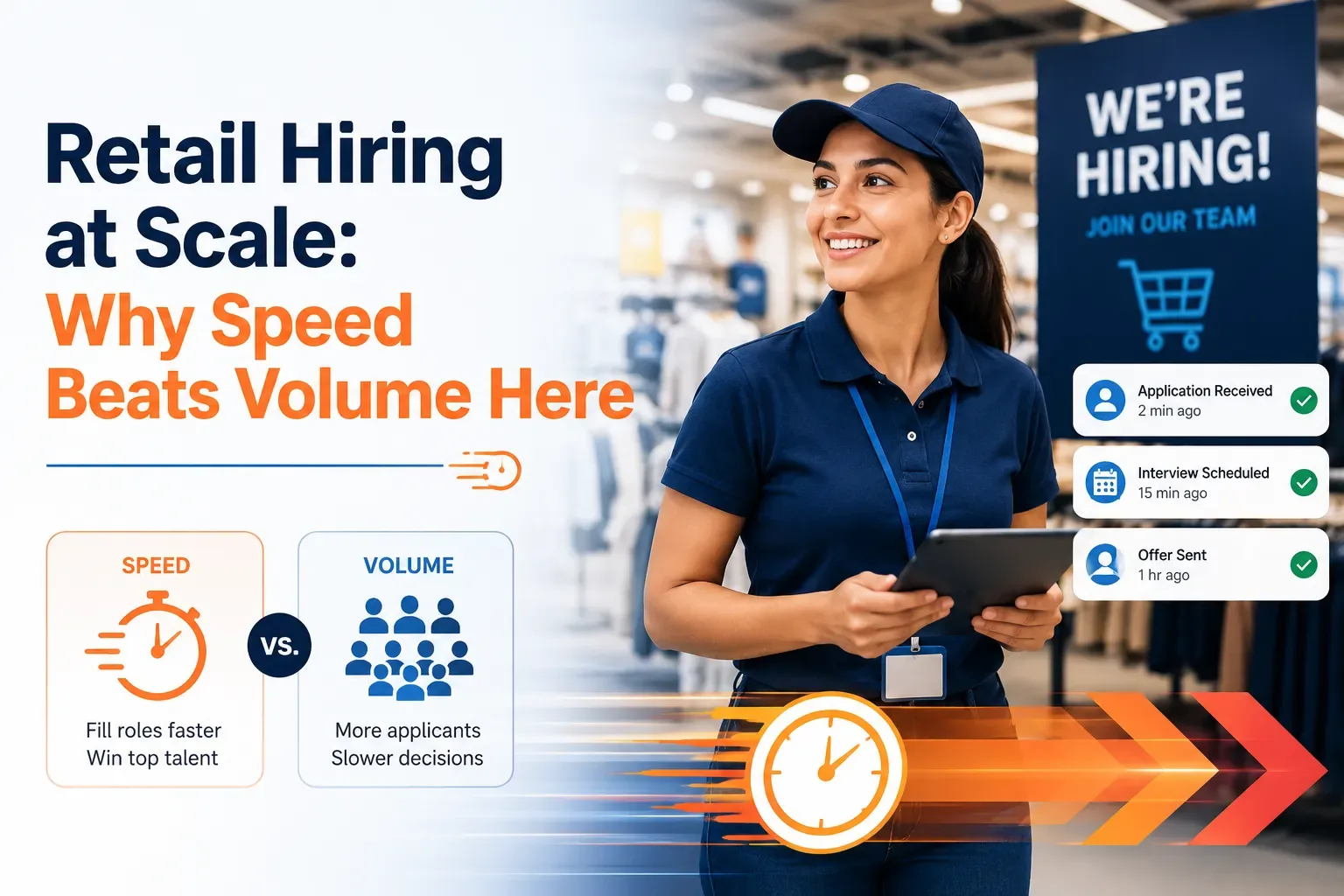
A retail chain hiring seasonal staff across 40 stores doesn’t usually struggle to get applicants. The job postings fill up fast. What happens next is the real problem. Candidates wait, the process drags, and by the time an offer goes out, a share of the best ones have already taken a job somewhere faster. Retail hiring at scale is less a sourcing problem than a speed problem. Most generic recruiting software isn’t built to fix that.
The Real Problem Isn’t Too Few Applicants, It’s Losing Them
Retail hiring usually isn’t short on volume. Seasonal pushes, store openings, and routine frontline turnover all generate a steady stream of applicants. The problem shows up after that. A slow, multi-step hiring process gives candidates time to look elsewhere. Hourly and entry-level candidates are often the least willing to wait around for a decision.
InCruiter’s retail hiring solutions page names this directly as a core retail pain point: reducing drop-offs caused by long hiring processes. That’s a different core problem from the one InCruiter has already documented in manufacturing hiring, where the bigger risk is a resume overstating a skill. In retail, the bigger risk is losing a perfectly good candidate to a slow process, not hiring the wrong one.
Screening for Fit, Not Just Credentials
Most retail roles don’t need deep technical verification. They need a fast, consistent read on whether a candidate can do the job well: communicate with customers, handle a fast-paced shift, work as part of a store team. That’s a different assessment problem than a coding test or a technical panel. A slow, multi-round interview process handles it badly, since every extra round is another chance to lose the candidate.
This is where fast, AI-assisted screening fits. InCruiter built its IncBot video-interview tool specifically for high-volume hiring in retail and healthcare, and states a 4x faster screening claim with reduced manual recruiter effort. That’s a specific claim from InCruiter’s own product page, not an independently audited benchmark. It still targets the actual bottleneck directly: how long it takes to reach a real screening decision, not how many applicants come in.
Picture a retailer opening 12 new stores before the holiday season, needing roughly 180 frontline hires in six weeks. Sourcing 180 candidates isn’t the hard part. The hard part is screening all of them for customer-facing fit fast enough that the strongest ones don’t take another retailer’s offer first. That’s what actually determines whether the stores open fully staffed.
Why One Schedule Doesn’t Work Across Many Stores
Retail hiring rarely happens in one location. A chain hiring across dozens of stores has to coordinate interviews around different shift patterns, different store hours, and often different local managers doing the interviewing, not one recruiting team on one calendar.
InCruiter states that its IncFeed scheduling tool automatically coordinates scheduling across shifts and locations, with reminders aimed at keeping the process moving instead of stalling on back-and-forth availability. For a multi-location retailer, that coordination problem grows with every additional store, not just every additional candidate.
The speed problem and the scheduling problem reinforce each other. A candidate who’s fast to screen but slow to get onto an interview calendar still risks dropping off. Fixing only one half doesn’t fix the actual drop-off rate.
Two signs the bottleneck is speed, not sourcing. First, applications convert to scheduled interviews slowly, even though the volume of applicants looks healthy that points at process speed, not a shortage of candidates. Second, candidates who accept an interview slot don’t show up, or go quiet after the first conversation. For hourly and frontline roles, that usually means they took a faster offer elsewhere, not that they lost interest in the role itself.
What to Actually Look For, Not a Full ATS
Say sourcing already works, and the real issue is candidates dropping off between application and offer. The right fix is narrower than replacing a retail ATS or workforce-management system. A few concrete things to check:
- Does the screening tool actually speed up the decision, not just digitize the same slow process?
- Does it evaluate the things that matter for frontline retail roles communication, customer-facing fit rather than testing for skills the role doesn’t need?
- Does the scheduling tool genuinely handle multiple store locations and shift patterns, not just one central calendar?
- Can it scale up for a seasonal hiring push and scale back down afterward, without a long-term commitment?
Getting this right matters because the two mistakes are both expensive. A full platform replacement to fix a speed problem is slow to roll out and doesn’t address the actual bottleneck. A narrow screening tool won’t fix a genuine sourcing shortfall either. Knowing exactly where you’re losing candidates determines which fix is worth buying.
Retail hiring rarely fails because nobody applied. It fails because the process took too long to reach the candidates who were already interested.
Also Read:
Manufacturing Hiring: Where Interview Outsourcing and Shift-Based Scheduling Fit
Frequently asked questions
Why do retail hiring processes lose good candidates before an offer goes out?
Retail hiring usually has enough applicants. The drop-off happens because the process between application and offer takes too long. Frontline and hourly candidates are often willing to take the first solid offer rather than wait.
What should retail hiring actually screen for, if not deep technical skill?
Most retail roles need soft-skill and customer-facing fit evaluated consistently and quickly communication, pace, and teamwork rather than a deep technical assessment most retail roles don’t require.
How does scheduling work when hiring is spread across many stores and shifts?
It requires coordinating around each location’s shift patterns and store hours rather than one central calendar, which is where generic scheduling tools built for a single office tend to break down.
Do I need a full ATS, or something more specific to screening and scheduling?
It depends on where you’re actually losing candidates. If sourcing is genuinely short, that’s an ATS or sourcing problem. If applicants are there but the process is too slow to keep them, that’s the narrower problem fast screening and multi-location scheduling address.
How is retail hiring different from manufacturing or healthcare hiring?
Manufacturing needs real technical skill verified, and healthcare deals with a similar shift-and-volume pattern. Retail’s edge case is speed itself: most roles need soft-skill fit read quickly, not deep technical screening. The candidates most likely to be hourly or entry-level are also the least likely to wait through a slow process.
Ready to Transform Your Hiring Process?
Discover how our AI-powered interview platform can streamline your recruitment and find the best candidates faster.
Make Your Hiring Process Smart and Fast