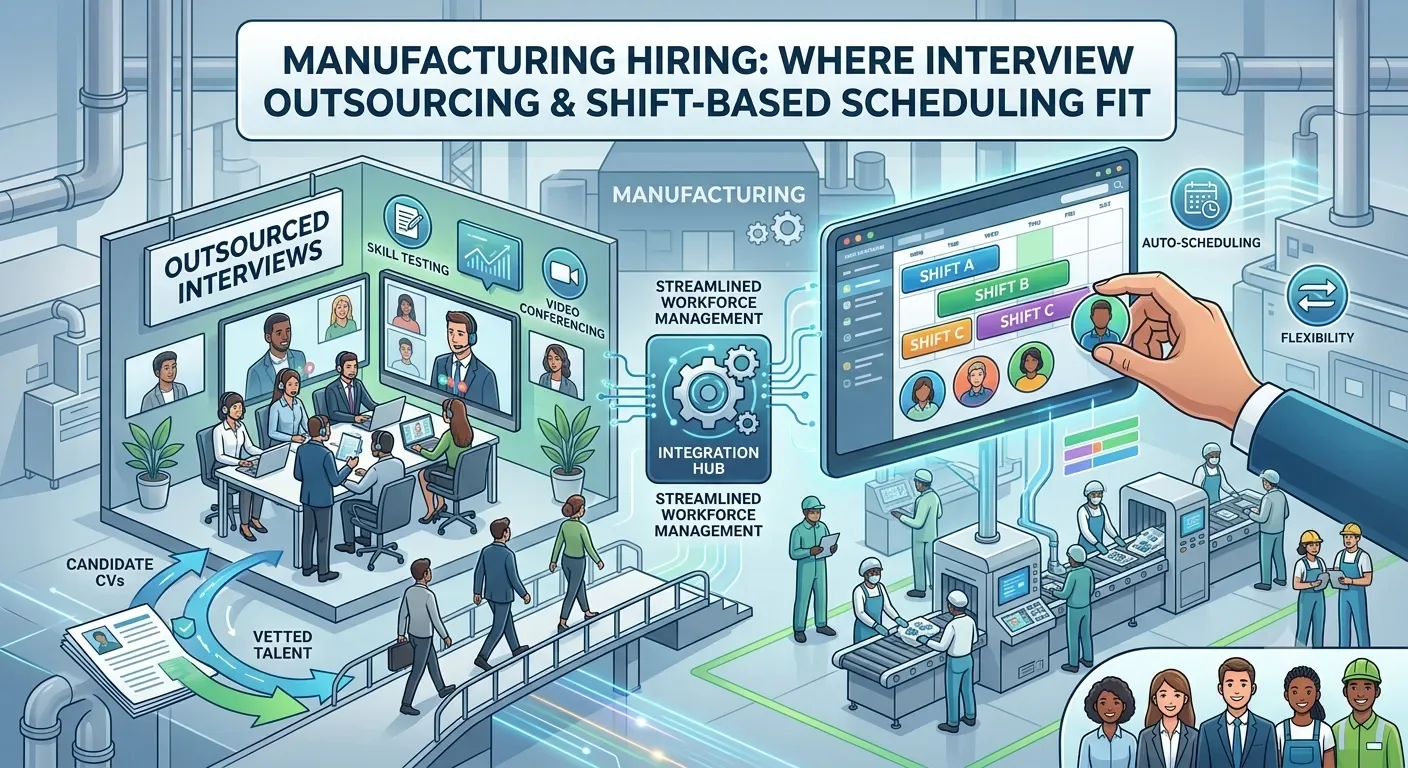
A plant hiring 25 machine operators and 3 automation technicians in the same month has a hiring problem most recruiting software wasn’t built for. The volume is high. Several roles need genuinely verified technical skill, not just a resume claim, and the workforce runs on shifts, not a 9-to-5 calendar. Generic ATS platforms can hold the applications. They don’t verify whether a candidate can actually run the automation line. They don’t make scheduling around a rotating shift pattern any easier either.
Why Manufacturing Hiring Breaks Generic Recruiting Software
Most recruiting software assumes a fairly standard hiring pattern. A candidate applies, a recruiter reviews the resume, and an interview gets scheduled within normal business hours. Manufacturing hiring often doesn’t fit that pattern on either end.
On one end, roles like automation technicians, machine operators, and production engineers require real, demonstrable technical skill. A resume can claim familiarity with PLC programming or automated line troubleshooting. Whether that’s actually true only shows up when someone is asked to demonstrate it.
On the other end, plants typically run multiple shifts across one or more locations. A large share of candidates for production-line roles already work shift schedules themselves, which makes standard daytime interview slots genuinely hard to fill.
InCruiter’s manufacturing hiring solutions page names both problems directly. It’s the same underlying pattern InCruiter has already documented in healthcare hiring high volume, shift-based availability, and a skill-verification gap generic tools don’t solve.
Verifying Real Skill, Not Just a Resume
For technical and automation roles, the interview stage carries more weight than it does for most hiring. A production engineer might be hired on the strength of a well-written resume. If they can’t actually troubleshoot an automated line, that’s a far more expensive mistake than a slow time-to-fill.
This is where outsourced technical interviewing fits. Internal staff don’t have to build and run technical assessments for every hiring wave. InCruiter states that its IncServe offering brings in AI-driven, structured assessments built for exactly this kind of industry-specific screening.
One specific capability worth calling out: InCruiter’s platform includes a real-time coding-challenge feature. It’s aimed at automation, machine-operation, and production-systems roles specifically, not just generic software-engineering screens. That’s a narrow, verifiable claim from InCruiter’s own product page, not an independently audited benchmark. It’s still a genuine match for a problem competing ATS content doesn’t address at all, since skills verification isn’t an ATS feature.
Picture a plant that needs to fill 8 automation technician roles before a new production line goes live in two months. Posting the role and collecting 120 applications isn’t the hard part. The hard part is confirming which of those 120 candidates can actually configure and troubleshoot the equipment. That’s what determines whether the line launches on schedule, or with an expensive skills gap on day one.
This matters most during expansion or a new-line rollout. Internal engineering staff are already stretched thin running the current operation. They have no spare time to build and administer technical interviews for a hiring surge on top of that.
Why Shift Patterns Make Scheduling Harder Here
Even when skill verification isn’t the bottleneck, getting a shift-working candidate onto an interview calendar often is. A candidate on a rotating or overnight shift can’t take a standard mid-morning interview slot. Manually coordinating around that for dozens of candidates a month, often across more than one plant location, eats real recruiter time.
InCruiter states that its IncFeed scheduling tool coordinates interview scheduling around shifts and time zones and sends automated reminders to reduce no-shows. For a manufacturer hiring across multiple sites, that coordination problem compounds with each additional location, not just each additional candidate.
The two problems reinforce each other. A candidate who’s hard to schedule and slow to get through a skills assessment carries real risk of accepting another offer. That risk is higher still in a tight labor market for skilled trades. Fixing only one half better scheduling without real skill verification, or the reverse leaves the other half fully in place.
What to Actually Look For, Not a Full ATS
Say your applicant pipeline already works, and the bottleneck sits at the interview and assessment stage. The right fix is narrower than replacing your ATS or HRIS. A few concrete things to check:
- Does the assessment actually test the specific skill the role needs automation, PLC programming, machine operation rather than a generic technical-aptitude quiz?
- Does the scheduling tool genuinely handle shift patterns and multiple locations, not just standard business-hours slots?
- Can outsourced technical interviewing scale up temporarily for a hiring surge or new-line launch, and scale back down afterward, without a long-term commitment?
- Does it integrate with the ATS and HRIS you already use, rather than trying to replace the parts of them that already work?
Getting this distinction right matters. A full platform replacement to fix an interview-stage skill-verification gap is expensive and slow to roll out. A narrow interview-outsourcing or assessment tool won’t fix a genuine sourcing shortage either. Being specific about which problem you actually have determines which fix is worth buying.
The applicant volume is rarely the hard part in manufacturing hiring plants know how to post a role and get responses. The hard part is confirming which candidates can actually do the work. It’s also getting them onto a calendar that doesn’t assume everyone works a standard day shift.
Frequently asked questions
Why is manufacturing hiring different from hiring in other industries?
It combines high volume, shift-based candidate availability, and roles where verifying real technical or automation skill matters more than usual. A resume claim and a demonstrated skill aren’t the same thing, and the gap between them is expensive to discover after hiring.
How do you verify real technical skill instead of relying on a resume?
Structured, role-specific assessments test whether a candidate can actually do the work, rather than how well they describe it. That includes real-time coding or configuration challenges for automation and production-systems roles specifically.
How does shift-based scheduling affect manufacturing interviews specifically?
Many candidates for production-line and technical roles already work shift schedules themselves. Manufacturers also often hire across multiple plant locations with different shift patterns, and scheduling tools built for standard business hours don’t handle that coordination well.
Do I need a full ATS, or something more specific to interviewing and assessment?
It depends on where your actual bottleneck sits. If applications are piling up unreviewed, that’s a sourcing or ATS problem. If applications get reviewed but verifying skill and scheduling interviews is the slow part, that’s the narrower problem interview outsourcing and shift-aware scheduling address.
Ready to Transform Your Hiring Process?
Discover how our AI-powered interview platform can streamline your recruitment and find the best candidates faster.
Make Your Hiring Process Smart and Fast