




Key Takeaways
- AI-assisted interview cheating is increasing in remote hiring, with candidates using tools like ChatGPT, coding assistants, hidden earpieces, and deepfake technology to generate answers during live interviews.
- Remote interviews make cheating easier, because candidates control their environment, devices, and screens without direct supervision.
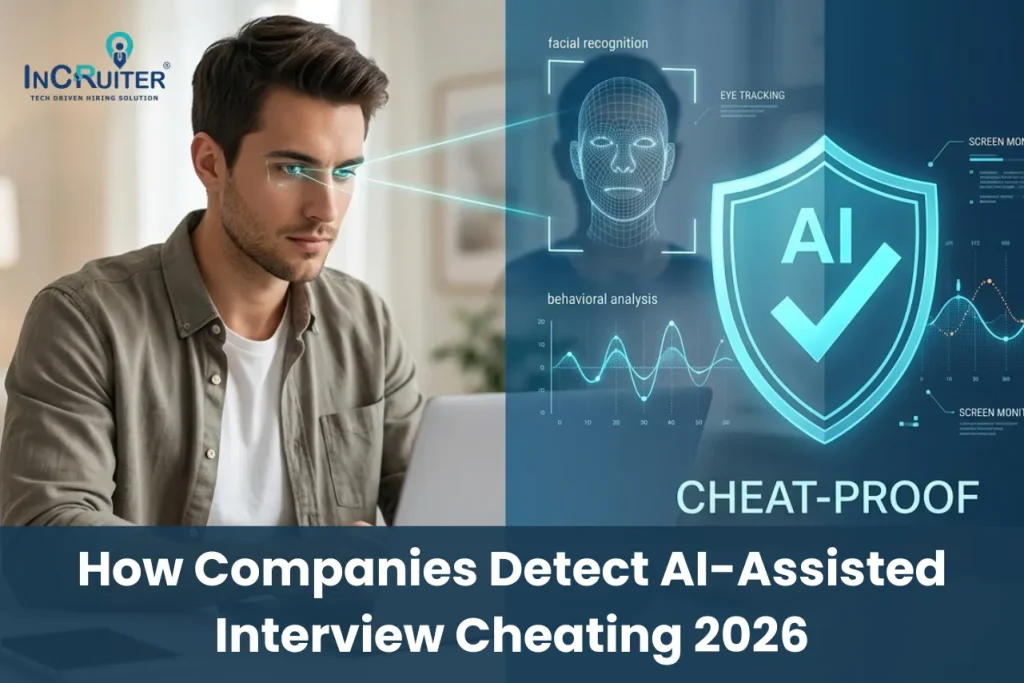
- Companies detect AI interview cheating using multiple signals, including eye-gaze tracking, screen monitoring, response timing analysis, and behavioral biometrics.
- AI-powered proctoring software analyzes candidate behavior in real time, identifying suspicious activities such as second-screen usage, unusual response speed, or external audio input.
- Identity verification and liveness detection help prevent impersonation, ensuring that the candidate attending the interview matches the original applicant.
- Behavioral analytics can reveal AI-generated responses, as AI answers often appear unusually structured, fast, and consistent compared to natural human responses.
- Recruiters are also adopting structured interview techniques, such as follow-up questions and real-time problem solving, to reduce the effectiveness of AI-assisted cheating.
- The future of interview integrity will rely on multimodal detection, combining video, audio, behavioral, and device-level signals to accurately detect interview fraud.
- Organizations that adopt AI interview monitoring tools early will reduce hiring risks, improve candidate authenticity, and maintain fair hiring processes.
Hiring used to be pretty straightforward, but things got complicated fast. Now that remote interviews are everywhere, recruiters have a new problem: candidates are using AI to cheat. This isn’t some distant threat it’s happening all over. People feed AI-generated answers through earpieces, use apps to clone their voice or even manipulate their video feed so they look and sound like someone else. They’re cheating in real time, and it’s not just entry-level jobs. Even senior positions see this kind of trickery.
For recruiters and HR pros, it’s a nightmare. They think they’re judging a candidate’s skills, but sometimes, all they’re seeing is how cleverly someone set up their AI helper. The gap between interview performance and actual job skills has always been there but AI just blasted it wide open.
This guide pulls back the curtain on how AI interview cheating works, why old-school detection methods fail, and what companies can do about it without treating honest candidates like criminals.
The Rise of AI Interview Cheating in Remote Hiring
So, how did we get here? Remote hiring took off big time between 2020 and 2024. Video interviews flipped from backup plan to standard operating procedure. That shift didn’t just make life easier for job hunters; it opened the door to people who wanted to game the system.
Look at the numbers. According to LinkedIn’s Talent Trends, over 60% of companies now handle most interviews remotely. Gartner’s 2024 survey found nearly 58% of organizations use AI tools in their own hiring process so both sides are getting smarter, but not always transparent. In a 2023 HireVue survey, more than 85% of HR leaders said they worried about candidates cheating during virtual interviews. Tools like Interview Coder and Parakeet AI now have hundreds of thousands of users, and some even brag that interviewers won’t notice.
In short, remote interview cheating isn’t a rare exception anymore. Smart organizations recognize it as a real risk and are building detection into their hiring playbooks.
What Is AI-Assisted Interview Cheating? (And Why It’s Getting Worse)
Here’s what AI-assisted interview cheating actually looks like: candidates use technology during interviews to give themselves an edge without the interviewer knowing. Forget sticky notes. These tools are much sneakier.
Check out some of the tricks:
- Candidates use a hidden second monitor loaded with AI answers.
- They pump questions into ChatGPT right from their phone or another device.
- Earpieces feed AI-generated answers quietly into their ear.
- Deepfake video overlays replace the live feed with something pre-recorded or AI-generated.
- Extensions like Interview Coder or Parakeet AI put answers right in front of candidates during live sessions.
This isn’t just a theory a Google engineer was recently caught using an AI assistant in a live coding interview. That kind of move is almost normal now.
The bottom line: AI interview cheating isn’t just a headache for recruiters, it’s reshaping how companies think about hiring, and the old ways of spotting fraud just don’t cut it anymore.
Real Examples of AI Interview Cheating Across Job Types
If you want to spot interview cheating early, you’ve got to understand how it actually happens. Here’s how recruiters are running into AI-powered fraud across all sorts of jobs.
AI Cheating in Coding Interviews
This is the most infamous arena for AI cheating. Candidates quietly run AI tools in the background, have them transcribe the coding prompt, and get a finished solution almost instantly. Then, they just paste the code, maybe tweak a variable or two, but that’s it.
Early in 2025, CNBC told the story of a Google engineer who leaned on an AI coding assistant right in the middle of a live interview. The news caught fire and developers everywhere started questioning if coding interviews were even meaningful anymore.
Why’s it so slippery? Well, candidates can review the AI-generated code and explain it convincingly. Unless the interviewer digs deeper with follow-up questions, this trick slips through a lot of the time.
AI Cheating in Customer Support and Behavioral Interviews
It’s not just technical roles. In customer support or behavioral interviews, people use AI chatbots for crisp, organized answers to those classic “Tell me about a time when…” questions. The results? Answers more polished than the candidate could muster naturally, making them look like communication pros. Once hired, though, the gap shows they struggle to perform anywhere near that level.
Candidate Impersonation in Remote Developer Role Interviews
Remote developer roles are competitive and high-stakes, so impersonation is on the rise. Candidates pay proxies to sit the interview, use video spoofing, or share accounts to dodge detection. Hiring platforms say impersonation has exploded since 2022. Some companies find their new hires can’t even pass basic competency checks after a month.
The Pattern That Links Every Case of AI Interview Fraud
Across every scenario, there’s a glaring gap: candidates ace interviews using AI, then flop on the job. Catching AI cheating before you make that offer saves you a ton in wasted training, onboarding, and rehiring.
Why Old-School Detection Methods Fail Against AI Interview Fraud?
In-person interviews had built-in safeguards, body language, eye contact, and that room energy. Remote interviews? Most of those signals are gone.
On video calls, candidates control everything: camera angle, lighting, what’s in the background. They’re free to run whatever apps they want; most video platforms don’t see what else is going on.
Asking directly if someone used AI isn’t a strategy; cheaters won’t just fess up. Banning AI tools is nearly impossible unless you’ve got real software in place.
Gartner’s analysis says that if you don’t have a structured AI interview fraud detection process, you’re exposed especially in remote developer roles where AI tools are running wild.
That’s why companies are moving to specialized tech for catching AI cheating.
How Companies Detect AI Interview Cheating Today?
Modern proctoring software is smart. It looks at behavior, surroundings, and uses AI to spot anything odd in real time.
Here’s what top platforms scan for:
Eye Gaze Tracking to Detect AI Answer Reading
Where you look tells a story. If your eyes keep darting away (maybe at a second screen), that’s not how you’d normally think through a problem. Proctors monitor those tiny movements.
Screen Activity Monitoring for Unauthorized AI Tools
Some tools require you to share your screen or monitor your browser. They sniff out extra tabs, apps, or browser extensions that help candidates cheat.
Audio Analysis to Catch Earpiece-Assisted Cheating
AI-driven tools can pick up faint earpiece sounds, background typing, or unnatural pause signs someone’s listening to AI advice and then parroting it.
Response Timing Analysis to Flag AI-Generated Answers
Real candidates pause, stumble, self-correct. AI-assisted answers pop out fast and polished. Behavioral tools track how quickly and smoothly answers arrive to spot “too perfect” responses.
Facial and Environmental Detection During Remote Interviews
Proctoring flags when someone keeps leaving the frame, if multiple people show up, or if lighting shifts (which can mean another screen just turned on).
Device and Network Analysis to Identify Hidden AI Setups
Advanced systems notice multiple devices connected, weird IP setups, or candidates using virtual machinesall common setups for running AI tools in secret.
How AI Interview Platforms Help Fight Remote Interview Cheating?
AI interview platforms now go way beyond basic Q&A they constantly watch integrity signals while the session runs.
Unlike human interviewers, who can only see what’s on camera, these platforms analyze dozens of behaviors at once. They generate risk scores for each session, flagging moments for recruiters to review instead of guessing.
This matters most for:
- High-volume hiring (can’t manually review every session)
- Technical assessments (where coached answers skew results)
- Early screening rounds (most likely to see AI-powered cheating)
Behavioral Biometrics: The Science Behind Detecting AI Cheating in Interviews
One super effective method is behavioral biometrics. It’s not about what the candidate says, but how they say it.
Examples include:
- Keystroke rhythm: Oddly fast or choppy typing during written tasks.
- Speech pattern analysis: Robotic or templated delivery typical of AI content.
- Consistency checks: Follow-up questions reveal gaps that AI tools gloss over.
- Micro-expression monitoring: Tiny facial movements that signal reading vs. thinking.
All these signals together paint a clearer picture than a single interview can.
Interview Scheduling and Workflow: Your First Line of Defense Against AI Fraud
Keeping interviews honest starts way before they go live. At the scheduling stage, good software verifies identity to ensure the applicant matches the person on camera.
That means:
- ID check during booking: Candidates submit a valid ID before confirmation.
- Liveness check: Software confirms it’s a live feed, not a recording.
- Randomized interview timing: Makes prepping AI scripts much harder.
Catch the fraud before it gets rolling.
Why Detecting AI Interview Cheating Is Still a Challenge?
With all these defenses, AI interview fraud keeps getting trickier to spot. Why?
- Tools are evolving fast. Detection tech that works today could be outdated tomorrow.
- False positives happen. Anxiety, slow internet, or language barriers can mimic cheating signals. Bad calibration punishes genuine candidates.
- Legal hurdles exist. Some places require strict consent for screen recording or biometric data.
- Policies aren’t clear. Without a formal AI integrity policy, even when fraud gets flagged, teams don’t always know what to do.
Bottom line: technology isn’t enough. You need solid tools and clear policies.
Best Practices for Recruiters to Prevent AI-Assisted Interview Cheating
There’s practical stuff HR teams can do to boost interview integrity:
- Clarify your AI policy: Spell out what’s allowed and what’s not.
- Use proctored platforms: Don’t just rely on video calls; use tech that monitors behavior.
- Ask follow-up questions: Dynamic questions trip up AI tools.
- Verify identity more than once: Cross-check application info, ID, and live video.
- Score behavioral signals: Don’t focus only on contentassess authenticity, too.
- Train your interviewers: Make sure humans know what tech-assisted cheating looks like.
AI Interview Cheating vs Traditional Interview Fraud
| Factor | Traditional Interview Cheating | AI Interview Cheating |
| Tools Used | Notes, external help | AI assistants, ChatGPT |
| Response Speed | Slow | Instant |
| Detection Difficulty | Moderate | High |
| Common Roles | Entry level | Technical roles |
The Future of AI Interview Fraud Detection Technology
The tug-of-war between cheaters and detection tools is ramping up.
Coming soon:
- Multimodal detection: Merging voice, video, keyboard, and behavior into a single risk profile.
- Adaptive interview questions: Systems change questions on the fly to cut through scripted AI answers.
- Blockchain credentials: Permanent skill records for easier verification.
- Federated identity: Multi-platform identity checks to curb impersonation.
Companies investing now will be miles ahead as these shifts pick up speed.
How AI Proctoring Software Helps Prevent Interview Cheating?
Today’s online proctoring software is designed exactly for this: catching AI interview cheating.
Expect:
Automated Risk Scoring Across Every Interview Session
Each session gets real-time analysis, collecting behavioral, gaze, audio, and environmental data. Recruiters get flagged moments, not hours of raw footage.
Full Session Transparency With Timestamped Fraud Logs
Timestamped logs let recruiters jump straight to problem spots, skipping endless recording reviews.
Candidate-Friendly Design That Minimizes False Positives
Good proctoring tools aim to minimize false positives. They tell the difference between genuine nerves and systematic cheating, so honest candidates aren’t penalized unfairly.
Seamless Integration With Your AI Interview and Scheduling Workflow
Top platforms fit right into existing AI interview platforms and interview scheduling software, creating a seamless layer of integrity, no extra friction.
Built to Scale for High-Volume Remote Hiring
Manual fraud detection just doesn’t scale. AI proctoring covers every interview, keeping standards consistent.
Bottom line: The hiring process gets tougher to game, fairer to honest folks, and easier to defend if a hire doesn’t pan out.
Conclusion: Detecting AI Interview Cheating Starts With the Right Tools
AI-aided cheating in interviews isn’t just hype it’s here, and it’s messing with hiring integrity. Honest candidates lose out, and companies end up hiring people who can’t do the job.
But it can be caught. With the right mix of tech, behavioral analysis, identity checks, and clear policy, you can cut your risk way down.
Don’t treat this as a fringe problem. Remote interview cheating is mainstream nowand beating AI cheating means getting serious, upgrading your toolkit, and using platforms built to solve it.
If your team is still relying on gut feelings and regular video calls, you’re probably missing stuff. The good news? Tools are out there, and recruiters using them are seeing the difference.
Frequently Asked Questions About AI Interview Cheating Detection
1. What is AI-assisted interview cheating and how common is it?
AI-assisted interview cheating occurs when a candidate uses AI tools such as real-time answer generators, earpiece assistants, or deepfake video to gain an unfair advantage during a job interview without the interviewer’s knowledge. Its prevalence has grown significantly since 2023. Industry reports from SHRM indicate that interview fraud has risen sharply alongside remote hiring, with recruiters across technical and non-technical roles reporting more suspicious response patterns than ever before.
2. How do companies detect AI cheating in interviews?
Companies detect AI cheating in interviews using a combination of eye gaze tracking, screen activity monitoring, audio analysis, response timing analysis, facial recognition, and behavioral biometrics. Purpose-built online proctoring software automates this process, generating risk scores for each session and flagging specific moments for human review. Some platforms also cross-reference candidate behavior with their application data and prior assessments to identify inconsistencies that suggest AI assistance.
3. Can interview proctoring software tell if a candidate is using ChatGPT?
Proctoring software cannot always detect ChatGPT use directly, but it flags the behavioral signals that come with it unusually fast and polished responses, low hesitation rates, and gaze patterns consistent with reading from a second screen. When combined with follow-up questions and consistency checks across the session, these signals build a strong picture. Most platforms generate a risk score rather than a definitive verdict, leaving final judgment to the recruiter.
4. What are the legal considerations for monitoring candidates during remote interviews?
Legal requirements for remote interview monitoring vary by region. In many jurisdictions, candidates must be explicitly informed and must consent before any screen recording, biometric data collection, or audio analysis begins. HR teams should review local data protection laws including GDPR in Europe and applicable state laws in the US before deploying proctoring tools. Consulting legal counsel before rollout is strongly recommended to avoid compliance risk.
5. How can small companies without enterprise software reduce AI interview fraud?
Smaller teams can reduce AI interview fraud without dedicated proctoring tools by using targeted interview design. Ask open-ended follow-up questions that require contextual reasoning beyond what AI can script. Request screen sharing during technical assessments. Include live problem-solving components with real-time commentary. Use video interviews with basic ID verification at booking. These low-cost steps significantly raise the effort required to cheat and help surface genuine capability gaps.
6. Can AI tools help candidates cheat in coding interviews?
Yes this is one of the most common forms of AI interview fraud today. Tools designed specifically for coding interviews can silently transcribe a problem, generate a working solution, and display it on the candidate’s screen within seconds. Some operate as invisible browser overlays, undetectable by standard video platforms. Recruiters can counter this by asking candidates to explain their code line-by-line, introduce deliberate errors for the candidate to debug, or complete a follow-up problem in a different language or context.
Also Read
How AI Powered Monitoring Exams Work
AI Proctoring: Prevent Interview Fraud in Remote Hiring
Ready to Transform Your Hiring Process?
Discover how our AI-powered interview platform can streamline your recruitment and find the best candidates faster.

Related Blogs
How Does Video Interviewing Work? The Complete Guide for Recruiters in 2026
What Is Video Interview Software? Video interview software is a technology solution designed to facilitate remote job interviews through online video. It encompasses tools for...
Top 10 Best AI interview Software for Hiring in 2026
Work will become optional, we agree entirely with Elon Musk’s words, owner of xAI (Artificial Intelligence). Having witnessed in 2025 that 88% of white-collar jobs,...
Top 5 Real-Time Coding Interview Tools with Built-In Assessments in 2026
Every recruiter’s inbox in 2026 is flooded with AI-polished resumes. But resumes don’t reveal how a developer thinks under pressure a real-time collaborative coding session...
Structured vs Unstructured Interviews: Complete Hiring Guide
Interviews are not just a one-to-one video conference between two individuals. It’s a traditional decision-making tool used to decide people’s intelligence, abilities, and predict how...

Interview Management System: How to Choose the Right Tool For Your Business
This guide helps you choose the perfect interview management system for your business by evaluating key features, integrations, and hiring needs.
Virtual Interviews Explained
InCruiter’s AI-powered video interview platform streamlines hiring with live, recorded, and coding interviews, delivering faster, fairer, and more efficient recruitment.


