




Hiring the right person isn’t luck – it’s a process. Every organization, whether a startup or a Fortune 500 company, follows a structured employee selection process to identify, evaluate, and hire the best-fit candidate for a role. Get it right and you build high-performing teams. Get it wrong and you face costly mis-hires, low morale, and lost productivity.
In this guide, we break down the complete selection process – what it means, every step involved, how it differs across industries, and how modern tools like AI-powered interview platforms are making it faster and more accurate than ever.
What is the Employee Selection Process?
The employee selection process is a systematic series of steps an organization follows to identify and hire the most suitable candidate from a pool of applicants. It is a critical part of staffing in HRM that begins after recruitment ends – once you have applicants, selection begins.
Selection is the process of differentiating between applicants to identify and hire those with the greatest likelihood of success in the job.
The goal is simple: find the right person, for the right role, at the right time — while minimizing bias, cost, and time-to-hire.
Selection vs. Recruitment – What’s the Difference?
| Factor | Recruitment | Selection |
| Purpose | Attract candidates | Choose the best candidate |
| Nature | Positive (inviting) | Eliminative (filtering) |
| Process | Broad | Narrow & structured |
| Output | Pool of applicants | One hired employee |
Why is the Selection Process Important in HRM?
The selection process in HRM is not just an HR formality — it directly impacts business performance. Here’s why it matters:
- Reduces mis-hires — A structured process filters out unqualified or mismatched candidates early
- Saves cost — The cost of a bad hire can be up to 30% of annual salary
- Improves team performance — Right hires contribute faster and stay longer
- Ensures legal compliance — Structured processes reduce hiring bias and discrimination risk
- Strengthens employer brand — A smooth, professional selection experience impresses candidates
The 10 Steps in the Employee Selection Process
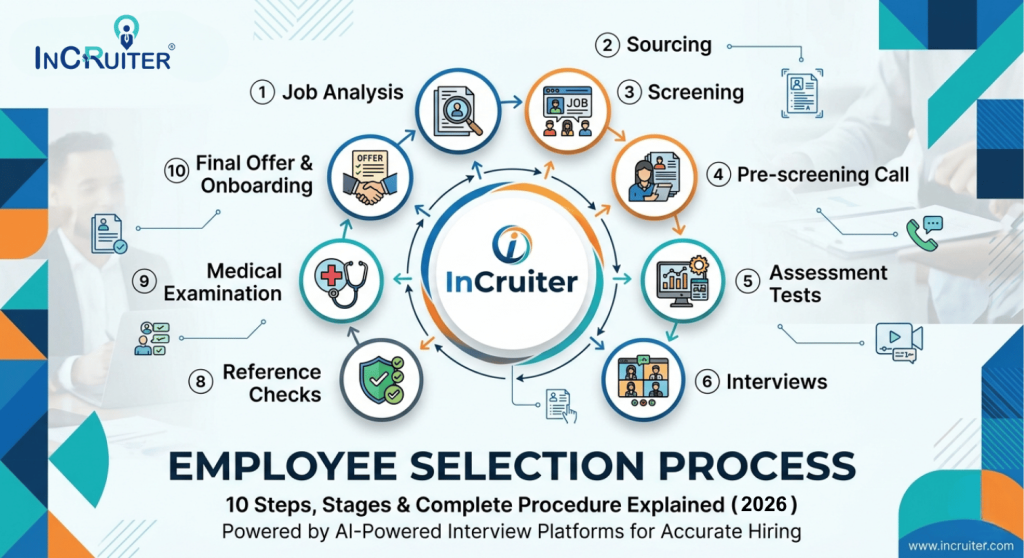
Here is the complete, step-by-step selection process used by HR teams across industries:
Step 1 — Job Analysis & Defining the Role
Before accepting a single application, HR must clearly define what they are hiring for. This is the starting point of the selection process.
This includes:
- Writing a detailed job description — title, responsibilities, KPIs
- Defining must-have vs. nice-to-have qualifications
- Setting salary range, reporting structure, and team fit requirements
Why it matters: Vague job requirements lead to mismatched applicants and wasted interview time. A precise job definition acts as the filter for every subsequent step.
What is a Job Description?
A job description outlines the role title, key duties, required qualifications, skills, experience, and working conditions. It sets expectations for both the employer and the candidate before the process even begins.
Step 2 — Job Application & Candidate Sourcing
Once the role is defined, the job is posted and applications begin flowing in. This is the first active step in the selection process of employees.
Sourcing channels include:
- Company career page
- Job boards (LinkedIn, Naukri, Indeed)
- Employee referrals
- Campus hiring
- Recruitment agencies
Key Tip for 2025
Mobile-optimized job applications are critical — over 86% of job seekers now search and apply for jobs via mobile devices. If your application form isn’t mobile-friendly, you’re losing top talent before the process starts.
Step 3 — Application Screening & Resume Shortlisting
This step involves reviewing all incoming applications to filter out candidates who don’t meet the basic role requirements.
What HR looks for:
- Relevant experience and educational qualifications
- Skill match against the job description
- Career trajectory and stability
- Red flags — unexplained employment gaps, frequent job hopping
Tools used: Applicant Tracking Systems (ATS), AI resume parsers, and keyword-based filters help HR teams screen hundreds of resumes efficiently.
What Happens at This Stage?
Resumes that pass the initial filter are passed to the hiring manager for a secondary review. The hiring manager shortlists candidates who align with team needs and proceeds to the next step.
Step 4 — Screening Calls (Telephonic / Video Pre-screening)
Shortlisted candidates are contacted for an initial screening call — typically 15–30 minutes. This is a quick check before investing time in a full interview.
Topics covered in screening calls:
- Current role and notice period
- Salary expectations
- Basic role-fit questions
- Availability and location
Why it matters: This step eliminates candidates who are misaligned on expectations — saving hours of full interview time for both sides.
Step 5 — Assessment Tests & Skill Evaluations
Candidates who pass the screening call are asked to complete assessment tests relevant to the role. This is one of the most critical steps in the selection process.
Types of assessments used:
Cognitive & Aptitude Tests
Measure logical reasoning, numerical ability, and verbal skills — useful for analytical roles.
Technical / Skills Tests
Role-specific tasks — coding challenges for developers, writing samples for content roles, case studies for consulting positions.
Personality & Behavioural Assessments
Tools like DISC or MBTI help evaluate how a candidate thinks, works in teams, and handles pressure.
Situational Judgement Tests (SJTs)
Present real-world workplace scenarios and evaluate how candidates respond — widely used in management hiring.
Step 6 — Interviews (Structured Panel & Video Interviews)
The interview is the most critical and visible step in the entire selection process. It’s where candidates are evaluated in real-time on their skills, communication, cultural fit, and role suitability.
Types of interviews in the selection process:
Structured Interviews
Every candidate is asked the same set of pre-defined questions — making evaluation consistent, fair, and comparable. Structured interviews are proven to be 2x more predictive of job performance than unstructured ones.
Behavioural Interviews
Based on the premise that past behaviour predicts future performance. Questions follow the STAR format (Situation, Task, Action, Result).
Example: “Tell me about a time you managed a challenging deadline.”
Technical Interviews
Especially common in IT, engineering, and finance — designed to assess domain expertise through problem-solving, coding, or case-based questions.
Panel Interviews
Multiple interviewers evaluate a candidate simultaneously — reducing individual bias and getting diverse perspectives.
Video Interviews
Remote hiring has made video interviews a standard step. AI-powered platforms like InCruiter enable structured video interviews with expert interviewers, real-time feedback, and bias-free evaluation — reducing time-to-hire by up to 40%.
Step 7 — Background Verification
A background check is an essential protective step before making an offer. It verifies that the candidate’s claims are accurate and flags any potential risks.
What background checks cover:
- Criminal record check
- Employment history verification
- Educational qualification verification
- Credit history (for finance roles)
- Social media profile review
2025 Data Point: 85% of employers now review candidates’ social media profiles as part of background screening.
Step 8 — Reference Checks
Reference checks involve contacting the candidate’s former managers or colleagues to validate their work history, performance, and character.
Key questions asked in reference checks:
- How did the candidate perform in their previous role?
- What are their key strengths and areas for improvement?
- Would you rehire this person?
- How did they handle pressure and conflict?
Pro tip: Always speak to direct managers — not just colleagues — for the most relevant insights.
Step 9 — Medical Examination
For certain roles — especially in manufacturing, healthcare, government, or physically demanding environments — a pre-employment medical examination is a required step.
Medical checks typically include:
- Physical fitness examination
- Drug and substance screening
- Psychological or mental fitness evaluation (for high-stress roles)
This step ensures the candidate is physically and mentally capable of performing the job safely and effectively.
Step 10 — Final Decision, Job Offer & Onboarding
The final step in the selection process is making the hiring decision and extending a formal job offer.
The Final Decision
Based on all the data collected — assessments, interview scores, background checks, references — the hiring team makes a collective decision on the best candidate.
The Job Offer Letter
The offer letter is a formal document that includes:
- Job title and department
- Compensation and benefits package
- Start date and work location
- Reporting structure
- Terms and conditions of employment
Both parties sign the offer letter, and the candidate is officially hired.
Onboarding — The Bridge Between Selection and Performance
Onboarding is the final bridge in the employee selection journey. A structured onboarding programme ensures new hires integrate smoothly, understand company culture, and reach full productivity faster.
The 5 C’s of Onboarding:
- Clarity — Clear role expectations
- Compliance — Legal and policy orientation
- Culture — Understanding company values and norms
- Connection — Building relationships with team
- Check-In — Regular feedback in the first 90 days
Selection Process in HRM — Class 12 Definition
For students studying Business Studies or HRM at Class 12 level:
Definition: Selection is the process of choosing the most suitable candidates from those who have applied for a job. It involves a series of steps to eliminate unsuitable candidates at each stage, until the most appropriate person is identified.
Selection in HRM is part of the staffing function and follows recruitment. The selection procedure in management involves both objective tools (tests, background checks) and subjective evaluation (interviews).
Selection Process in Staffing — Key Stages
The selection process in staffing follows these broad stages:
Stage 1 — Preliminary Screening: Application review and initial shortlisting Stage 2 — Testing & Assessment: Skills and aptitude evaluation Stage 3 — Interviewing: Structured, behavioural, and technical interviews Stage 4 — Verification: Background and reference checks Stage 5 — Final Selection: Decision, offer, and onboarding
Factors That Influence the Employee Selection Process
The process of selection of employees is usually influenced by several internal and external factors:
Internal Factors:
- Organizational size and structure
- Budget and hiring timeline
- Internal promotion policies
- Role seniority and criticality
External Factors:
- Labour market conditions
- Industry competition for talent
- Legal and compliance requirements
- Economic environment
Selection Process in Management vs. HRM — Is There a Difference?
In management, the selection process focuses on choosing candidates who align with organizational goals and leadership competencies. In HRM, the selection process is more structured, process-driven, and compliance-focused.
Both follow the same core steps — but HRM adds layers of documentation, compliance checks, and structured evaluation frameworks that management-level hiring may bypass in smaller organizations.
How AI is Transforming the Employee Selection Process in 2025
Modern hiring is no longer purely human-driven. AI is reshaping every step of the selection process:
- Resume screening — AI parses thousands of resumes in seconds
- Scheduling — Automated interview scheduling reduces back-and-forth by 80%
- Video interviews — AI-powered platforms conduct and evaluate structured interviews
- Bias reduction — Structured, data-driven evaluation removes unconscious bias
- Predictive analytics — AI predicts candidate success based on historical hiring data
InCruiter’s AI-powered interview platform combines expert human interviewers with AI evaluation tools — giving you structured, consistent, and bias-free interviews at scale. Companies using InCruiter have reduced time-to-hire by up to 40% while improving quality of hire.
Common Mistakes to Avoid in the Selection Process
Even experienced HR teams make these costly mistakes:
- Skipping structured interviews — Unstructured conversations introduce bias and inconsistency
- Ignoring cultural fit — Skills can be trained; values alignment is harder to fix
- Rushing the process — Pressure to fill roles leads to poor decisions
- Neglecting candidate experience — A slow, disorganized process damages employer brand
- Not verifying references — Skipping this step leaves critical information gaps
- Over-relying on gut feel — Data and structured tools should drive final decisions
H2: What is the Employee Selection Process?
The employee selection process is a systematic series of steps an organization follows to identify and hire the most suitable candidate from a pool of applicants. It is a critical part of staffing in HRM that begins after recruitment ends — once you have applicants, selection begins.
Selection is the process of differentiating between applicants to identify and hire those with the greatest likelihood of success in the job.
The goal is simple: find the right person, for the right role, at the right time — while minimizing bias, cost, and time-to-hire.
H3: Selection vs. Recruitment — What’s the Difference?
| Factor | Recruitment | Selection |
| Purpose | Attract candidates | Choose the best candidate |
| Nature | Positive (inviting) | Eliminative (filtering) |
| Process | Broad | Narrow & structured |
| Output | Pool of applicants | One hired employee |
H2: Why is the Selection Process Important in HRM?
The selection process in HRM is not just an HR formality — it directly impacts business performance. Here’s why it matters:
- Reduces mis-hires — A structured process filters out unqualified or mismatched candidates early
- Saves cost — The cost of a bad hire can be up to 30% of annual salary
- Improves team performance — Right hires contribute faster and stay longer
- Ensures legal compliance — Structured processes reduce hiring bias and discrimination risk
- Strengthens employer brand — A smooth, professional selection experience impresses candidates
H2: The 10 Steps in the Employee Selection Process
Here is the complete, step-by-step selection process used by HR teams across industries:
H3: Step 1 — Job Analysis & Defining the Role
Before accepting a single application, HR must clearly define what they are hiring for. This is the starting point of the selection process.
This includes:
- Writing a detailed job description — title, responsibilities, KPIs
- Defining must-have vs. nice-to-have qualifications
- Setting salary range, reporting structure, and team fit requirements
Why it matters: Vague job requirements lead to mismatched applicants and wasted interview time. A precise job definition acts as the filter for every subsequent step.
H4: What is a Job Description?
A job description outlines the role title, key duties, required qualifications, skills, experience, and working conditions. It sets expectations for both the employer and the candidate before the process even begins.
H3: Step 2 — Job Application & Candidate Sourcing
Once the role is defined, the job is posted and applications begin flowing in. This is the first active step in the selection process of employees.
Sourcing channels include:
- Company career page
- Job boards (LinkedIn, Naukri, Indeed)
- Employee referrals
- Campus hiring
- Recruitment agencies
H4: Key Tip for 2025
Mobile-optimized job applications are critical — over 86% of job seekers now search and apply for jobs via mobile devices. If your application form isn’t mobile-friendly, you’re losing top talent before the process starts.
H3: Step 3 — Application Screening & Resume Shortlisting
This step involves reviewing all incoming applications to filter out candidates who don’t meet the basic role requirements.
What HR looks for:
- Relevant experience and educational qualifications
- Skill match against the job description
- Career trajectory and stability
- Red flags — unexplained employment gaps, frequent job hopping
Tools used: Applicant Tracking Systems (ATS), AI resume parsers, and keyword-based filters help HR teams screen hundreds of resumes efficiently.
H4: What Happens at This Stage?
Resumes that pass the initial filter are passed to the hiring manager for a secondary review. The hiring manager shortlists candidates who align with team needs and proceeds to the next step.
H3: Step 4 — Screening Calls (Telephonic / Video Pre-screening)
Shortlisted candidates are contacted for an initial screening call — typically 15–30 minutes. This is a quick check before investing time in a full interview.
Topics covered in screening calls:
- Current role and notice period
- Salary expectations
- Basic role-fit questions
- Availability and location
Why it matters: This step eliminates candidates who are misaligned on expectations — saving hours of full interview time for both sides.
H3: Step 5 — Assessment Tests & Skill Evaluations
Candidates who pass the screening call are asked to complete assessment tests relevant to the role. This is one of the most critical steps in the selection process.
Types of assessments used:
H4: Cognitive & Aptitude Tests
Measure logical reasoning, numerical ability, and verbal skills — useful for analytical roles.
H4: Technical / Skills Tests
Role-specific tasks — coding challenges for developers, writing samples for content roles, case studies for consulting positions.
H4: Personality & Behavioural Assessments
Tools like DISC or MBTI help evaluate how a candidate thinks, works in teams, and handles pressure.
H4: Situational Judgement Tests (SJTs)
Present real-world workplace scenarios and evaluate how candidates respond — widely used in management hiring.
H3: Step 6 — Interviews (Structured Panel & Video Interviews)
The interview is the most critical and visible step in the entire selection process. It’s where candidates are evaluated in real-time on their skills, communication, cultural fit, and role suitability.
Types of interviews in the selection process:
H4: Structured Interviews
Every candidate is asked the same set of pre-defined questions — making evaluation consistent, fair, and comparable. Structured interviews are proven to be 2x more predictive of job performance than unstructured ones.
H4: Behavioural Interviews
Based on the premise that past behaviour predicts future performance. Questions follow the STAR format (Situation, Task, Action, Result).
Example: “Tell me about a time you managed a challenging deadline.”
H4: Technical Interviews
Especially common in IT, engineering, and finance — designed to assess domain expertise through problem-solving, coding, or case-based questions.
H4: Panel Interviews
Multiple interviewers evaluate a candidate simultaneously — reducing individual bias and getting diverse perspectives.
H4: Video Interviews
Remote hiring has made video interviews a standard step. AI-powered platforms like InCruiter enable structured video interviews with expert interviewers, real-time feedback, and bias-free evaluation — reducing time-to-hire by up to 40%.
H3: Step 7 — Background Verification
A background check is an essential protective step before making an offer. It verifies that the candidate’s claims are accurate and flags any potential risks.
What background checks cover:
- Criminal record check
- Employment history verification
- Educational qualification verification
- Credit history (for finance roles)
- Social media profile review
2025 Data Point: 85% of employers now review candidates’ social media profiles as part of background screening.
H3: Step 8 — Reference Checks
Reference checks involve contacting the candidate’s former managers or colleagues to validate their work history, performance, and character.
Key questions asked in reference checks:
- How did the candidate perform in their previous role?
- What are their key strengths and areas for improvement?
- Would you rehire this person?
- How did they handle pressure and conflict?
Pro tip: Always speak to direct managers — not just colleagues — for the most relevant insights.
H3: Step 9 — Medical Examination
For certain roles — especially in manufacturing, healthcare, government, or physically demanding environments — a pre-employment medical examination is a required step.
Medical checks typically include:
- Physical fitness examination
- Drug and substance screening
- Psychological or mental fitness evaluation (for high-stress roles)
This step ensures the candidate is physically and mentally capable of performing the job safely and effectively.
H3: Step 10 — Final Decision, Job Offer & Onboarding
The final step in the selection process is making the hiring decision and extending a formal job offer.
H4: The Final Decision
Based on all the data collected — assessments, interview scores, background checks, references — the hiring team makes a collective decision on the best candidate.
H4: The Job Offer Letter
The offer letter is a formal document that includes:
- Job title and department
- Compensation and benefits package
- Start date and work location
- Reporting structure
- Terms and conditions of employment
Both parties sign the offer letter, and the candidate is officially hired.
H4: Onboarding — The Bridge Between Selection and Performance
Onboarding is the final bridge in the employee selection journey. A structured onboarding programme ensures new hires integrate smoothly, understand company culture, and reach full productivity faster.
The 5 C’s of Onboarding:
- Clarity — Clear role expectations
- Compliance — Legal and policy orientation
- Culture — Understanding company values and norms
- Connection — Building relationships with team
- Check-In — Regular feedback in the first 90 days
H2: Selection Process in HRM — Class 12 Definition
For students studying Business Studies or HRM at Class 12 level:
Definition: Selection is the process of choosing the most suitable candidates from those who have applied for a job. It involves a series of steps to eliminate unsuitable candidates at each stage, until the most appropriate person is identified.
Selection in HRM is part of the staffing function and follows recruitment. The selection procedure in management involves both objective tools (tests, background checks) and subjective evaluation (interviews).
H2: Selection Process in Staffing — Key Stages
The selection process in staffing follows these broad stages:
Stage 1 — Preliminary Screening: Application review and initial shortlisting Stage 2 — Testing & Assessment: Skills and aptitude evaluation Stage 3 — Interviewing: Structured, behavioural, and technical interviews Stage 4 — Verification: Background and reference checks Stage 5 — Final Selection: Decision, offer, and onboarding
H2: Factors That Influence the Employee Selection Process
The process of selection of employees is usually influenced by several internal and external factors:
Internal Factors:
- Organizational size and structure
- Budget and hiring timeline
- Internal promotion policies
- Role seniority and criticality
External Factors:
- Labour market conditions
- Industry competition for talent
- Legal and compliance requirements
- Economic environment
H2: Selection Process in Management vs. HRM — Is There a Difference?
In management, the selection process focuses on choosing candidates who align with organizational goals and leadership competencies. In HRM, the selection process is more structured, process-driven, and compliance-focused.
Both follow the same core steps — but HRM adds layers of documentation, compliance checks, and structured evaluation frameworks that management-level hiring may bypass in smaller organizations.
H2: How AI is Transforming the Employee Selection Process in 2025
Modern hiring is no longer purely human-driven. AI is reshaping every step of the selection process:
- Resume screening — AI parses thousands of resumes in seconds
- Scheduling — Automated interview scheduling reduces back-and-forth by 80%
- Video interviews — AI-powered platforms conduct and evaluate structured interviews
- Bias reduction — Structured, data-driven evaluation removes unconscious bias
- Predictive analytics — AI predicts candidate success based on historical hiring data
InCruiter’s AI-powered interview platform combines expert human interviewers with AI evaluation tools — giving you structured, consistent, and bias-free interviews at scale. Companies using InCruiter have reduced time-to-hire by up to 40% while improving quality of hire.
H2: Common Mistakes to Avoid in the Selection Process
Even experienced HR teams make these costly mistakes:
- Skipping structured interviews — Unstructured conversations introduce bias and inconsistency
- Ignoring cultural fit — Skills can be trained; values alignment is harder to fix
- Rushing the process — Pressure to fill roles leads to poor decisions
- Neglecting candidate experience — A slow, disorganized process damages employer brand
- Not verifying references — Skipping this step leaves critical information gaps
- Over-relying on gut feel — Data and structured tools should drive final decisions
Conclusion — Build Your Best Team with a Structured Selection Process
The employee selection process is not a formality — it is one of the most strategic activities an organization undertakes. Every step, from defining the role to signing the offer letter, plays a critical role in ensuring you hire someone who will perform, stay, and contribute.
Whether you are an HR professional managing hundreds of roles or a startup founder hiring your first team, following a structured, data-driven selection procedure eliminates guesswork and dramatically improves hiring outcomes.
InCruiter helps organizations run structured, AI-powered interviews at scale — with expert interviewers, real-time feedback, and bias-free evaluations — so every hiring decision is backed by data, not gut feel.
Frequently Asked Questions (FAQs)
What is the selection process in HRM?
The selection process in HRM is a structured sequence of steps used to evaluate and choose the most suitable candidate from a pool of applicants. It typically includes application screening, interviews, assessments, background checks, and a final job offer.
What are the steps involved in the selection process?
The steps involved in the selection process are: job analysis, job application, application screening, screening calls, assessment tests, interviews, background verification, reference checks, medical examination, and final job offer.
What is the first step in the selection process?
The first step in the selection process is job analysis and defining the role — this includes writing the job description and setting the qualification criteria before accepting any applications.
What is the starting point of the selection process?
The starting point of the selection process is receipt of applications, which begins after the recruitment phase produces a pool of interested candidates.
What are the stages of the selection process?
The key stages of the selection process are: preliminary screening, testing and assessment, interviewing, background and reference verification, and final selection with job offer.
What is selection in staffing?
Selection in staffing refers to the procedure of choosing the right candidates from those recruited to fill open positions. It is a core function of the staffing process in HRM.
How do HR professionals select candidates?
HR professionals select candidates by reviewing applications, conducting structured interviews, administering skill assessments, checking backgrounds and references, and making a final data-driven hiring decision in collaboration with the hiring manager.
What is the difference between recruitment and selection?
Recruitment is the process of attracting candidates to apply for a job. Selection is the process of evaluating those candidates and choosing the best one. Recruitment is positive and inclusive; selection is analytical and eliminative.
What is a job offer in the selection process?
A job offer is the formal document extended to the selected candidate at the final stage of the selection process. It outlines compensation, role details, start date, and employment terms. Once accepted and signed, the candidate officially joins the organization.
What is the selection process in Class 12 HRM?
In Class 12 Business Studies, the selection process is defined as choosing the most suitable candidate from applicants through a series of elimination steps including application screening, tests, interviews, reference checks, and appointment letter issuance.
What are the 4 Ps of recruitment?
The 4 Ps of recruitment are Positioning (defining the role), Promotion (attracting candidates), Processing (screening and selection), and People (building relationships and candidate experience).
What is onboarding in HR?
Onboarding in HR is the process of integrating a newly hired employee into the organization — including orientation, role training, culture immersion, and team introductions — ensuring they become productive quickly.
How many steps are in the selection process?
Most organizations follow 8 to 10 steps in the selection process, depending on the role seniority and industry. The standard steps are: application, screening, assessment, interview, background check, reference check, medical check, and job offer.
What is the procedure for selection of employees?
The procedure for selection of employees involves: defining the role → sourcing applications → screening resumes → conducting screening calls → administering tests → holding structured interviews → verifying background and references → making the final offer.
Ready to Transform Your Hiring Process?
Discover how our AI-powered interview platform can streamline your recruitment and find the best candidates faster.

Related Blogs
Virtual Interviews Explained
InCruiter’s AI-powered video interview platform streamlines hiring with live, recorded, and coding interviews, delivering faster, fairer, and more efficient recruitment.

How Companies Detect AI-Assisted Interview Cheating 2026
Hiring used to be pretty straightforward, but things got complicated fast. Now that remote interviews are everywhere, recruiters have a new problem: candidates are using...
How Does Video Interviewing Work? The Complete Guide for Recruiters in 2026
What Is Video Interview Software? Video interview software is a technology solution designed to facilitate remote job interviews through online video. It encompasses tools for...
Top 5 Real-Time Coding Interview Tools with Built-In Assessments in 2026
Every recruiter’s inbox in 2026 is flooded with AI-polished resumes. But resumes don’t reveal how a developer thinks under pressure a real-time collaborative coding session...

Interview Management System: How to Choose the Right Tool For Your Business
This guide helps you choose the perfect interview management system for your business by evaluating key features, integrations, and hiring needs.
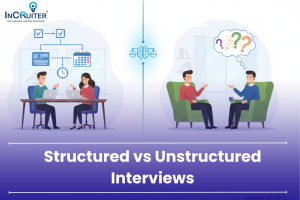
Structured vs Unstructured Interviews: Complete Hiring Guide
Interviews are not just a one-to-one video conference between two individuals. It’s a traditional decision-making tool used to decide people’s intelligence, abilities, and predict how...


