Search “candidate assessment tools” and you’ll find a dozen near-identical lists eight tools, ten tools, fifteen picks. Each one comes with a logo, a one-line description, and a star rating. None of them help with the actual problem. Picking the right tool isn’t about which one has the longest feature list. It’s about which one fits how you actually hire.
What Candidate Assessment Tools Actually Test
Most tools in this space fall into four broad categories, and most vendors blend more than one. Technical and coding assessments test actual skills writing code, debugging, solving a real problem in a sandboxed environment. They’re usually scored against test cases rather than a human reviewer’s impression. Cognitive and aptitude tests measure reasoning, problem-solving, and learning speed, independent of a specific technical skill. They’re useful when a role doesn’t map to a testable hard skill but still demands strong judgment. Personality and culture-fit tools assess working style and team fit, usually through structured questionnaires rather than open-ended interviews. That structure makes results easier to compare across candidates. AI-scored interview platforms evaluate structured interview responses, sometimes combined with proctoring or behavioral signals, and increasingly replace a first-round human screen for high-volume roles.
None of these categories is inherently “better.” They test different things, and a tool built for one doesn’t automatically do the others well. A strong coding assessment platform isn’t necessarily a strong personality-fit tool, even if the vendor’s marketing implies otherwise. The practical takeaway: define what you’re actually trying to measure before you look at a single vendor’s website.
The Real Question Isn’t “Best Tool” It’s “Best Fit”
Before comparing vendors, work through four factors. They narrow the field faster than any feature comparison table:
Match the tool to the role type
Technical roles need tools that test real skills in a real environment actual code execution, not just multiple-choice questions about syntax. A dedicated coding assessment platform built for this purpose behaves differently than a general skills-test tool with a coding module bolted on. Non-technical roles need the opposite emphasis: structured scenarios, judgment tests, or role-specific simulations rather than a code editor.
Match the tool to your hiring volume
A tool that works well for 20 hires a year can fall apart at 2,000. High-volume hiring needs fast turnaround, bulk scheduling, and automated scoring that doesn’t require a human to review every result individually. Low-volume, high-stakes hiring can afford more manual review per candidate, and often benefits from it. Buying a high-volume-optimized tool for selective hiring, or vice versa, usually means paying for capacity you don’t use or missing capacity you actually need.
Don’t treat integrity as an afterthought
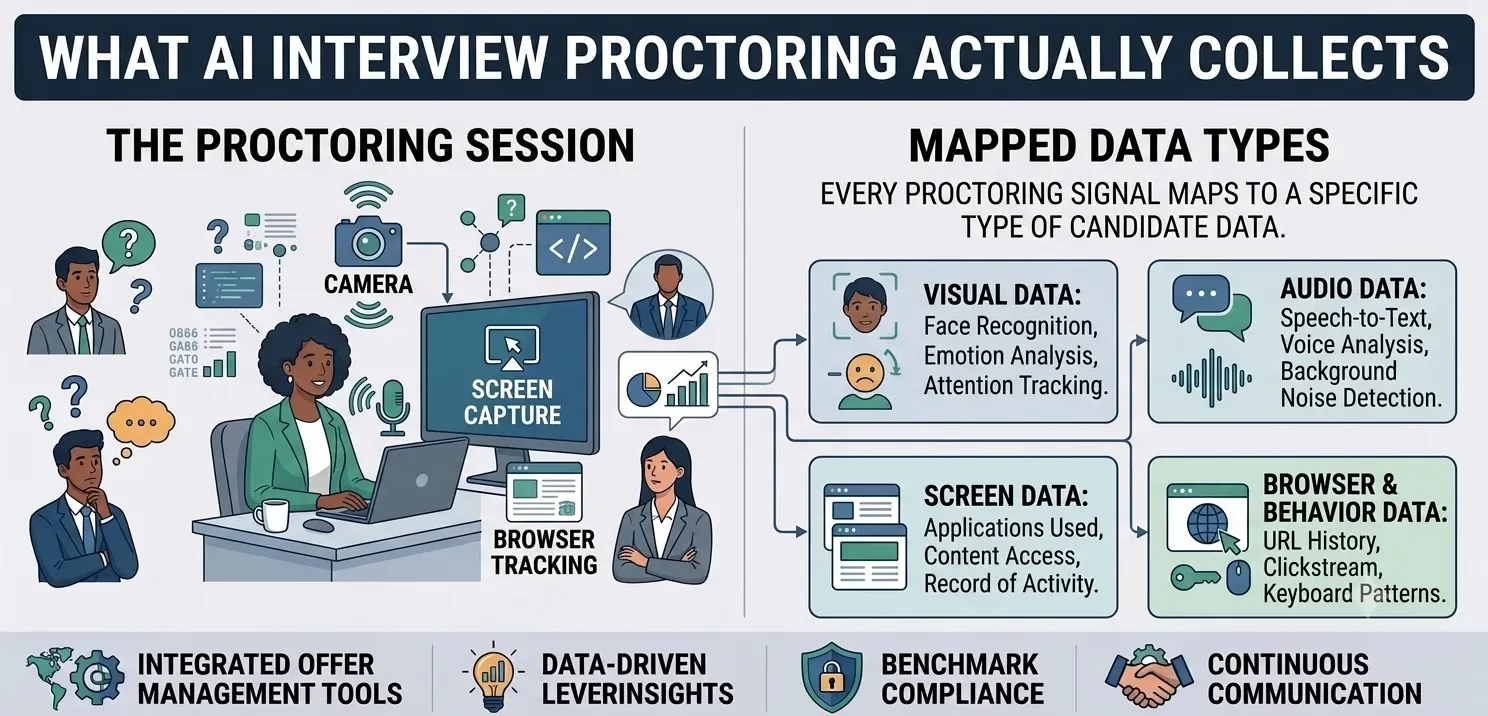
Remote assessments raise an obvious question: is the person taking the test actually the candidate, working alone, without outside help? A proctoring layer like IncProctor addresses this directly. Identity verification, tab-switch detection, multi-face detection, and session recording all exist because remote testing removes the built-in integrity of an in-person room. Skipping this isn’t a minor gap. It means the results you’re scoring candidates on might not reflect what they can actually do.
Check ATS integration before the feature list
An assessment tool that doesn’t sync cleanly with your applicant tracking system creates manual work for every single candidate. Someone ends up exporting results by hand, updating statuses one at a time, and chasing down scores that live in a separate dashboard. This is easy to overlook during a demo, where the assessment features get all the attention. It’s expensive to discover after you’ve already signed a contract.
How to Run a Short Pilot Before You Commit
Feature comparisons only tell you so much. A short pilot with real candidates, or at least a realistic internal test group, tells you things a demo can’t. You see how candidates actually experience the assessment and how long it genuinely takes to complete. You also see whether the scoring matches what your interviewers see later in the process.
Keep it small and time-boxed a couple of weeks, a handful of requisitions, one role type rather than every open role at once. Compare the assessment scores against how those same candidates actually perform once hired, where you can. A tool that looks strong on paper but produces scores that don’t track with real performance isn’t solving the problem you bought it for. That’s true no matter how complete its feature list looks.
Where AI Fits Into Assessment Now
AI has moved from a scoring add-on to a core part of how assessments work. AI-scored interview software can evaluate structured responses consistently across hundreds of candidates, which a purely manual process can’t match at scale. That consistency is real value, but it depends on the underlying structure being sound. An AI layer scoring poorly designed questions just produces poorly informed scores faster. The tool doesn’t fix a weak assessment design it amplifies whatever design is already there, good or bad. For a closer look at why enterprises specifically are making this shift, InCruiter’s guide to AI candidate screening covers that transition in more depth.
The tools all look similar in a demo. What actually separates them is whether they fit how you hire and that’s a question worth answering before you start comparing feature lists, not after.
Frequently asked questions
What should I look for in a candidate assessment tool?
Start with the four factors above role type, hiring volume, integrity needs, and ATS integration before comparing individual vendor feature lists. They narrow your actual requirements faster than a side-by-side comparison table.
What’s the difference between tools for technical vs. non-technical roles?
Technical assessment tools need real code-execution environments and language-specific test coverage. Non-technical tools rely more on structured scenarios, judgment tests, or role-specific simulations. A tool strong in one doesn’t automatically transfer to the other.
Do I need proctoring or integrity checks in an assessment tool?
For any remote assessment, it’s worth taking seriously rather than treating as optional. Identity verification and session monitoring directly affect whether your results reflect the candidate’s actual ability.
How do candidate assessment tools integrate with an ATS?
Most modern platforms offer some level of integration, but depth varies widely from a basic CSV export to real-time two-way sync. Confirm the specific integration before committing, not after.
Should I run a pilot before switching assessment tools?
It’s worth it whenever you can manage the time. A short, time-boxed pilot with one role type shows you how the tool performs with real candidates, which a demo or feature list can’t fully replicate.
Are AI-scored assessments reliable?
They can be, when built on a clear underlying structure. AI scoring adds consistency at scale, but it reflects the quality of the assessment design underneath it. A well-structured assessment scored by AI outperforms a weak one AI or not.
Ready to Transform Your Hiring Process?
Discover how our AI-powered interview platform can streamline your recruitment and find the best candidates faster.
Make Your Hiring Process Smart and Fast