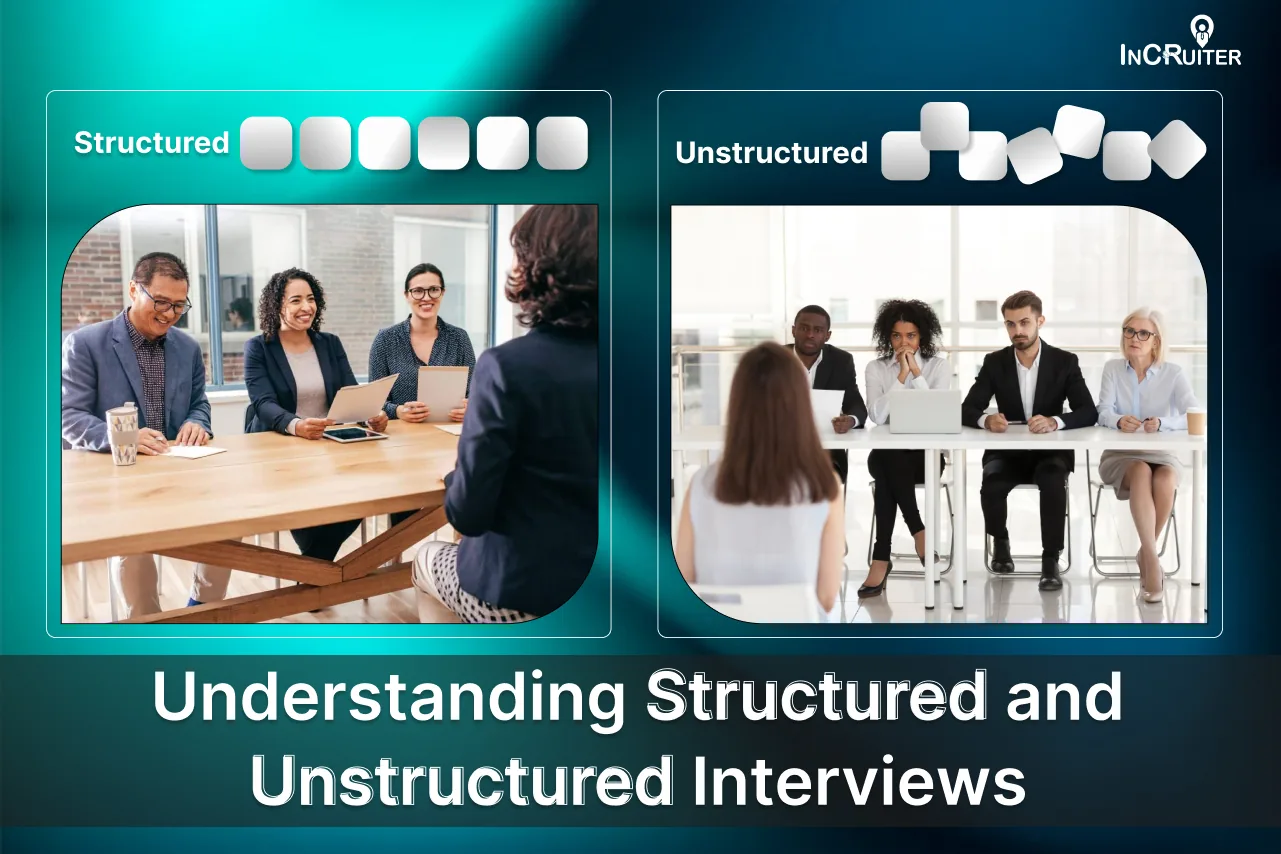
What Structured Interviews Actually Are
A structured interview asks every candidate for a given role the same predetermined questions, in the same order, and scores their answers against a shared rubric, often something like Google’s own model of poor, borderline, solid, and outstanding responses for each question. The goal isn’t to make the conversation feel rigid for its own sake. It’s to make sure that when two candidates are compared afterward, the comparison is actually fair, based on how they each responded to the same prompt, not on how comfortable one interviewer happened to feel with one candidate’s personality.
This format produces what’s essentially quantitative data: consistent scores across a fixed set of dimensions, which is exactly what you need when a hiring decision has to weigh multiple candidates against each other objectively.
What Unstructured Interviews Actually Are
An unstructured interview doesn’t follow a fixed script. The interviewer asks questions based on what comes up, follows interesting threads in the candidate’s answers, and the conversation can look meaningfully different from one candidate to the next. This format is better described as qualitative: it’s built to explore how someone thinks and communicates in real time, not to produce a directly comparable score.
This makes unstructured interviews genuinely useful for certain things, reading how a candidate handles an unexpected tangent, gauging communication style, or having an open conversation about fit that doesn’t reduce cleanly to a rubric. It also makes them considerably more vulnerable to bias, since two interviewers having two different conversations with two candidates are, in a real sense, not evaluating the same thing.
The Real Difference Isn’t Format, It’s What Each One Is Built to Measure
Most explanations of structured versus unstructured interviews stop at listing differences: standardized questions versus improvised ones, closed-ended versus open-ended, quantitative versus qualitative. Those are accurate, but they miss the more useful point. The real question isn’t which format is more rigorous. It’s what decision you’re actually trying to make with the interview.
If the decision is “which of these 40 candidates should move to the next round,” you need consistency across all 40 conversations, which only a structured format can reliably give you. If the decision is “does this specific candidate’s judgment and communication style work for a senior, ambiguous role,” a more open conversation often surfaces more of what you actually need to know, even though it’s harder to compare across candidates afterward.

Structured vs Unstructured Interviews, Side by Side
| **Factor** | **Structured Interview** | **Unstructured Interview** |
| Question format | Predetermined, identical for every candidate | Formed in the moment, varies by candidate |
| Data type | Quantitative, scored against a shared rubric | Qualitative, exploratory |
| Predictive validity | Higher, per Google re:Work’s own research | Lower, more prone to interviewer bias |
| Candidate experience | Rejected candidates report 35% higher satisfaction (Google re:Work data) | More variable, depends heavily on interviewer skill |
| Time investment | Upfront cost to build rubric, then saves \~40 minutes per interview | Little upfront prep, but harder to score consistently afterward |
| Best suited for | Screening and comparison stages, technical assessment | Exploratory, senior-level, or culture-fit conversations |
| Bias risk | Lower, same bar applied to every candidate | Higher, no fixed reference point across candidates |
When to Actually Use Each Format
Early-round screening is the clearest case for structured interviews. When you’re comparing a large pool of candidates against the same requirements, a fixed set of questions and a rubric is what makes the comparison meaningful instead of just a collection of separate impressions. This is also where the 40-minutes-per-interview time savings Google’s research found actually compounds, since it repeats across every candidate in that stage.
Later-round, senior, or ambiguous-role conversations are where unstructured formats earn their place. A leadership hire, a role with genuinely undefined day-to-day work, or a conversation specifically about culture fit benefits from following the thread of what the candidate actually says, rather than forcing it into a rubric built for a different purpose. The trade-off is real: it’s harder to compare these conversations across candidates afterward, which is exactly why this format fits better once you’re down to a shortlist than when you’re screening dozens.
The mistake to watch for is running an unstructured conversation at the stage where you actually need comparability. An early technical screen conducted as a loose, improvised chat means every candidate is being judged against a slightly different bar, set by whatever the interviewer happened to ask that day.
The Hybrid Approach Most Companies Actually Use
In practice, most well-run hiring processes aren’t purely structured or purely unstructured, they blend the two by stage. A common pattern: a structured technical or skills-based screen early on to build a consistent shortlist, followed by a semi-structured or unstructured final conversation focused on judgment, communication, and fit, where the earlier structured data has already done the job of narrowing the field fairly.
This isn’t a compromise, it’s matching the format to what each stage is actually trying to accomplish, consistent comparison early, and deeper individual judgment later.
What to Check Before You Standardize Your Interviews
a) Do Interviewers Actually Follow the Rubric, or Just the Questions?
A structured interview only works if scoring is consistent too. Asking the same questions but scoring answers on gut feeling recreates the exact inconsistency structured interviews are supposed to remove.
b) Are Questions Refreshed Often Enough?
If the same fixed questions circulate long enough, candidates compare notes and prepare specific answers rather than demonstrating genuine skill. Google’s own guidance flags this as a real maintenance cost of structured interviewing, not a one-time setup.
c) Is There Room Left for Judgment Where It Actually Matters?
Standardizing every stage of every interview can strip out the moments where a genuine, unscripted conversation would have surfaced something a rubric can’t capture, particularly for senior or highly ambiguous roles.
How InCruiter Supports Structured Interviewing at Scale
Building and maintaining a good structured-interview rubric by hand, for every role, is the part most teams underestimate. InCruiter’s AI-generated, role-specific questions remove that manual step, automatically producing structured, relevant prompts based on the job description rather than requiring a hiring manager to write and test a new set for every open role. IncBot conducts AI-scored interviews against consistent, structured criteria for high-volume early rounds, while InCruiter’s video interview platform, IncVid, gives live panels the same standardized scorecards and feedback structure for later, more conversational rounds, so the shift from structured screening to a more open final conversation doesn’t mean losing consistency in how feedback gets recorded.
Not sure whether your current interview process is actually structured, or just repeats the same questions without a real rubric behind them? Book a demo with InCruiter and see how AI-generated questions and standardized scorecards work together across every stage.
Frequently asked questions
Do structured interviews actually predict job performance better?
According to Google’s own re:Work research, yes. Structured interview scores were more predictive of actual on-the-job performance than unstructured interview scores, when compared against the same hires’ performance data afterward.
Are unstructured interviews always more biased?
They carry more bias risk because there’s no fixed reference point across candidates, but that doesn’t make them useless. The bias risk is a trade-off for the qualitative depth they provide, which is why they tend to work better later in a process, after structured stages have already done the objective comparison work.
Can a single interview be both structured and unstructured?
Yes, this is common in practice. Many interviews open with a few fixed, scored questions for consistency, then move into a more open conversation once the baseline assessment is done, blending both formats within a single session.
Does using structured interviews slow down the hiring process?
It can add upfront time to build the rubric and questions, but Google’s research found it saves time per interview afterward, an average of 40 minutes, once that structure exists, since interviewers aren’t deciding what to ask or how to score it on the fly.
Ready to Transform Your Hiring Process?
Discover how our AI-powered interview platform can streamline your recruitment and find the best candidates faster.
Make Your Hiring Process Smart and Fast