




Key Takeaways
- The STAR interview method is a structured way to answer behavioral interview questions by explaining the Situation, Task, Action, and Result of a real experience.
- It helps candidates give clear, focused answers while allowing interviewers to evaluate skills based on real-life scenarios rather than assumptions.
- The method encourages well-organized responses that highlight individual responsibilities, actions taken, and measurable outcomes.
- The article includes practical STAR-based examples for common interview questions such as teamwork, leadership, conflict resolution, and handling pressure.
- It also shares preparation tips and common mistakes to avoid, such as being too vague, missing results, or overemphasizing team contributions instead of personal impact.
What Is the STAR Interview Method?
The STAR interview method is a widely used formula for answering behavioral, leadership, conflict-resolution, and problem-solving questions, breaking down responses into four parts, namely – Situation, Task, Action, and Result.
It helps the candidate to frame their answer into a storytelling format to reflect on their skills, decision-making capabilities, and achievements with real instances from past work experiences.
So, what is the STAR method? The START method abbreviation consists of:
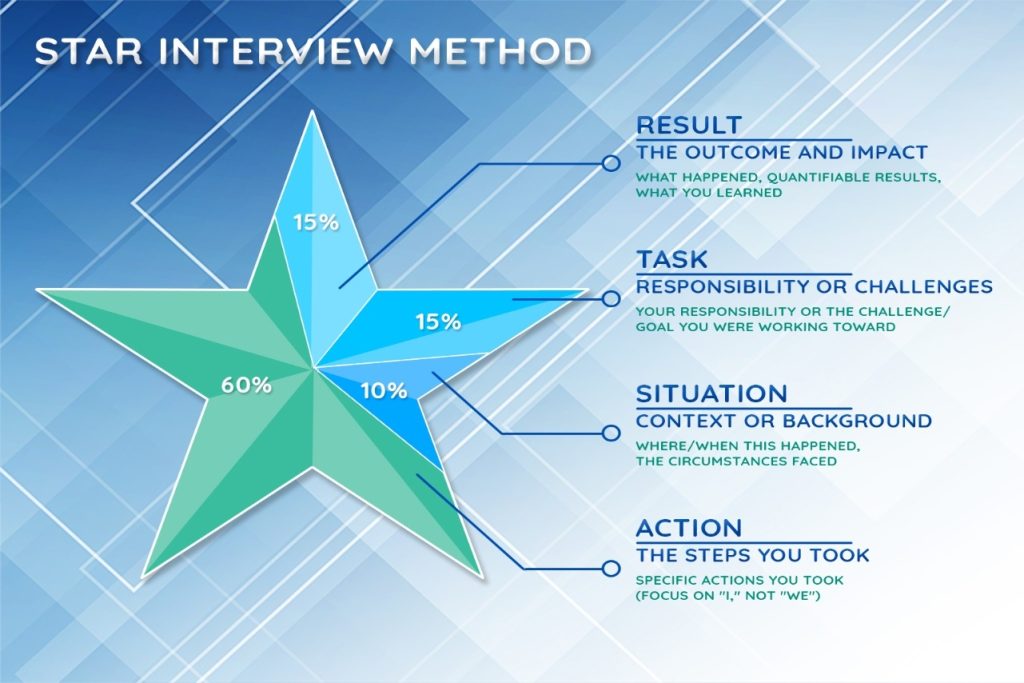
| STAR Component | Weight | What does it mean? | What to Include? |
| Situation | 10% | Context or Background | Where/When this happened, the circumstances faced |
| Task | 15% | responsibility or challenges | Your responsibility or the challenge/goal you were working toward |
| Action | 60% | The steps you took | Specific actions you took (focus on “I,” not “we”) |
| Result | 15% | The outcome and impact | What happened, quantifiable results, what you learned |
Simple Example:
Question: “Tell me about a time you solved a problem at work.”
STAR Answer:
- Situation: “I remember in my previous retail job at a busy clothing store, during peak season, in just the first week, customer complaints suddenly increased by 40%”
- Task: “As shift supervisor on duty in the store, it was my responsibility to identify the triggering point behind this surge, improve customer experience, and reduce complaints quickly.”
- Action: “I reviewed all complaint logs, discussed the customer faced challenges with the front-line staff of the store, and identified a clear pattern with long checkout issues during peak hours and weekends. To resolve this, I took several steps:
- Observed peak-hour traffic
- Reorganized break schedules
- Trained a backup cashier
- Improved communication
- Result: “Implementation of these changes reflects on the customer satisfaction score, which was also increased, but this time in a positive way, from 3.2 to 4.5 stars, and all the complaints dropped by 60%.”
Why the STAR Method Interview Technique Is Important for Job Seekers?
The STAR, or “Situation, Task, Action, Result,” method is important for job seekers because it helps them provide answers in a structured format that reflects the core capabilities of their past experience to the interviewer to predict future role success.
Here is why it matters most to the job seekers:
1. Provides Clear Structure
During live interviews, many candidates panic when faced with questions like “Tell me about a time…”, “Describe a situation…”, and “Give me an example…”. Answering this question without any structure may sound too general or vague.
STAR prevents rambling by restructuring the responses of the respondent with logical sections, silently providing the answer of What happened (Situation), What you needed to do (Task), What you did (Action), What changed (Result).
For example, instead of a generic, dry response like “I improved team communication.” STAR helps the candidate say, “I stepped into the project during the panic moment where deadlines were already delayed by almost 3 weeks.
To fix all this, I took several steps, assigned roles to the team, held weekly check-ins, and this reduced delays by 35%.”
2. Demonstrates Real Experience
“Candidate has handled similar situations before” is something every interviewer checks in an interview. Helping job seekers to reflect on this particular criterion, STAR ensures answers are experience-based, not generic “would do” hypothetical.
For example, a candidate can say, “During a slow quarter, I launched a client follow-up initiative and increased sales by 25% in 6 weeks.”
3. Keeps You Focused on What Matters
Without any structured approach, candidates often get lost in unwanted information that does not directly relate to their skills, actions, or the result of work in the job requirements.
Here, STAR plays a crucial role in making responses relevant, role-aligned, and short but intense.
For example, again and again, just talking about the history of organizations you work for, this method forces you to reveal:
- What problem were you solving?
- What was your personal contribution?
- What measurable result did you achieve?
4. Showcases Problem-Solving Abilities
The method helps candidates to show how they think, act, or perform under pressure naturally. Through this, they can talk about the reasoning involved behind the action taken, the skill applied, and the challenges they have overcome.
Employers follow this method to evaluate key qualities such as: Critical thinking, Adaptability, and Accountability.
For example, “previously, when our main supplier suddenly shut down supplies due to late payments, I immediately identified the need and secured an alternative supplier within 48 hours, and prevented a production delay.”
5. Builds Interview Confidence
Regular practice with the method is no less than appearing in an interview with complete confidence. STAR-practiced candidates never run short of examples; they respond with precisely what is needed for the best answer to be expected on the question to satisfy the evaluator’s need.
How to Answer Interview Questions Using the STAR Method
To use the “STAR” method in interviews, candidates start by structuring their answer, providing context about past experience, describing their roles and responsibilities in the scenario, then discussing the steps they took, the strategy they applied, and the outcomes they achieved last.
This technique encourages the candidate to draft their answer in clear, concise, and understandable language using real-life examples.
Here is how to use each part effectively:
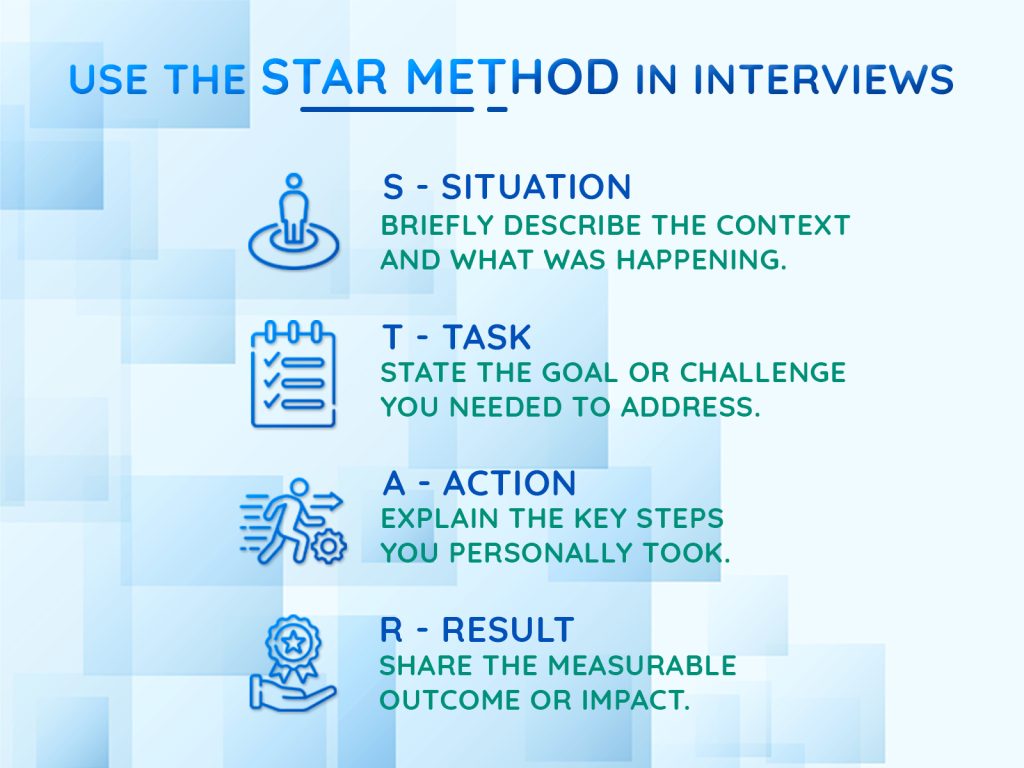
S – Situation
Start with a short introduction about the scenario, context, or background of your working experience, letting the interviewer understand and connect with your story. This briefly covers “Who was involved“. “What was happening?” and “Where it occurred or what organization/team.”
For instance, “My customer support team in my previous role was receiving low satisfaction scores due to delayed responses.” This is short, relevant, and directly aligned to the question asked.
T – Task
Describe your duties or the challenges in precise wording that you need to address to resolve the issue. This stage involves the information of “What needed to be achieved”, “Why it mattered.”
For example: “I was assigned to reduce the average response time and improve customer satisfaction.” This sets up your opportunity to shine in the next “Action” phase.
A – Action
This is the most important part, which almost impacts 60% of your answer. Highlight exactly what you did, what steps you took, what kind of strategy you applied, and the decision you made, not what the team did. Use active verbs and keep “I” as the focus.
For example, “I created a priority ticketing workflow, trained agents on quicker resolution techniques, and introduced daily performance check-ins.” This way, you can showcase your ability to solve real-world problems in the real workplace.
R – Result
Use quantifiable data means the information that measured, counted, or expressed your previous work result in numerical values. This stage also covers information about recognition, awards, or promotions if relevant. And any real-life learning that you can utilize in your future role.
A quantifiable approach helps employers to make decisions based on your achievements and outcomes, not just the skills written in your resume or experience in interviews.
For example, while interviewing, you can talk and provide the evidence of your outcome, like “Within just 2 months following the new approach, I improved the customer satisfaction rate from 72% to 90% and response time in addressing queries was cut by 50%.
A Simple Before and After STAR Example
Weak answer (no STAR): “I helped improve customer service by supporting my team.”
Strong STAR answer: “When our support team struggled with slow responses (Situation), I was tasked to improve our resolution timeline (Task). I built a new ticketing workflow and trained agents (Action), increasing satisfaction by 18% in 6 weeks (Result).”
When Should You Use STAR?
You should use the STAR (Situation, Task, Action, Result) method whenever an interviewer asks behavioral questions around conflict, teamwork, leadership, mistake handling, pressure, etc. Evaluators basically ask questions around this to check skills, problem-solving approaches, and achievements.
These questions start with phrases such as:
- “Tell me about a time when…”
- “Give me an example of…”
- “Describe a situation where…”
- “Can you share an experience when you…”
- “Have you ever had to…”
STAR Interview Questions with Sample Answers
Below are ready-to-use STAR responses categorized by key interview themes. You can replace company names, metrics, and responsibilities to match your experience.
Conflict & Communication
Example 1: Difficult Colleague
Question: “Tell me about a time you had to work with a difficult colleague.”
STAR Answer:
- Situation: At my previous company, as a project manager, I worked with a senior designer who had twice my experience. Because of their seniority, they are giving me late replies and frequently missing project deadlines.
- Task: Despite communication challenges, I was responsible for ensuring the website redesign was completed before the deadline.
- Action: I met with all the designers one-on-one, understood their challenges, and also assessed the criticality of the work they do during everyday office hours. After this, I learned they were handling multiple projects. Introduce a strategy to divide the project work among the designers so that everything is completed before the deadlines.
- Result: Following this collaboration approach, the project was finished 2 days before the deadline with a 95% satisfaction rate.
Here, the employer can notice the project completed in 2 days with 95% satisfaction.
Example 2: Handling an Unhappy Customer
Question: “Describe a situation where you dealt with an angry customer.”
STAR Answer:
- Situation: While working at a retail store during the Christmas season, I encountered a customer who received the wrong item in their parcel. He was so upset because he needed it as a gift that evening.
- Task: As someone emotionally involved, I must address this immediately to resolve it quickly and restore the customer’s confidence in our service.
- Action: I begin with an apology, locate the correct item in our inventory, offer a 25% discount to compensate for our mistake, and personally wrap the gift for them.
- Result: This mess-up ended with a happy and satisfied customer, who wrote a positive review about personalized treatment, mentioning by name on their social media handle. And this customer came to the store again, asking for my personal assistance with their New Year’s gift.
Notable results for Evlautor: Converted an angry customer into a repeat customer.
Teamwork & Collaboration
Example 3: Working Cross-Functionally
Question: “Give me an example of when you collaborated across different departments.”
STAR Answer:
- Situation: In my previous marketing manager role, during Diwali, our campaign was delayed because the sales team released the seasonal offer late, the design team took extra hours for the discount banner, and the development team was stuck with deployment work, so there was no one available to add the banner to the homepage.
- Task: I needed to coordinate between three departments: sales, design, and the product team to get the campaign launched within our original timeline.
- Action: I made a list of tasks, scheduled a cross-departmental meeting, discussed everyone’s responsibilities with set deadlines, and created the Slack group for real-time updates.
- Result: Through all implemented suggestions, we launched our marketing campaign in just 3 days instead of 2 weeks, and generated 1333 leads in the first week.
Notable results for Evlautor: Reduced delay from 2 weeks to 3 days, 1333 leads generated, cross-functional workflow established for future campaigns.
Example 4: Helping a Teammate Succeed
Question: “Tell me about a time you helped a struggling team member.”
STAR Answer:
- Situation: A newly joined developer group in my team was dealing with work challenges such as codebase understanding, missing sprint deadlines, and time management.
- Task: Being a senior developer, it was my responsibility to mentor them and boost their morale to succeed in their role.
- Action: I documented the workflow in an easy-to-understand format, explained their tasks, and offered two weekly code collaboration sessions. Break new joiners’ tasks into small, manageable chunks or tickets. And every day took 10 minutes of a standup meeting discussing today’s to-do list.
- Result: Within a month, their productivity increased by 85% from 40%, they started hitting sprint on time, and later, after completing their internship, they shared with our manager that my support was pivotal to their growth.
Notable results for Evlautor: Code approval rate increased from 40% to 85%, sprint commitments met consistently
Leadership & Ownership
Example 5: Motivating a Team
Question: “Describe a time when you motivated a team during a challenging period.”
STAR Answer:
- Situation: At my previous company, due to some product issues, our customer support team worked almost double, handling 70% more complaints manually. I noticed a decline in their morale and an increase in sick days.
- Task: Being the team leader, it was my responsibility to ensure the team worked with full potential while waiting for the engineers to fix the bug.
- Action: I developed an amazing strategy after receiving approval from upper management. We created the visible countdown to the product fix with daily progress updates, implemented “Fun Friday Activity” where we celebrated our positive customer feedback with our employee name, and for their convenience, I negotiated with management for a flexible work schedule for the team.
- Result: Despite the ongoing issue, our CSAT score increased by 3.8 to 4.3, sick leaves decreased by 60% and we achieved a 100% team retention rate during that period.
Notable results for Evlautor: 60% reduction in sick days, CSAT increased from 3.8 to 4.3, and 100% retention.
Example 6: Delegation Challenge
Question: “Tell me about a time you had to delegate an important task.”
STAR Answer:
- Situation: I remember the instance of time where I had to lead a product launch and was asked to present our quarterly results to executives within the same week.
- Task: Both were my responsibility to ensure the product launch went flawlessly while preparing for the executive presentation.
- Action: For the product launch, I delegated the coordination work to a few of my trusted team members. I explained the complete execution plan, provided a checklist ensuring nothing was missed on the day, and allowed them to make $5k decision. I made myself available only for handling the escalation.
- Result: The product launch finished with an utmost accuracy of 99.8% uptime. My team member gained real product launch experience, which helps them with their promotion later. And my executive presentation impressed everyone because I got enough time to prepare everything.
Notable results for Evlautor: 99.8% uptime during launch, delegated team member received promotion
Working Under Pressure
Example 7: Tight Deadline
Question: “Give me an example of when you worked under a tight deadline.”
STAR Answer:
- Situation: I handled a client request for a custom analytics dashboard with only 2 weeks’ notice, which was half our team’s usual timeframe. The client’s Series B funding was dependent on this delivery.
- Task: As a Sr. Data Analyst, I needed to leverage my capabilities to deliver a fully functional analytical dashboard that was not only visually compelling but also met all the client’s functional requirements.
- Action: I immediately prioritized this dashboard project, moving aside everything. Connected with the client to understand must-have versus nice-to-have features, identified reusable components of the previous version, and provided daily demos to catch issues on time.
- Result: This approach helps me to deliver a dashboard one day before the timeline. The client’s investor meeting was successful, and they got $50M in funding in the next 6 months.
Notable results for Evlautor: Delivered 1 day early, secured $50M funding, and secured client funding.
Also read: Java Common Interview Questions
Example 8: Unexpected Problem
Question: “Describe a time you had to solve an unexpected problem quickly.”
STAR Answer:
- Situation: In my previous company, just three hours before an important product demonstration to 500 virtual conference attendees, our demo setup crashed, and it would not restart.
- Task: As the project manager, I needed to make sure the demo runs successfully without any glitches or technical errors.
- Action: Instead of fixing the current system issues, which would take hours, I decided to go with a backup plan. I switched this demo to our production environment with a demo account, pre-loaded sample data, and tested the modified flow 2 times with the QA team.
- Result: The demo finished without a break, we generated 50+ leads from the people who attended this, and closed six deals worth $400K in the following quarter.
Notable results for Evlautor: 50+ qualified leads, $400K in closed deals.
Failure & Learning
Example 9: Mistake You Corrected
Question: “Tell me about a mistake you made and how you handled it.”
STAR Answer:
- Situation: I accidentally triggered 50,000 marketing emails with a broken checkout link to our subscribers during a flash sale event.
- Task: To minimize revenue loss for our company, I have to fix this mistake quickly.
- Action: I immediately discussed this issue with my manager, sent a corrected email within 15 minutes with an apology, and we extended sale hours by 2 to compensate for the loss. After this, I implemented a necessary link testing checklist for all future sales events.
- Result: Despite the error, we still achieved 87% of our sales goal (only 13% below target), received positive feedback from customers about our quick response and transparency, and we had zero email errors in the following 12 months due to the new checklist.
- Regardless of mistakes, we still achieved 89% of the decided sales goal (only 11% below the target), with happy customer feedback about our quick response to the problem. Due to the new checklist in the next 12 months, we had zero email errors.
Notable results for Evlautor: Recovered to 87% of sales goal, zero email errors for 12 months
Example 10: Negative Feedback Turned Positive
Question: “Describe a time you received critical feedback and how you responded.”
STAR Answer:
- Situation: During my initial days in my career, my managers told me about my presentation skills. I used to be too technical, which might have made it difficult for non-engineering background stakeholders to understand.
- Task: I needed to up-scale my communication skills to be more approachable for cross-functional meetings.
- Action: I watched almost 2 to 3 videos about technical communication on YouTube, I joined a workshop to master “communication skills”, practiced with colleagues from other departments, and created executive summary slides for each technical presentation.
- Result: Within 3 months, I was selected to present our team’s work at the company’s all-hands, received positive feedback from the CEO, and was asked to coach other engineers on stakeholder communication.
Notable results for Evlautor: Selected for the company’s all-hands presentation, asked to coach other engineers
Note: Practice STAR interview stories with the InCruiter AI-powered Mock Interview Platform to excel in real job interviews.
How to Prepare STAR Stories Before Your Interview?
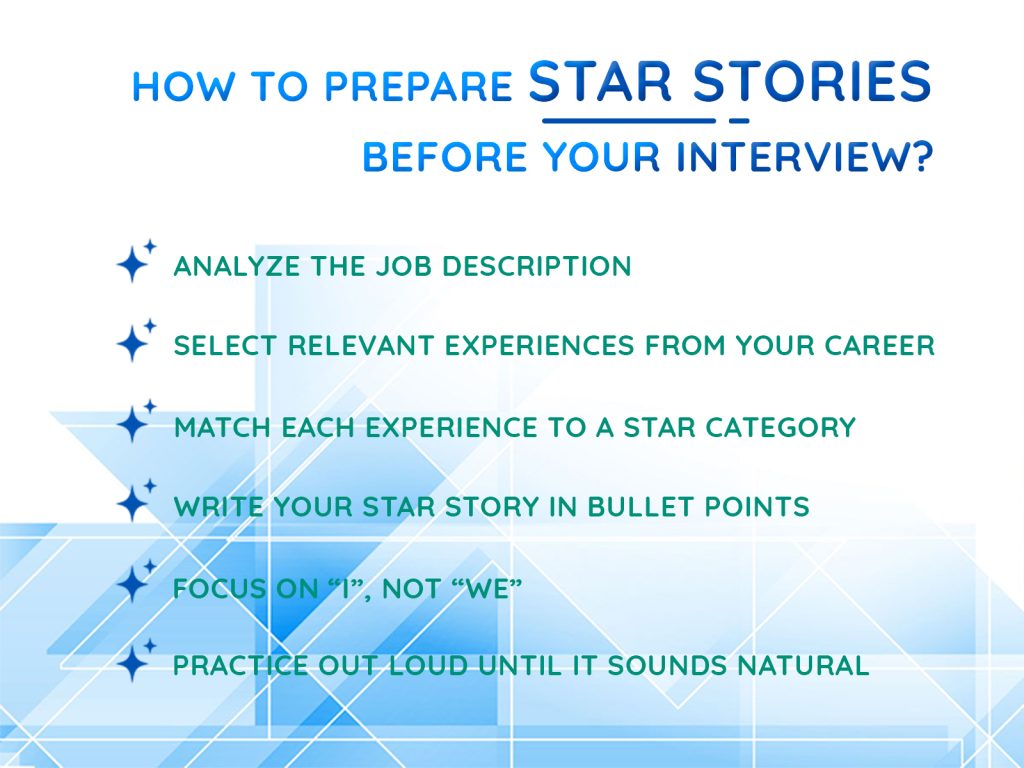
To prepare the STAR stories before an interview, walk through the job description details you are applying for. Select the most relevant experiences, events, or instances from your work life that show you have enough capabilities to handle the role. Then draft those experiences into pleasing stories using the Situation, Task, Action, Result (STAR) formula.
Here is the step-by-step approach to help you with the story preparation:
1. Analyze the Job Description
Spend the time to read the information written on the job description to identify the necessary skills, knowledge, and abilities the employer is looking for, such as teamwork, leadership, adaptability, customer focus, problem-solving, and technical skills.
These are all the areas where the interviewer might ask questions (that usually start with “Tell me about a time when…,” “Give me an example of…,” or “Describe a situation where…,”).
2. Select Relevant Experiences from Your Career
After identifying the key areas that employers are looking for, select the experiences from your career history, academic projects, internships, volunteer activities, or real-life situations to show those required skills.
And choose those examples, successes or failures, which are recent and directly align with the applied role requirement. At least prepare 3 to 5 stories as examples so you can adapt to different questions.
3. Match Each Experience to a STAR Category
Arranges these stories according to the idea they reflect most, such as conflict handling, team success, pressure or challenges, innovation, customer outcomes, and learning from failure. This story arrangement helps you to recall easily during the interview process from the archive.
4. Write Your STAR Story in Bullet Points
While preparing, ensure stories follow a structured format with short 2 or 3-line sentences. In answer, write a situation in 2 to 3 lines, giving context, a task in 1 line describing roles and responsibilities, and an action, which is the most essential part.
Write it in 3 to 5 points, discussing what measures you took in solving the problem. And in the end, quantify the outcomes in 2 or 3 points, helping the interviewer to understand the impact of your actions.
5. Focus on “I”, Not “We”
The interviewer asks behavioural questions to check the candidate’s contribution, role, and action in resolving the challenges. So even if it’s a team achievement, show the decision you made, the skills you used, and how you personally contributed to making it possible. It is highly recommended to use a first-person tone while using the STAR method. It’s expert advice.
6. Practice Out Loud Until It Sounds Natural
Practice speaking your stories out loud with your friend, family member, or in front of a mirror. Do not memorize your answer word-for-word because interviewers have enough experience to identify whether this response is natural or scripted. Practice your answer with time is the best approach that always works; give yourself only 2 to 3 minutes to speak.
Common STAR Mistakes to Avoid
Even the most prepared candidates make these mistakes while using STAR methods. Here is what to look out for:
❌ Being Too Vague or Generic
Mistake: “I always help my colleagues to finish work.”
Why it fails: No example. No outcome. No context.
Fix: Set the information ground, mention the project name, talk about the time, and what impact you created.
❌ Focusing on “We” Instead of “I”
Mistake: “Together we run a massive marketing campaign before launching the product.”
Why it fails: Creates confusion about your contribution in the campaign.
Fix: Focus on your effort with the use of “I”.
Better: “I studied the product, understood its features, and brainstormed with the team to develop the marketing strategy. Created the content calendar, well planned the use of $10k budget to increase the 30% sales.”
❌ Rambling Without Structure
Mistake: Storytelling without a clear structure creates no impact on listeners.
Why it fails: It makes the interviewer think too much about the story.
Fix: Follow the strict STAR formula, spending 10% on situation, 15% on task, 60% on action, and 15% on outcomes.
❌ Skipping or Minimizing Results
Mistake: “I introduced a new strategy that set everything in just 2 weeks.”
Why it fails: “that set everything” provides no proof.
Fix: In result, always use percentages (%), dollar ($) amounts, time saved, satisfaction scores, or other metrics.
❌ Using Hypothetical Situations
Mistake: “If I were in that situation, I would probably…”
Why it fails: This loses the job seeker’s chance of a further round, because interviewers always expect real examples.
Fix: Talk about a real thing you worked on in a past role. Or you can directly say to the interviewer, “I have not encountered this type of situation in past experiences…”
❌ Making It All About the Situation
Mistake: Spending 80% of the time setting the background of the story.
Why it fails: From this interviewer, get the idea about the problem, not about skills.
Fix: Spend a short time, around 2 to 3 sentences in the situation, focus 60% on the action part.
Pro Tips to Stand Out in Behavioral Interviews
To stand out in behavioral interview questions, always remember the 10/15/60/15 formula. Spnd 10th part of the answer in setting the ground, 15th on describing what you have to do in that scenario, 60th on what you exactly did, and again 15th to talk about what you achieve from your actions.
Using this formula, prepare 7 to 10 stories around different competencies before the big day of your interview. Interviewer loves impact, so focus on quantifying everything you did in your previous work experience with the use of specific numbers, percentages, and timeframes.
Don’t make the interviewer bored. Spend only 90 to 120 seconds per response with the structured format. Modify your answer with the need for the asked questions to create a long-lasting impact on the story. And always end with a pointer about learning, like “Here’s what I learned…”
Final Thoughts
Mastering the STAR method transforms your interview performance from uncertain to compelling. When you prepare structured stories ahead of time, you speak with clarity, confidence, and proof of your impact. With consistent practice, you can answer even the toughest behavioral questions with ease and stand out as a strong, capable candidate.
If you want to take this further, download the STAR Story Template or start crafting your examples today so you enter your next interview fully prepared and ready to win the role.
Frequently Asked Questions (FAQs)
1. What types of interview questions are best answered using the STAR method?
Ideally, applicants use the STAR method to answer behavioral-type questions. Specifically for those questions that asked to check the candidates’ leadership skills, teamwork, problem-solving, adaptability, and work pressure handling capabilities. This question generally starts like,
- “Tell me about a time when…”,
- “Describe a situation where…”
- “Give me an example of…”
2. How long should a STAR method answer be in an interview?
If the candidate is well-practiced with the STAR method, then it will ideally take 90 to 120 seconds to complete one answer. They usually follow 10/15/60/15 rule to make the answer structured, engaging, and impactful, which means
- Briefly explain the situation (10%)
- Clarify the task (15%)
- Focus most on your actions (60%)
- conclude with measurable results (15%)
3. Can freshers or candidates with limited experience use the STAR method?
Yes, for fresher candidates, the STAR approach is an effective method to impress the interviewer. Using this approach, Fresher incorporates their internship, academic projects, group assignments, or part-time job experience into their answers because all interviewers value a problem-solving approach, not just corporate experience.
4. What are the most common mistakes candidates make when using the STAR method?
The most common mistakes committed by candidates is focusing on group efforts instead of talking about their personal efforts. Also they skip measurable outcomes with the general discussion, and any hypothetical imaginary example, that ultimately weaken their answers.
5. How can I prepare STAR stories before an interview?
To prepare STAR stories before an interview their are multiple way but you can apply most effective way. First download JD, or copy and paste to the ChatGPT, ask them to provide required skill on that particular job role. Then upload your CV, with the prompt instrucing to provide 7 to 10 STAR stories covering different competencies like leadership, conflict handling, team work and failures align with resume. Then turn on the live discussion mode of tool, practice aloud, and tell AI to assess your answer in a scale of 10.
Ready to Transform Your Hiring Process?
Discover how our AI-powered interview platform can streamline your recruitment and find the best candidates faster.

Related Blogs

Why BFSI Hiring Needs a Fresh Approach?
Relying on traditional hiring methods in the Banking, Financial Services, and Insurance (BFSI) sector is leading to significant losses for organizations. Slow, outdated processes fail...

How Conversational AI is Revolutionizing One-Way Video Interviews?
Conversational AI is revolutionizing one-way video interviews by introducing adaptive follow-up questions, enhancing recruiter efficiency, and candidate engagement.

How AI Interviews Transform the Candidate Selection Process
Gone are the days when manual hiring was all the rage. Now we have AI interviews, your new hiring assistant. If you belong to the...

Best Practices for Evaluating Candidates Using Video Interview Software
A survey revealed that 47% use video interview software to shorten the hiring timeframe. Are you doing it too? We are in an era where...

Video Interview Tips: Complete Guide to a Successful Interview
Master your next video interview with these expert tips! Learn how to confidently navigate live and pre-recorded formats for the best results.

Exit Interview Services: A Key to Reducing Employee Turnover
Exit Interview Services offer insights into why employees leave, helping companies address issues, improve retention, and cut turnover costs effectively.


