




Key Takeaways
- Defines what a skill assessment test is and its role in modern recruitment.
- Explains why companies use skill tests to improve hiring accuracy and reduce bias.
- Covers major types of skill assessment tests, including technical, cognitive, personality, situational judgment, and language assessments.
- Provides real-world examples of assessments used for developers, data analysts, writers, and marketing professionals.
- Shows how skill assessments fit into the hiring process before interviews to filter qualified candidates.
- Describes how online assessments support remote hiring and global recruitment.
- Highlights common challenges such as test relevance, cheating risks, and candidate fatigue.
- Outlines best practices for designing fair and effective skill tests.
- Examines how AI is transforming recruitment assessments through automated scoring and predictive insights.
- Clarifies the difference between skill assessments and technical interviews and how both work together in hiring.
Hiring the right person has never been easy. Resumes look polished, interviews can be rehearsed, and references rarely tell the full story. That’s exactly why skill assessment tests have become one of the most trusted tools in a recruiter’s toolkit , they cut through the noise and show you what a candidate can actually do.
What is a skill assessment test?
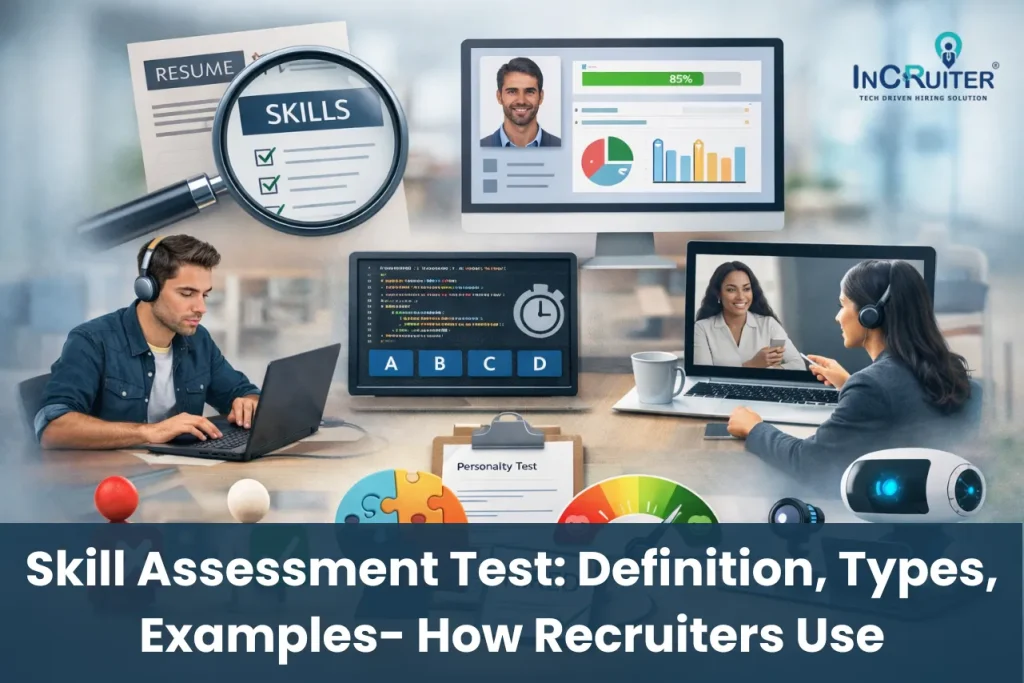
A skill assessment test is a structured evaluation that measures a candidate’s ability to perform tasks that are directly relevant to a job role. Unlike a resume, which tells you what someone claims to have done, a skill test shows you what they can actually do right now.
These tests are designed to evaluate specific competencies , whether that’s writing clean code, analyzing data in a spreadsheet, communicating ideas clearly, or making smart decisions under pressure. The format varies depending on the role, but the goal is always the same: give recruiters objective, measurable evidence about a candidate’s readiness before they move forward in the hiring process.
Think of it like a trial run. Instead of spending an hour in an interview guessing whether someone can do the job, you give them a real task , and let the results speak for themselves. Instead of spending an hour in an interview guessing whether someone can do the job, you give them a real task and let the results speak for themselves. Many companies now combine these assessments with AI-powered interviews to evaluate candidates more efficiently.
Why skill assessment tests matter in recruitment?
The hiring process is full of guesswork. Two candidates can have near-identical resumes but very different skill levels. A confident interviewee can easily mask gaps in knowledge. Skill tests remove that uncertainty by grounding hiring decisions in actual performance data rather than impressions.
For recruiters dealing with hundreds of applications, this kind of structured evaluation also makes the screening process significantly faster. Instead of reading through every resume in detail, they can use assessment results to identify which candidates deserve closer attention.
Why do companies use skill assessment tests in hiring?
Organizations don’t use skill tests just because they’re convenient , they use them because they genuinely improve hiring outcomes. Here’s how:
Improve hiring accuracy
Traditional interviews are notoriously unreliable predictors of job performance. Skill tests, on the other hand, create a direct link between what a candidate demonstrates and what the job actually demands. When you hire based on verified skills, you’re far less likely to make a costly mistake.
Reduce hiring bias
Subjective judgments , whether conscious or not , can influence hiring decisions in ways that aren’t fair or even legal. A standardized skill assessment applies the same challenge to every candidate, so evaluation is based on what they do, not who they are or how they present themselves.
Speed up recruitment
When you have 200 applicants for a role, reading every resume in full isn’t realistic. Skill tests let you filter candidates early, so your interview slots go only to people who’ve already proven they meet the minimum bar. That saves time for everyone involved.
Identify job-ready candidates
Some candidates look great on paper but need several months of ramp-up time before they can contribute meaningfully. Skill assessments help you identify people who are ready to hit the ground running , which matters especially for roles where productivity is expected from day one.
Types of skill assessment tests used in recruitment
Not all skill tests look the same. The right type depends on the role you’re hiring for and the qualities you’re trying to measure.
Technical skill tests
These are used for roles in software development, data analysis, engineering, finance, and other fields where specific technical knowledge is required.A coding challenge for a backend developer or a financial modeling test for an analyst are classic examples. Many companies now use coding assessment platforms to evaluate developers in real-world scenarios before moving them to interviews. The goal is to see whether a candidate can actually do the technical work the job demands.
Cognitive ability tests
Cognitive tests measure how a person thinks , their ability to process information, spot patterns, reason logically, and solve problems they haven’t seen before. These tests are particularly useful for roles that involve constant decision-making, learning new systems, or handling complex data.
Personality and behavioral assessments
These aren’t about right or wrong answers. Instead, they help recruiters understand how a candidate tends to work , their communication style, how they handle pressure, whether they prefer working independently or as part of a team. Used alongside other assessments, they help predict cultural fit and working style.
Situational judgment tests (SJTs)
Situational judgment tests present candidates with realistic workplace scenarios and ask them to choose how they would respond. A customer service role, for example, might involve a scenario where an angry customer is asking for something outside company policy. How the candidate responds reveals their judgment, empathy, and problem-solving approach in context.
Language proficiency tests
For roles that require strong written or spoken communication , especially in a second language , language assessments measure vocabulary, grammar, comprehension, and fluency. These are common in global companies, content roles, and customer-facing positions.
Examples of skill assessment tests
The best way to understand how these tests work is to look at real-world applications across different industries and roles.
- Software developers are often asked to complete a timed coding challenge , debugging broken code, building a small feature, or solving an algorithmic problem.
- Data analysts might receive a dataset and be asked to clean it, build a pivot table, and answer specific business questions using Excel or SQL.
- Content writers are typically given a brief and asked to write a short article or social media caption. Recruiters look at clarity, tone, structure, and accuracy.
- Customer service candidates may be presented with a mock customer complaint and asked to draft a response , testing both writing ability and emotional intelligence.
- Marketing professionals might be asked to critique an existing campaign or propose a strategy for a new product launch.
What all these examples share is that they closely mirror actual job tasks. The best skill tests aren’t generic puzzles , they’re realistic simulations of what candidates will face when they join your team.
How skill assessment tests work in the hiring process
Skill tests typically slot into the early or middle stages of the recruitment funnel , after initial applications come in but before formal interviews begin. Here’s how the process usually unfolds:
- Application: Candidates apply for the role through your careers page or job board.
- Assessment invitation: Shortlisted applicants receive a link to complete the skill assessment, usually with a deadline of 48–72 hours.
- Candidate completion: The candidate works through the test at their own pace (within the time limit). Depending on the platform, this may be proctored.
- Automated scoring: Most modern platforms automatically score objective responses , coding tests, multiple-choice questions, and data tasks are evaluated instantly.
- Recruiter review: For open-ended tasks like writing samples or case studies, a human reviewer evaluates the submissions using a scoring rubric.
- Interview shortlisting: Candidates who meet the threshold move forward to structured interviews, where results can be used as conversation starters.
Skill assessment tests for remote hiring
The shift to remote work has made online skill assessments even more central to recruitment. When you can’t meet a candidate in person, having a reliable way to verify their abilities becomes essential.
Modern assessment platforms allow companies to administer tests entirely online, with features like time limits, randomized question pools, and AI-based proctoring to maintain integrity. Some platforms also integrate directly with applicant tracking systems (ATS), so test scores flow automatically into candidate profiles.
For technical roles, remote-friendly tools like live coding environments, shared document editors, and video-recorded task walkthroughs have become standard. These tools replicate the experience of working together in real time, even when both parties are on opposite sides of the world.
Challenges of skill assessment tests
Skill tests are genuinely useful, but they’re not without limitations. Recruiters should be aware of a few common pitfalls:
Test relevance
A generic test that doesn’t reflect the actual demands of the role is one of the biggest issues. If you’re hiring a marketing strategist but your assessment focuses heavily on data manipulation, you’re measuring the wrong thing. Tests should be designed or customized to match what the role actually requires.
Candidate cheating
Remote assessments are harder to control than in-person ones. Some candidates may use outside help, look up answers, or have someone else complete the test entirely. Proctoring tools, randomized question banks, and time limits help reduce this, but they can’t eliminate it entirely.
Test fatigue
Candidates are often applying to multiple companies at once, and a long or poorly designed assessment can drive strong candidates away. If your skill test takes three hours to complete and doesn’t communicate its purpose clearly, you may lose good people before they even finish.
Potential bias in design
Even objective-looking tests can carry unintentional bias. If a test relies heavily on cultural references, industry-specific jargon from one particular background, or communication styles that favor certain groups, it may disadvantage otherwise qualified candidates.
Best practices for conducting skill assessment tests
To get the most out of your skill assessments and keep the candidate experience positive, follow these principles:
- Align the test to the job description. Every question or task should reflect something the person will actually need to do in the role.
- Keep it reasonably short. Most effective skill tests run between 30 and 90 minutes. Anything longer risks candidate drop-off and doesn’t necessarily yield better data.
- Communicate expectations clearly. Tell candidates what the test involves, how long it will take, and how results will be used. Transparency builds trust.
- Use real-world tasks, not abstract puzzles. A writing task is better than a verbal reasoning test for a content role. A data analysis scenario is better than a general math quiz for an analyst position.
- Standardize your scoring criteria. Define what a strong, acceptable, and weak response looks like before you evaluate anyone. This keeps assessments fair and consistent.
- Gather feedback from candidates. Regularly ask test-takers about their experience. If the test is too long, confusing, or poorly formatted, fix it.
How AI is transforming skill assessment tests
Artificial intelligence is changing what’s possible in recruitment assessment , and not just in small ways. AI-powered platforms can now score open-ended written responses, evaluate code quality beyond simple pass/fail checks, and flag anomalies that may indicate cheating.
Some platforms use natural language processing (NLP) to analyze the depth and clarity of a candidate’s written answers. Others use machine learning to compare a candidate’s assessment profile against the profiles of successful employees in similar roles , giving recruiters a predictive signal rather than just a snapshot score.
Video-based assessments have also advanced significantly. Modern AI recruiter platforms can analyze candidate responses, automate evaluation workflows, and help recruiters identify the most promising applicants faster. AI can analyze verbal responses, pacing, and coherence during recorded interviews , though this area remains controversial and should be used carefully to avoid introducing new forms of bias.
The bottom line is that AI doesn’t replace the human judgment recruiters bring to the table. What it does is process large volumes of data faster and more consistently than any human reviewer could , freeing up recruiters to focus on the qualitative conversations that really matter.
When should recruiters use skill assessment tests?
The short answer: earlier than most companies currently do. Skill tests are most effective when they’re positioned before the first interview , not after. Here’s why that sequencing matters:
- If you interview first and test later, you’ve already invested time in candidates who may not have the skills the role requires.
- Testing before interviews means interview time can be spent exploring cultural fit, motivation, and growth potential , things a test can’t fully capture.
- For high-volume roles, early testing dramatically reduces the number of candidates who need to reach the interview stage.
For senior or specialized roles, skill tests may come later in the process , after an initial conversation to gauge interest and cultural alignment , with a more in-depth task presented as a final evaluation step.
Skill assessment test vs technical interview: what’s the difference?
| Skill Assessment | Technical Interview |
| Completed independently, on the candidate’s time | Live, two-way conversation with an interviewer |
| Objective, structured, and standardized | Evaluates reasoning, communication, and adaptability |
| Measures practical output and task completion | Can probe depth of knowledge in real time |
| Scalable , works for hundreds of candidates | Resource-intensive , requires interviewer time |
| Results are documented and comparable | Results depend on interviewer judgment |
The two aren’t in competition , they complement each other. Skill tests filter for ability. Technical interviews explore depth. The best hiring processes use both at the right stages.
Conclusion
A well-designed skill assessment test is one of the most reliable tools a recruiter has. It brings objectivity to a process that’s often dominated by instinct, removes ambiguity from hiring decisions, and gives candidates a chance to demonstrate what they can actually do rather than just what they’ve done before.
As hiring becomes more competitive and more global, the companies that get skills-based assessment right will consistently build stronger teams , faster and with less guesswork. The technology to support that is better than it’s ever been. The real work now is designing assessments that are fair, relevant, and genuinely reflective of the job.
Modern hiring platforms increasingly combine skill assessment tools with AI-driven interviews and structured evaluation pipelines , making it possible to assess more candidates, more consistently, with less manual effort from recruiters.
Frequently asked questions
What is a skill assessment test in recruitment?
A skill assessment test is a structured evaluation that measures a candidate’s ability to perform tasks relevant to a specific job role. It gives recruiters objective data about what a candidate can actually do , not just what they claim on a resume.
Are skill assessment tests used before interviews?
Yes, in most hiring processes skill tests are administered before the first formal interview. This allows recruiters to filter candidates based on verified ability, so interview time is spent on people who’ve already demonstrated they meet the baseline requirements.
What types of skill assessment tests are commonly used?
The most common types include technical skill tests, cognitive ability tests, personality and behavioral assessments, situational judgment tests, and language proficiency tests. The right type depends on the role and what qualities the recruiter needs to evaluate.
How long does a skill assessment test take?
Most effective skill tests run between 30 and 90 minutes. Some specialized assessments , like a full case study or a complex coding challenge , can take up to two hours, but anything beyond that risks candidate drop-off without a meaningful gain in data quality.
Can skill assessment tests be conducted online?
Yes. Modern assessment platforms are built for online delivery, with features like time limits, randomized questions, and AI-based proctoring to maintain integrity. Many integrate directly with applicant tracking systems for a seamless recruiter workflow.
Also Read
Coding Assessment Tools: Enhancing Skill Verification with Adaptive Testing
How a Coding Assessment Platform Enhances Developer Hiring?
Mock Interviews Online For Enhancing Your Interviewing Skills
Ready to Transform Your Hiring Process?
Discover how our AI-powered interview platform can streamline your recruitment and find the best candidates faster.

Related Blogs
AI For Interviews: How Artificial Intelligence Enhances the Job Interview Process
Explore how AI Interview software is reshaping job interviews with smart screening, real-time feedback, and bias-free evaluations to hire faster and better.
Employee Selection Process: 10 Steps, Stages & Complete Procedure in HRM (2026)
Hiring the right person isn’t luck – it’s a process. Every organization, whether a startup or a Fortune 500 company, follows a structured employee selection...

How Companies Detect AI-Assisted Interview Cheating 2026
Hiring used to be pretty straightforward, but things got complicated fast. Now that remote interviews are everywhere, recruiters have a new problem: candidates are using...
Interview Management System: How to Choose the Right Tool For Your Business
This guide helps you choose the perfect interview management system for your business by evaluating key features, integrations, and hiring needs.
How Does Video Interviewing Work? The Complete Guide for Recruiters in 2026
What Is Video Interview Software? Video interview software is a technology solution designed to facilitate remote job interviews through online video. It encompasses tools for...
Top 5 Real-Time Coding Interview Tools with Built-In Assessments in 2026
Every recruiter’s inbox in 2026 is flooded with AI-polished resumes. But resumes don’t reveal how a developer thinks under pressure a real-time collaborative coding session...


