A recruiter who runs 40 phone screens a week looks busy. A recruiter who runs 15, but whose candidates convert to interviews at three times the rate, is doing better work. Most “recruiter productivity” conversations measure the wrong thing: activity instead of output. InCruiter’s guide to recruitment metrics covers the full picture this piece goes deeper on the one most teams get wrong.
Productivity Isn’t the Same as Activity
Recruiting has a volume-measurement problem. Calls made, emails sent, and screens completed are easy to count, so they become the default productivity signal. None of them say anything about outcomes. A recruiter working fewer requisitions with sharper candidate targeting can out-perform one juggling twice the volume with a scattershot approach. Measuring the wrong thing doesn’t just miss the real signal it can actively reward the wrong behavior, pushing recruiters toward volume over judgment.
This matters more than it sounds like on paper. A team that reports on activity metrics in weekly standups, without pairing them against outcomes, sends a quiet signal. Recruiters learn to optimize for whatever number leadership is watching. If that number is calls made, expect more calls, not necessarily better hires.
The Metrics That Actually Measure Productivity
Three numbers do most of the real work here. None of them require new software to start tracking a spreadsheet pulling from your ATS is enough to get started.
Requisitions per recruiter
This is the load a single recruiter is actually carrying: open requisitions divided by number of recruiters on the team. It’s a starting point, not a verdict. Five open technical leadership searches is a very different workload than five open entry-level customer service roles, even though the raw number matches. Say a team has four recruiters covering 20 open roles. The average of five per recruiter means nothing on its own until you know the mix. A team stacked with senior technical searches is carrying a heavier real load than the number suggests, and a straight average hides that.
Submittal-to-interview ratio
Divide the number of candidates submitted to hiring managers by the number who actually get an interview. A low ratio usually means candidates aren’t matched well to the role before they’re submitted. A high ratio suggests strong upfront screening. This number says more about recruiter skill than raw call volume ever will. A recruiter submitting 3 candidates who all get interviews is outperforming one submitting 12 candidates for the same two interview slots, even though the second recruiter looks busier on paper.
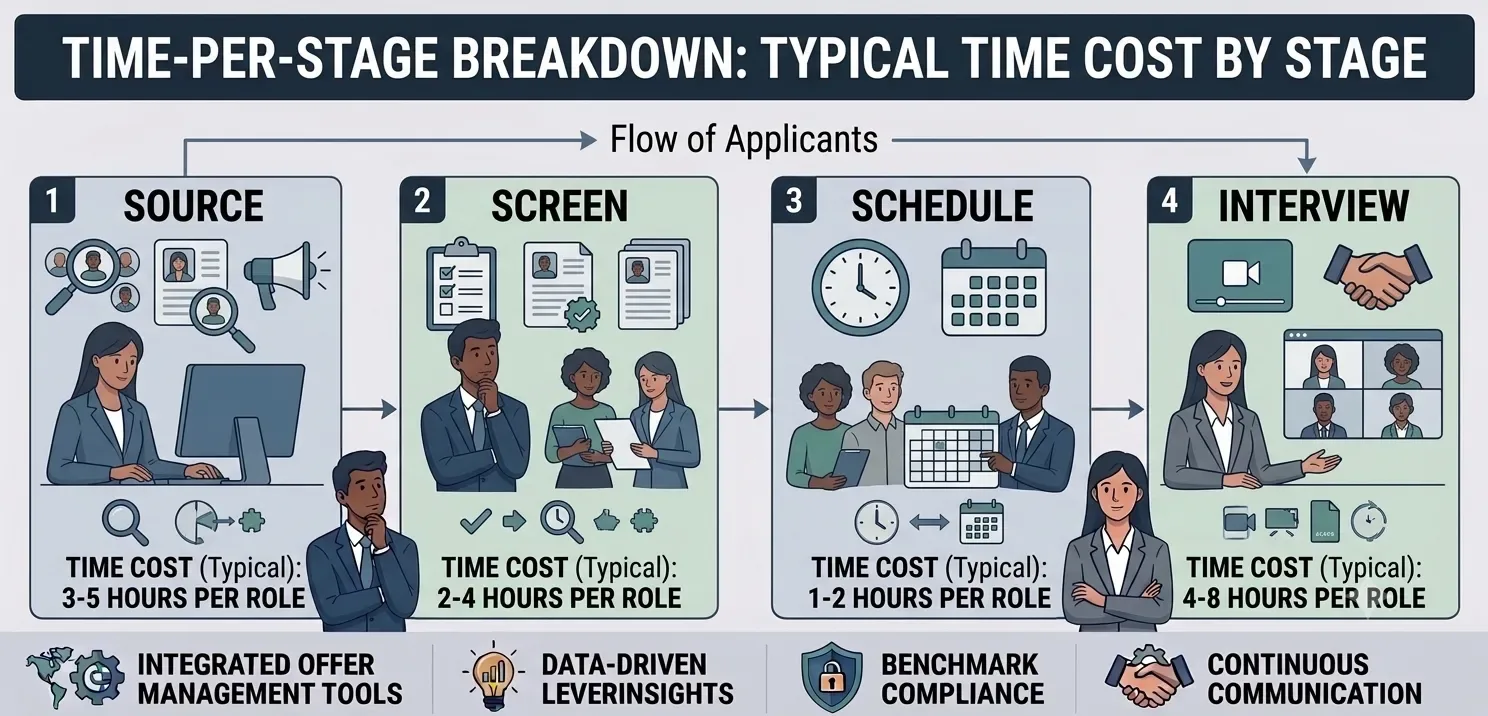
Time-per-stage breakdown
Rather than one blended “time to hire” figure, break the pipeline into stages: time to source a candidate, time to screen them, and time to schedule the resulting interview. A slow overall number can hide exactly where the actual bottleneck sits. If sourcing is fast but scheduling drags for a week, that’s a completely different fix than if screening itself is the slow part. Teams that only track the blended number often fix the wrong stage first, because the aggregate figure doesn’t point anywhere specific.
What Changes When You Automate Part of the Pipeline
Automation doesn’t make every part of recruiting faster it changes specific stages, and it’s worth being precise about which ones. Automated interview scheduling removes the back-and-forth email chain that typically eats days out of the time-to-schedule number. AI-assisted screening can shrink the time-to-screen stage by handling structured first-round evaluation consistently across a large candidate pool.
What doesn’t change: negotiation, relationship-building, and judgment calls on borderline candidates all stay human-paced no matter what tooling sits underneath them. A team that automates scheduling and screening should expect its time-per-stage numbers to shift specifically in those two stages. It shouldn’t expect a uniform improvement across the whole pipeline. Claiming otherwise oversells what any tool actually does.
This is exactly why the stage-by-stage breakdown matters more than a single blended number. A team that only tracks overall time-to-hire won’t see which specific stage improved after adopting new tooling. It won’t know whether the investment actually worked, or whether some other factor moved the number.
The Mistake to Avoid: Turning Metrics Into a Scoreboard
These numbers are diagnostic tools for the hiring process, not a way to rank recruiters against each other. A recruiter handling a harder set of requisitions will look “less productive” on paper than one handling easier roles, even if they’re doing better work. Using submittal-to-interview ratio or requisitions-per-recruiter as an individual performance score tends to backfire, especially without context. It pushes people toward gaming the number instead of doing better work submitting weaker candidates just to hit a ratio target, for example. Track these at the team and process level first. Individual context matters too much for a raw number to stand alone.
The recruiter running fewer searches with sharper judgment is often doing the harder, better job. Seeing that requires looking past raw activity to what’s actually converting.
Frequently asked questions
What is recruiter productivity, and how is it different from recruiter activity?
Activity is volume calls made, screens completed. Productivity is about outcomes relative to that volume, like how many submitted candidates actually convert to interviews. High activity with poor conversion isn’t productive, even though it looks busy.
What metrics measure recruiter productivity?
Requisitions per recruiter, submittal-to-interview ratio, and a time-per-stage breakdown across sourcing, screening, and scheduling are the three covered here. Together they show workload, candidate-matching quality, and where time actually goes.
How many requisitions should one recruiter handle?
There’s no reliable universal number. It depends on role complexity and hiring volume. Five technical leadership searches is a very different load than five entry-level roles, even though the count is identical.
Does automation actually improve recruiter productivity, or just shift the work?
Both, depending on the stage. Automated scheduling and AI-assisted screening genuinely shrink time spent in those specific stages. They don’t speed up negotiation or relationship-building, which stay human-paced regardless of tooling.
Is it a mistake to use these metrics to rank individual recruiters?
Generally, yes, without heavy context. Workload difficulty varies too much between recruiters for a raw number to fairly compare them. Use these metrics to diagnose the process first, not to score individuals.
Ready to Transform Your Hiring Process?
Discover how our AI-powered interview platform can streamline your recruitment and find the best candidates faster.
Make Your Hiring Process Smart and Fast