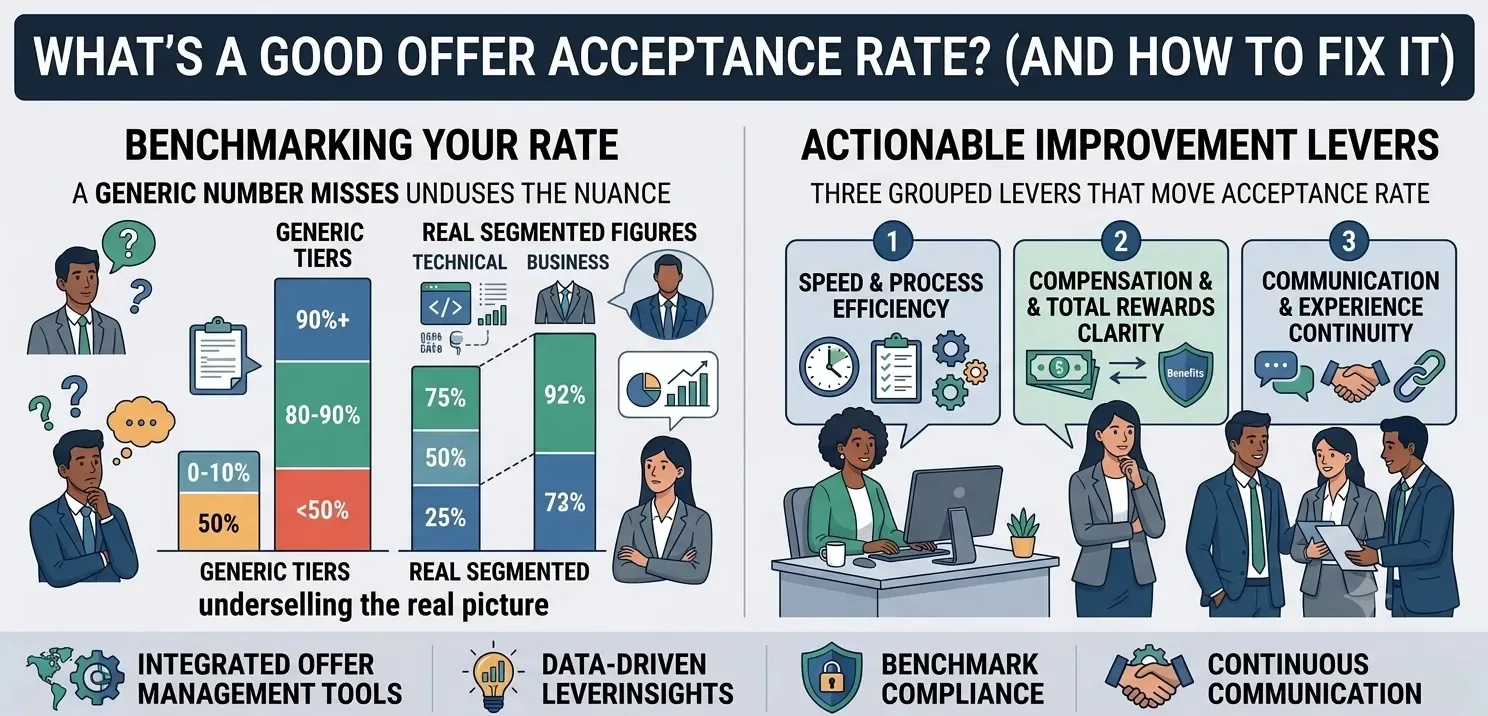
A recruiting team hits 90% and calls it a win. Another sits at 75% and worries something’s broken. Both might be doing fine. Offer acceptance rate isn’t one universal number. It depends heavily on what kind of role you’re hiring for, and most of the advice online doesn’t say so. This piece uses real segmented data, not a single flat benchmark, to fix that.
How to Calculate Offer Acceptance Rate
The formula is simple: divide the number of offers candidates accepted by the total number of offers you extended, then multiply by 100. If you extended 20 offers and 16 were accepted, your rate is 80%.
The tricky part isn’t the math. It’s deciding what to compare that number against. A flat industry average tells you less than you’d think, which is where most guides stop short.
Want the fuller picture on hiring costs too? InCruiter’s guide to calculating your cost per hire covers the other half of that equation. A low acceptance rate usually means a higher effective cost per hire. You’re re-running part of the process re-opening the requisition, re-screening candidates, and pushing your timeline out further.
What Counts as a Good Rate and Why That Depends on the Role
Most sources use a simple tier system. A rate of 90% or higher signals real competitive strength. Between 80% and 90% suggests some friction exists somewhere in the process. Below 50% points to a serious problem candidates are choosing other offers, or something in your process is pushing them away.
That tier system is a reasonable starting point, but it treats every role the same. Real data says otherwise. Ashby’s analysis of roughly 230,000 tracked offers between January 2021 and March 2024 found an overall three-year average of 78%. The number moved by year 77% in 2021, 76% in 2022, and 81% in 2023 but the more useful split is by function. Technical roles averaged 73% acceptance. Business roles averaged 84%. That’s an 11-point gap, and it held up consistently even through periods of industry layoffs.
Industry mattered too. Business services roles averaged 82% acceptance. Health technology sat at 80%. SaaS and cloud companies averaged 79%. Consumer apps and media roles came in lowest, at 73% and 72% respectively. If you’re hiring engineers at a consumer app company, a flat “90% is good” benchmark will make you feel like you’re failing. You might just be operating in a genuinely harder segment.
There’s a timing dimension too. The same data found candidates who accept an offer typically respond within about 2 to 2.8 days. Candidates who decline take longer, around 6 days on average. That makes sense declining usually means waiting to see if a better offer materializes first. Technical-role offers also sit open about a day longer than business-role offers before either happens. If a candidate hasn’t responded within your industry’s typical window, that’s a reasonable moment to check in, not necessarily a sign they’re gone.
Why Offer Acceptance Rates Drop
A handful of causes show up consistently, and none of them require guesswork.
Compensation that isn’t competitive. Candidates take the offer with better pay or benefits. This is the most direct and most common cause.
Slow hiring timelines. Every extra day between application and offer is a day a competing employer can move faster. InCruiter’s guide to time-to-fill and time-to-hire breaks down why that gap matters and how to measure it.
Poor candidate experience. Roughly 60% of candidates have abandoned a job application partway through because the process felt too complicated, according to HireVue research cited by AIHR. A frustrating process doesn’t just lose applicants earlier on it colors how candidates feel about the eventual offer too.
Weak employer brand. About 55% of jobseekers abandon an application after reading negative company reviews, per CareerArc data cited in the same source. That reputation follows candidates all the way to the offer stage.
Thin communication. Candidates who hear from you rarely, or only when something’s needed from them, have less reason to stay engaged once a competing offer appears.
The other side of the number: offer rescission
A low acceptance rate usually gets blamed entirely on candidates. Ashby’s data points to a less-discussed factor: employers rescinding offers after candidates decline something else, or after a hiring freeze hits mid-process. Its data found technical-role offers rescinded by the employer 17% of the time among declined offers, versus 27% for business roles. That’s a meaningful share of “declines” that were never really about the candidate at all. If your acceptance rate looks worse than expected, check how many of those were your own team pulling back. It might not be candidates walking away at all.
How to Actually Improve It
Rather than working through a long generic checklist, three levers account for most of the real movement.
Move faster, deliberately. Time is the one factor that compounds every other problem a slow process gives weak compensation and weak candidate experience more room to matter. Reducing delays in scheduling is one of the more mechanical fixes here; automated interview scheduling removes one of the more common sources of avoidable delay.
Be transparent about compensation earlier. Surface a realistic range before the final offer stage. That way, a candidate isn’t discovering a mismatch after they’ve already invested weeks in your process.
Stay in contact through the offer stage, not just up to it. Communication that stops the moment an offer goes out is a common, avoidable gap. A short check-in during the decision window costs little and keeps you visible against competing offers.
None of these levers guarantee a 90% rate. They address the causes that show up most often in the data. That beats a generic list of best practices meant to apply equally to every situation.
Don’t chase a flat 90% target if you’re hiring for roles or industries where the real benchmark sits lower. A rate that looks average against a generic number might already be strong for your specific segment. And one that looks fine against a generic number might be hiding a real, fixable problem underneath.
Reference:
Frequently asked questions
How do you calculate offer acceptance rate?
Divide the number of accepted offers by the total number of offers extended, then multiply by 100. A team that extends 20 offers and gets 16 acceptances has an 80% rate.
What’s a good offer acceptance rate?
Generically, 90%+ counts as strong and under 50% as concerning. But real platform data shows meaningful variation by role. Technical roles average closer to 73%, business roles closer to 84%. The honest answer depends on what you’re hiring for.
Is 80% a high acceptance rate?
It’s solidly within the “average, some friction” range by generic benchmarks, but for a technical role it sits above the segment average of 73%. Context matters more than the raw number.
Why do offer acceptance rates drop?
The most common causes are non-competitive compensation, slow hiring timelines, poor candidate experience, and weak employer brand. Thin communication during the decision window adds to all of them. It’s rarely one single mysterious factor.
How long should you wait for a candidate to respond to an offer?
Real platform data suggests candidates who plan to accept usually respond within 2 to 2.8 days. Those leaning toward declining tend to take closer to 6 days, often waiting to see if another offer comes through first. A check-in after a few days without a response is reasonable it isn’t premature.
Ready to Transform Your Hiring Process?
Discover how our AI-powered interview platform can streamline your recruitment and find the best candidates faster.
Make Your Hiring Process Smart and Fast