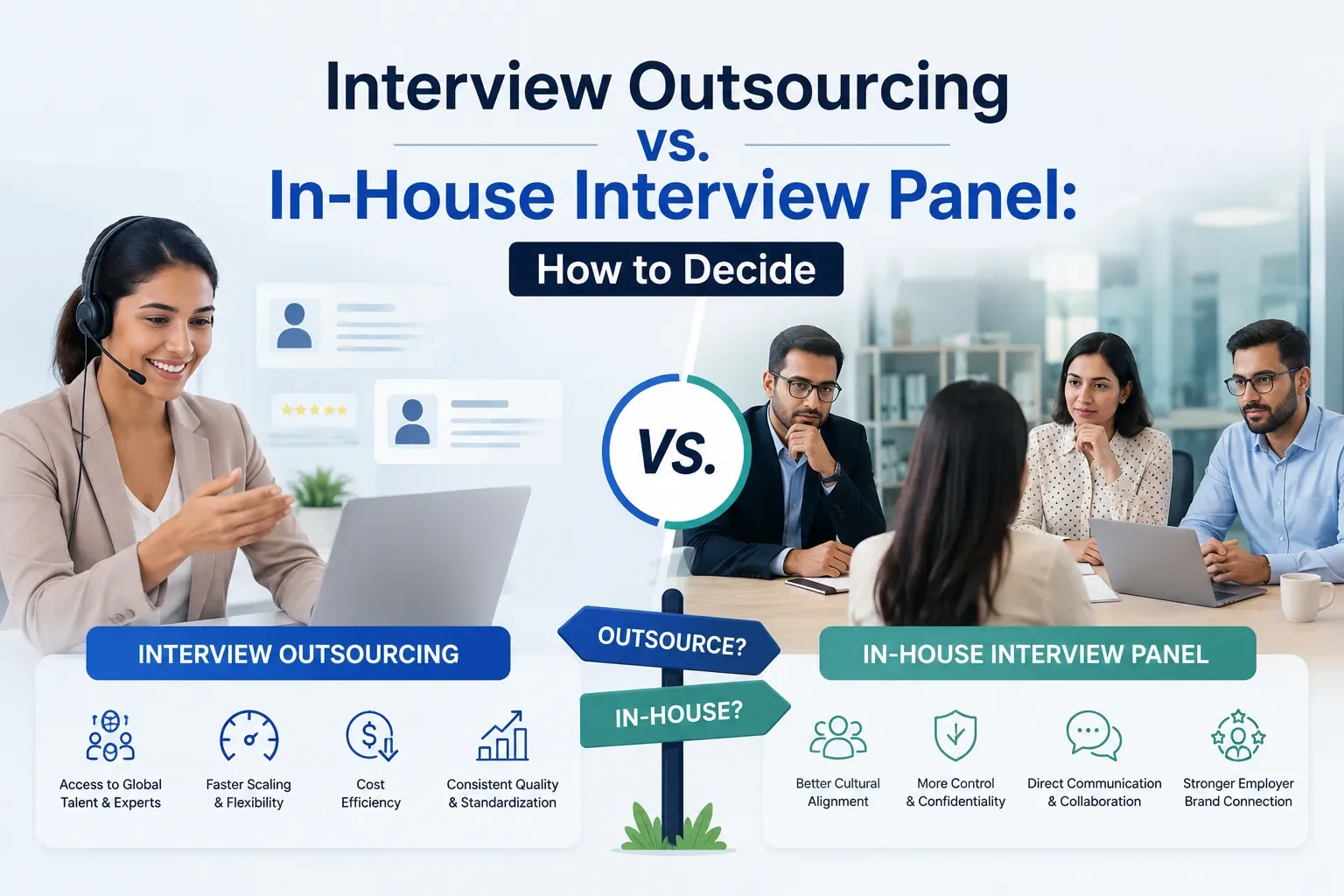
The Question That Actually Matters Here
Search “interview outsourcing company” and almost every result makes the same pitch: outsourcing is faster, cheaper, and more expert than doing it yourself. That’s often true, but it skips the harder, more useful question a hiring leader actually needs answered: should we build this capability ourselves, or is this specifically a job for a partner?
That’s a build-vs-buy decision, and it deserves to be treated like one, with real trade-offs on both sides, not a one-sided benefits pitch. Building an internal panel isn’t a mistake. Neither is outsourcing. The mistake is picking one by default without checking which trade-offs your actual hiring pattern can absorb.
What Building an Internal Interview Panel Actually Costs You
An internal panel means training your own employees, usually senior engineers, managers, or specialists, to conduct structured interviews on top of their regular job. The direct costs are recruiter and interviewer time, structured-interview training, and the tooling to keep evaluations consistent across different interviewers. The less obvious cost is ramp time: a newly formed internal panel doesn’t interview as consistently as an experienced outsourced panel on day one, and getting there takes real calendar time, not just a training session.
What you get in return is real: interviewers who already understand your culture, your team’s actual day-to-day work, and what “a good fit here” looks like beyond a scorecard. For roles you hire for constantly, that institutional knowledge compounds. It’s also the only option that keeps 100% of interview judgment inside the company, which matters for organizations that see interviewing itself as a core competency they want to own.
What Partnering With an Interview Outsourcing Company Actually Gets You
An interview outsourcing company solves a different problem: it removes the ramp-time and domain-coverage gap entirely by handing interviews to people who already do this, in your specific tech stack, at volume. InCruiter’s outsourced interviewer network spans 4,500+ experts across 250+ technologies, so a niche stack or a role your team has never had to interview for gets matched to someone with direct experience, not a generalist reading from a script.
The trade-off is the one internal-panel advocates raise first, and it’s fair: the interviewer isn’t your employee, and building the same depth of cultural context takes deliberate effort, usually through detailed briefing, shared scorecards, and a feedback loop with the provider. The upside is speed and consistency you can’t build overnight: InCruiter’s data shows outsourced technical interviews moving from request to completion in 6 hours, with a structured feedback report following within 2 hours, timelines a newly formed internal panel can’t match while it’s also still ramping.
Interview Outsourcing vs. In-House Panel, Side by Side
| **Factor** | **In-House Interview Panel** | **Interview Outsourcing Company** |
| Time to deploy | Weeks to months to train and calibrate | Days, using an existing trained panel |
| Cost pattern | Ongoing internal time cost, compounds with volume | Pay-per-use, scales with actual hiring need |
| Domain coverage | Limited to skills your current team has | Broad, matched to the specific role’s tech stack |
| Consistency early on | Variable while the panel is new and calibrating | Consistent from day one, provider has already standardized it |
| Cultural fit judgment | Strong, interviewers live your culture daily | Requires deliberate briefing to build context |
| Best fit for | Steady, high-frequency roles your team hires constantly | Spikes, niche skills, and roles nobody internal can properly assess |
| Long-term ownership | Full control stays inside the company | Shared, dependent on provider’s transparency and reporting |
The Real Decision Triggers, Not Just Headcount
Total open roles is the wrong number to anchor this decision on. The trigger that actually matters is variability. A team hiring the same three role types steadily, month after month, has time to build and calibrate an internal panel properly, and the compounding cultural-fit benefit is worth the upfront investment. A team facing an unpredictable spike, a sudden funding round, a new product line requiring a stack nobody on staff has touched, or a short-term contract push, is solving a completely different problem, and building a panel for it means training people for a need that might not exist in six months.
Role complexity matters just as much. A role that’s core to your business and hired for constantly (say, backend engineers at a product company) benefits from internal ownership. A role that’s rare, highly specialized, or outside your team’s actual expertise (a niche legacy stack, a compliance-heavy technical role, a language your engineering team doesn’t use) is exactly where an outsourced expert closes a gap internal training can’t close quickly.
Where This Usually Actually Lands: A Hybrid
In practice, most hiring functions that get this right don’t pick one side permanently. They build internal panels for the roles that define their core hiring motion, and lean on an interview outsourcing company for the rest: sudden volume spikes, niche or unfamiliar tech stacks, and final-round technical assessments where independent, expert judgment adds more value than internal familiarity. That’s not indecision, it’s matching the tool to the actual variability in the hiring pattern instead of forcing every role through the same process.
Questions to Ask Before You Decide
a) How Predictable Is This Hiring Need?
If you’re hiring for this role type every month indefinitely, that favors building internal capacity. If this is a one-time spike or a role you might not need again for a year, that favors outsourcing.
b) Does Anyone Internally Actually Know This Domain?
Be honest about whether your current team can evaluate the specific skill at the level the role needs, or whether “we’ll figure it out” is doing a lot of quiet work in that plan.
c) What Happens to Quality While the Internal Panel Ramps?
If you build internal, budget for a real calibration period where consistency will be lower than you want. If that ramp period coincides with urgent hiring need, outsourcing the interim gap is often cheaper than a bad early hire.
How InCruiter Supports Either Path
For the outsourcing side of this decision, InCruiter’s IncServe gives access to 4,500+ expert interviewers across 250+ technologies, with interviews conducted within 6 hours of a request and feedback delivered within 2 hours, plus direct integration into ATS platforms like Greenhouse, Workday, and Bullhorn so results land wherever your hiring data already lives. For teams building internal capacity instead, InCruiter’s broader platform, including structured AI-scored interviews through IncBot and standardized scorecards, helps a newly formed internal panel calibrate faster and more consistently than an unstructured, ad hoc process would.
Not sure which side of this decision your team is actually on? Book a demo with InCruiter and talk through where outsourcing fills a real gap versus where building internally is worth the investment.
Also Read:
The Real ROI of Interview as a Service: Is It Worth the Investment?
Frequently asked questions
Is it always cheaper to build an internal interview panel than to outsource?
Not necessarily. Internal panels have real ongoing costs in interviewer time, training, and calibration that don’t show up as a line item the way an outsourcing invoice does. For steady, high-frequency roles the math often favors building internally over time; for unpredictable or niche hiring needs, the ramp cost of building internal capacity can exceed what outsourcing would have cost.
Can we outsource just some interviews and keep others in-house?
Yes, and this is how most mature hiring functions actually operate. It’s common to keep culture-fit and final-round decisions internal while outsourcing technical screening, niche-skill assessments, or high-volume early rounds to a provider.
How fast can an outsourced interview panel actually get started, compared to building one internally?
An established outsourcing provider can typically start conducting interviews within days, since the panel is already trained and calibrated. Building an internal panel from scratch usually takes weeks to months before it reaches the same consistency.
What’s the biggest risk of building an internal panel too early?
Training people to interview for a role or volume pattern that turns out to be temporary. That effort doesn’t transfer well if the hiring need changes, whereas an outsourced provider absorbs that variability without leaving you with a trained-but-underused internal team.
What’s the biggest risk of outsourcing everything instead of building any internal capacity?
Losing visibility into how candidates are actually being assessed if the provider isn’t transparent about criteria, scoring, and reporting, and potentially losing the compounding cultural-fit judgment that only comes from interviewers who live in your organization daily.
Ready to Transform Your Hiring Process?
Discover how our AI-powered interview platform can streamline your recruitment and find the best candidates faster.
Make Your Hiring Process Smart and Fast