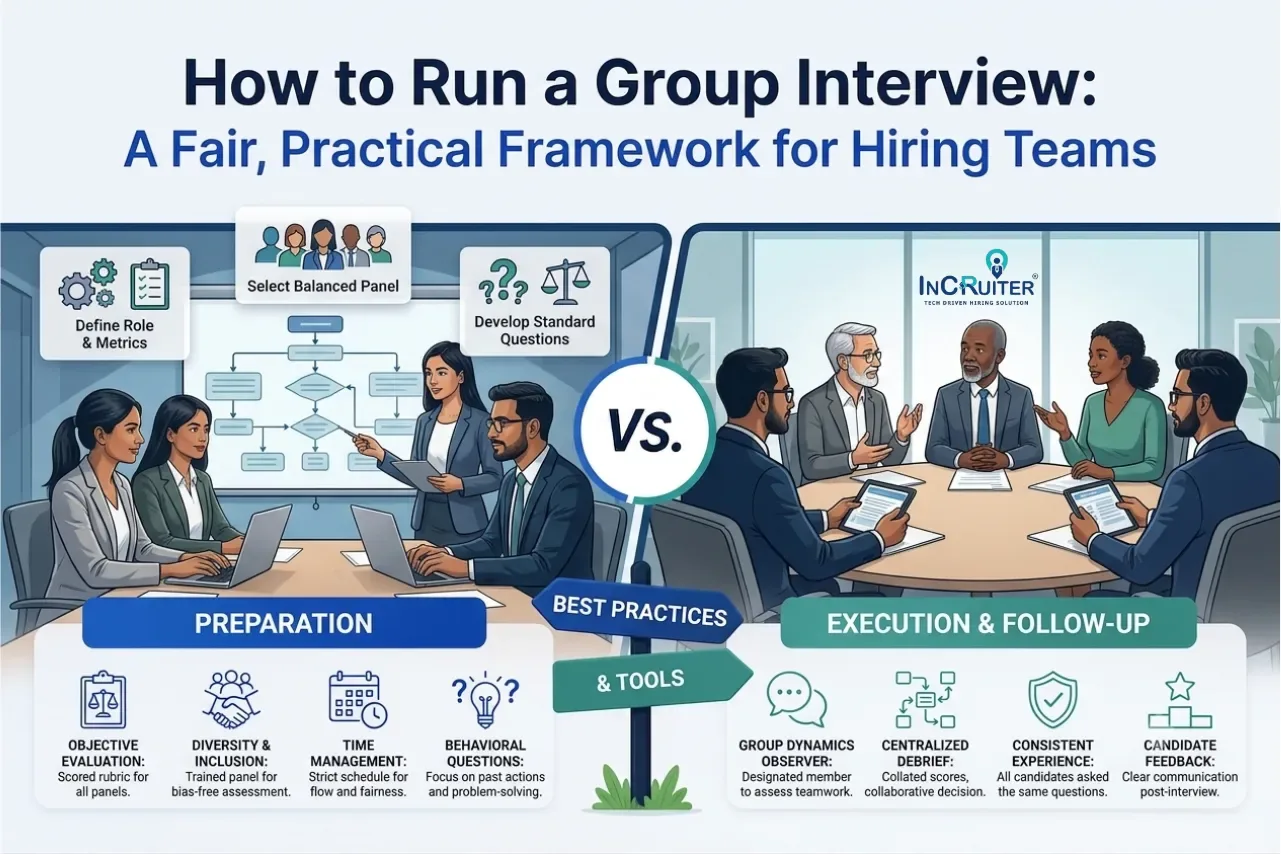
A group interview puts several candidates in the same room or the same call at the same time. It’s efficient: one time slot covers what would otherwise take several separate conversations, and it lets you watch how candidates actually behave alongside other people, not just how they describe themselves. It’s also, done carelessly, one of the least fair interview formats available: the candidate who talks first, talks most, or talks loudest tends to get remembered best, regardless of who actually answered better.
This is a guide for the person deciding whether to run a group interview and, if so, how to run one that doesn’t just reward confidence. It’s not a candidate-prep article, and it’s not a glossary entry it’s about structuring the session, the questions, and the scoring so every candidate in the room gets a fair, comparable shot.
What a Group Interview Is (and Isn’t)
A group interview is a single session where multiple candidates are evaluated together answering the same or similar questions, sometimes completing a shared task or discussion rather than being interviewed one at a time. It’s commonly used for high-volume roles, campus hiring, and positions where collaboration or communication under a bit of social pressure is genuinely part of the job.
It’s easy to confuse with a panel interview, but they solve different problems. A panel interview is multiple interviewers, one candidate the goal is to get several stakeholders’ independent read on a single person. A group interview is multiple candidates, one session the goal is usually throughput (screening many candidates quickly) or observing interpersonal behavior directly. If your actual goal is getting cross-functional buy-in on a single hire, you want a panel, not a group interview. If your goal is moving quickly through a large applicant pool for a role at similar seniority, a group interview may fit with the right structure.
When a Group Interview Is Worth It and When It Isn’t
Group interviews tend to earn their efficiency cost when:
- You’re hiring at volume for similarly-scoped roles campus recruitment drives, seasonal retail hiring, or entry-level BPO roles are the classic cases.
- The role genuinely involves working alongside others under time or social pressure, and watching that dynamic live tells you something a one-on-one answer wouldn’t.
- You need to screen a large pool down to a shortlist quickly, and a lighter-touch group round before deeper one-on-ones is a reasonable filter, not the final decision point.
They tend to create more risk than value when:
- The role requires deep individual technical assessment a shared-room format doesn’t give you enough uninterrupted signal on any one candidate’s depth.
- Your candidate pool is small. With few candidates, the efficiency gain is minimal and the fairness risk (one confident candidate skewing the read on everyone) isn’t worth taking.
- The hire is senior enough that a wrong read has real cost at that level, the individual depth of a one-on-one or the multiple-stakeholder rigor of a panel interview is worth the extra time.
If you’re running group interviews because they’re fast and have “always been how we screen campus hires,” it’s worth checking that reasoning against what the role actually needs before locking in a session.
Structuring the Session So Every Candidate Gets a Fair Shot
The single biggest failure mode in group interviews is airtime imbalance: a confident or simply louder candidate ends up answering more questions, or answering first every time, while a quieter (and possibly stronger) candidate gets less opportunity to demonstrate anything at all. Fix this with structure, not goodwill.
Rotate who answers first. Assign a fixed order at the start, and rotate it every question whoever answered first last time answers last this time. This one rule does more to equalize airtime than any amount of “let’s make sure everyone gets a chance” facilitation in the moment.
Time-box individual answers, especially for open-ended questions. Without a soft time limit, confident candidates will naturally take more of the available time, and interviewers will have less signal on everyone else by the time the session ends.
Handle logistics before the room fills up. If you’re running several candidates through one session, coordinate arrival times with buffer between them, use name cards or a visible seating chart so interviewers can track who said what, and confirm the format with candidates in advance so nobody’s caught off guard by seeing other applicants in the room. If your team runs these rounds often particularly for campus recruitment or high-volume seasonal hiring coordinating multiple candidates’ and interviewers’ calendars for a single slot is exactly the kind of multi-participant scheduling problem interview scheduling software is built for, rather than managing it over email or a shared spreadsheet.
For virtual group interviews, confirm every candidate’s video and audio work before the session starts a candidate struggling with a technical issue while others wait isn’t a fair test of anything and assign one person to manage the queue (muting, unmuting, keeping time) so the lead interviewer can focus on the conversation itself.
Designing Questions That Work in a Group Setting
Not every question works well when several candidates are answering it in sequence. Open-ended, opinion-based questions (“what’s your biggest strength?”) tend to reward whoever answers with the most polish, not whoever has the strongest actual fit and by the fourth candidate, you’re often hearing a slightly reworded version of the first three answers.
Questions that work better in a group format tend to be:
- Scenario-based and specific enough that candidates can’t easily converge on the same answer “describe a time you had to explain a technical problem to someone non-technical” gets more differentiated answers than “how do you communicate?”
- Tied to something observable in the room, if you’re using a light collaborative task not to create artificial competition, but because how a candidate contributes to a shared, low-stakes exercise is genuinely harder to fake than a rehearsed answer.
- Distributed across the group, not identical for everyone if every candidate answers the exact same prompt back-to-back, you’re mostly testing who went last and had time to refine their answer while listening to everyone else. Assigning related-but-distinct prompts per candidate reduces this.
Avoid pitting candidates directly against each other (“who here would make the best team lead?”) it manufactures artificial competition that tells you more about who’s comfortable being adversarial than who’s actually qualified, and it’s the kind of question most likely to produce a defensible fairness complaint later.
Scoring Candidates Without Comparing Them to Each Other
This is where group interviews go wrong most often, and it’s rarely intentional. When candidate three gives a noticeably strong answer, interviewers naturally start scoring candidates four and five relative to candidate three, rather than against the actual job requirement. That’s comparison bias, and it means your scores are measuring “how did this person do relative to whoever happened to be in the room with them” not “does this person meet the bar for the role.”
The fix mirrors the same principle that works in panel interviews, adapted for the different problem: score immediately, independently, and against a fixed rubric not after hearing everyone.
- Write the rubric before the session, tied to the actual role requirement, with concrete anchors for what a strong, adequate, and weak answer looks like. This is the fixed bar every candidate gets measured against, regardless of who answered around them.
- Score each candidate immediately after their turn, before the next candidate speaks a silent scorecard pass, not a group discussion in the moment. This prevents a strong or weak answer from a neighboring candidate from coloring how you hear the next one.
- Don’t rank candidates against each other until after every candidate has been scored against the rubric independently. Ranking is a legitimate final step for deciding who advances it should never be the mechanism you use to arrive at each candidate’s score.
This matters beyond fairness to individual candidates. Interview research on structured versus unstructured evaluation including a review of the topic by McGill University’s Department of Psychology, synthesizing findings from Levashina et al. (2013) and Macan (2009) consistently finds that unstructured, comparison-driven evaluation is more susceptible to halo effects and first-impression anchoring than structured, rubric-based scoring. A group format makes that risk worse by design, simply because candidates are heard back-to-back; a fixed rubric and immediate, independent scoring is the direct counter to it.
Common Mistakes That Undermine Group Interviews
- No fixed speaking order, so the same confident candidates naturally end up talking the most across the whole session.
- Scoring after the session instead of after each turn by the time you’re filling out scorecards for five candidates from memory, you’re mostly remembering whoever was most memorable, not whoever was strongest.
- Using identical open-ended questions for every candidate, which rewards whoever answers last and had time to refine their response while listening to everyone else.
- Treating a group interview as the final decision for anything beyond entry-level or high-volume roles, rather than as a first-pass filter ahead of a deeper one-on-one.
- Skipping the pre-session logistics, leaving candidates waiting together with no context, which creates an awkward, uneven start to the session before a single question is even asked.
A Group Interview Checklist
Before:
- Confirm a group interview is the right format for this role and candidate volume
- Write the scoring rubric, tied to the role, before the session
- Set a rotating speaking order
- Confirm logistics (room/call setup, timing, candidate notification) in advance
During:
- Rotate who answers first, every question
- Time-box individual answers
- Score each candidate immediately after their turn, before the next one speaks
- For virtual sessions, confirm audio/video for every candidate before starting
After:
- Finalize each candidate’s score against the rubric before comparing candidates to each other
- Rank only after independent scoring is complete
- Document the reasoning behind each score, not just the number
Group interviews are a legitimate tool for the right hiring situation high volume, comparable seniority, or roles where interpersonal behavior is a genuine signal. They stop being useful the moment they turn into a popularity contest between candidates who happened to be scheduled together. Structure rotation, a fixed rubric, and immediate independent scoring is what keeps the format fair.
Frequently asked questions
What’s the difference between a group interview and a panel interview?
A panel interview is multiple interviewers evaluating one candidate at the same time the goal is a shared, multi-stakeholder read on a single person. A group interview is multiple candidates being evaluated in the same session the goal is usually efficiency at volume, or observing how candidates behave alongside others. They’re often confused because both involve “more than one person in the room,” but the structure and the goal are different.
What’s the ideal number of candidates in a group interview?
Enough to be efficient without losing individual signal most hiring teams find 4 to 6 candidates workable. Beyond that, individual airtime per candidate drops enough that the format stops giving you meaningful signal on any one person.
Are group interviews unfair to quieter candidates?
They can be, if run without structure that’s the core risk this format carries. A fixed rotating speaking order, questions that don’t reward pure verbal confidence, and independent scoring immediately after each candidate’s turn are the specific fixes for that risk, not a reason to avoid the format outright.
How do you score a group interview fairly?
Score every candidate independently, immediately after their turn, against a rubric written before the session not after hearing the whole group, and not by ranking candidates against each other in the moment. Rank only as a final step, after every candidate has an independent, rubric-based score.
Ready to Transform Your Hiring Process?
Discover how our AI-powered interview platform can streamline your recruitment and find the best candidates faster.
Make Your Hiring Process Smart and Fast