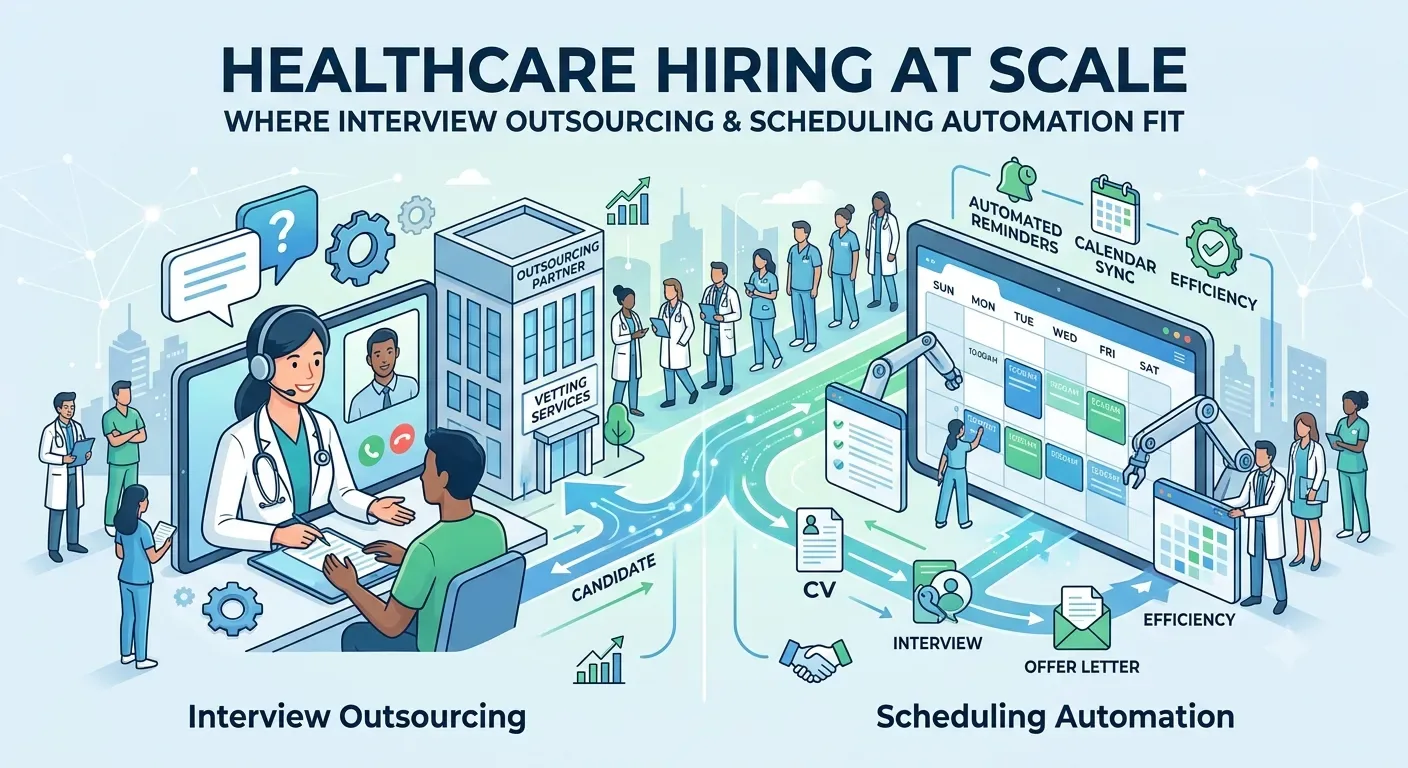
A hospital system hiring 40 nursing assistants a month faces a different problem than a tech company hiring 5 engineers a quarter. The volume is higher. The roles are shift-based. Many candidates can’t take a 2pm Tuesday interview call, because they’re on a floor shift at that exact time. Generic recruiting software assumes a standard 9-to-5 applicant pipeline. That assumption doesn’t hold in healthcare hiring. This isn’t a case for replacing your ATS. It’s about what actually needs to change at the interview stage.
Why Healthcare Hiring Breaks Generic Recruiting Tools
Most recruiting software assumes a fairly standard pattern. A candidate applies. A recruiter reviews the application during business hours. An interview gets scheduled a few days out. Healthcare hiring doesn’t follow that pattern in practice.
Roles like nursing assistants, medical technicians, and patient-facing support staff get hired at high volume. Hiring often runs on a tight timeline tied to a shift-coverage gap, not a planned headcount increase. Candidates for these roles often work shift schedules themselves already, which makes a standard daytime interview slot genuinely hard to fill, not just inconvenient.
InCruiter’s healthcare hiring solutions page frames the actual problem directly: finding candidates usually isn’t the hard part. Managing volume and coordination once they’ve applied is. A generic recruiting tool built for steady, low-volume hiring doesn’t have a real answer for either half of that.
Where Interview Outsourcing Fits
Screening a high volume of candidates for customer-facing healthcare roles takes real interviewer time, and healthcare TA teams often run lean well before a hiring surge even starts. Interview outsourcing addresses this directly.
Rather than growing internal recruiting headcount to handle a temporary surge, outsourced interviewing adds trained interviewers who can run first-round screens at volume, consistently. InCruiter states that its IncServe offering connects healthcare and manufacturing hiring teams with outside interviewers for exactly this kind of high-volume, first-round screening. That’s a claim from InCruiter’s own page, not an independently audited figure, but it genuinely matches the problem described above.
Picture a facility that needs to fill 15 certified nursing assistant openings before a new wing opens in six weeks. The internal team can post the role and collect 200 applications without much trouble. Screening 200 applicants for the right mix of certification, availability, and fit inside six weeks is a different task entirely, and it’s the one that stalls most often. Outsourced first-round interviewers can absorb that volume spike without the facility hiring and training temporary internal recruiters for a one-time surge.
This matters most during hiring surges: a seasonal staffing push, a new facility opening, or backfilling after unexpected turnover. A generic ATS can hold the applications just fine. It doesn’t add interviewer capacity when volume spikes past what an internal team can reasonably screen.
Why Scheduling Is the Hidden Bottleneck
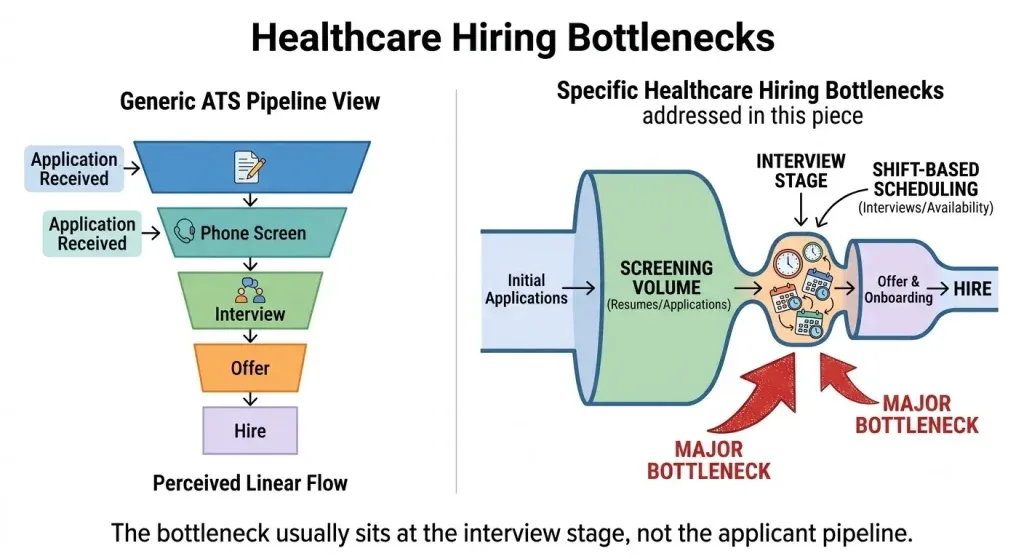
Even when screening capacity isn’t the problem, getting a shift-working candidate onto an interview calendar often is. A candidate working overnight shifts can’t take a standard 10am interview slot. Manually working around that for dozens of candidates a month eats real recruiter time, one calendar invite at a time.
InCruiter states that its IncFeed scheduling tool coordinates scheduling around shifts and time zones. It also sends automated reminders to reduce no-shows. That’s a direct answer to the coordination problem, not a generic calendar built for 9-to-5 availability.
The two problems compound each other. A candidate who is hard to schedule and slow to screen carries real risk of accepting another offer before your process even finishes. Solving only one half of the problem, more interviewer capacity without better scheduling or the reverse, leaves the other half of the bottleneck fully in place.
Three Signs Your Bottleneck Is the Interview Stage, Not the Pipeline
Not every healthcare hiring slowdown is an interview-stage problem. Before evaluating interview outsourcing or scheduling automation, check whether these three signs actually match your situation.
Applications convert to scheduled interviews slowly, but not to any response slowly. If candidates apply and hear nothing for days, that usually points to a pipeline or sourcing issue. If candidates get an initial response quickly but then wait a long time for an actual interview slot, that points to a screening or scheduling constraint instead.
Recruiters describe screening as the time-consuming part, not finding candidates. Teams with a pipeline problem usually say they don’t have enough applicants. Teams with an interview-stage problem usually say the opposite: applicants aren’t the issue, getting through them fast enough is.
Shift-based candidates drop out before interviewing more than other candidates do. Check whether the no-show and drop-off rate runs noticeably higher for shift-working roles than for standard daytime roles. If it does, that’s a strong signal the scheduling process itself, not candidate interest, is the actual problem.
What to Actually Look For, Not a Full ATS
If your applicant pipeline already works and the bottleneck sits specifically at the interview stage, the right fix is narrower than a full ATS replacement. A few concrete things to check:
- Does the tool genuinely handle shift-based scheduling, not just standard business-hours slots dressed up as flexible?
- Does the outsourced screening team actually specialize in the roles you’re hiring? A generic call-center-style screen that treats a CNA role the same as a retail role won’t catch the right things.
- Can it scale up temporarily for a hiring surge and scale back down afterward, without a long-term headcount or contract commitment?
- Does it integrate with the ATS you already use, instead of trying to replace the parts of it that already work fine?
Getting this distinction right matters. Buying a full platform replacement to fix an interview-stage bottleneck is expensive and slow to roll out. Buying a narrow interview-outsourcing or scheduling tool when the real problem sits upstream, in sourcing or application volume, won’t fix that problem either. The honest answer requires being specific about exactly where candidates are stalling.
The hiring surge itself usually isn’t the hard part most healthcare organizations know how to post a role and get applicants. The hard part is turning that volume into scheduled interviews fast enough that shift-working candidates don’t take another offer first.
Frequently asked questions
Why is healthcare hiring different from hiring in other industries?
It typically runs at higher volume and on shift-based schedules. Candidates for roles like nursing assistants or patient-facing support staff often already work shift schedules themselves. That makes standard daytime interview slots genuinely hard to fill, and hiring surges tied to shift-coverage gaps happen often.
What is interview outsourcing, and how does it help healthcare hiring?
It adds trained interviewers to handle first-round screening without growing internal recruiting headcount. That helps specifically during volume spikes an internal team can’t screen through fast enough on its own.
How does scheduling automation help with shift-based healthcare hiring?
It coordinates interview slots around shift patterns and time zones instead of assuming standard business-hours availability. It can also send automated reminders that reduce no-shows from candidates juggling shift schedules.
Does outsourced screening work for compliance-heavy healthcare roles?
It depends on what the screen is checking for. Outsourced first-round interviewers can assess communication, availability, and role fit at volume. Credential and license verification is a separate compliance step that should stay with a qualified internal or licensing-specific process, not something a general screening interview is assumed to cover.
Do I need a full ATS, or something more specific to interviewing?
It depends on where your actual bottleneck sits. If applications sit unreviewed for days, that’s an ATS or sourcing problem. If applications get reviewed but screening and scheduling interviews is the slow part, that’s the narrower problem interview outsourcing and scheduling automation address.
Ready to Transform Your Hiring Process?
Discover how our AI-powered interview platform can streamline your recruitment and find the best candidates faster.
Make Your Hiring Process Smart and Fast