




Hiring the right developers has become harder than ever. Resumes and traditional technical interviews often fail to show how a candidate actually thinks, communicates, or solves problems in real situations. Many candidates perform well in theory but struggle when working on real coding tasks with a team.
Pair programming interviews help hiring teams bridge this gap. Instead of relying on isolated questions, this interview format allows interviewers and candidates to work together on a live coding problem. It reveals practical coding skills, collaboration ability, and problem-solving approach in real time. In this guide, you’ll learn how pair programming interviews work, why companies use them, and how to conduct them effectively for technical hiring.
Why Technical Hiring Needs Better Interview Methods
Technical hiring mistakes can be expensive and disruptive for any organization. Selecting a candidate based only on resumes or standard interview questions often leads to mismatched skills and unmet expectations once the candidate starts working. Replacing such hires costs time, money, and team productivity.
Traditional interview methods focus heavily on theoretical knowledge or isolated coding tests. However, real engineering work requires collaboration, communication, and the ability to solve problems under practical constraints. Pair programming interviews address these challenges by simulating real working conditions. By observing how candidates write code, explain their thinking, and respond to feedback, hiring teams gain a clearer and more reliable view of a candidate’s true technical ability.
What is a Pair Programming Interview?
A pair programming interview is a practical and collaborative way to evaluate a developer’s real-world skills. Instead of solving problems alone, the candidate and interviewer work together on a live coding task. This approach is inspired by Agile and Extreme Programming (XP) practices, where teamwork and continuous feedback are core principles.
During the interview, the candidate usually takes the role of the Driver, writing and running the code, while the interviewer acts as the Navigator, reviewing logic, asking questions, and suggesting improvements. These roles may switch during the session to understand how well the candidate adapts, explains decisions, and responds to feedback. This setup mirrors how developers actually work in teams.
Many hiring teams prefer this method because it provides deeper insight into a candidate’s problem-solving approach, communication skills, and coding quality. Compared to traditional interviews, pair programming interviews help reduce hiring risks and improve confidence in final decisions.
How Pair Programming Interviews Work (Step-by-Step)
Interview Setup and Environment
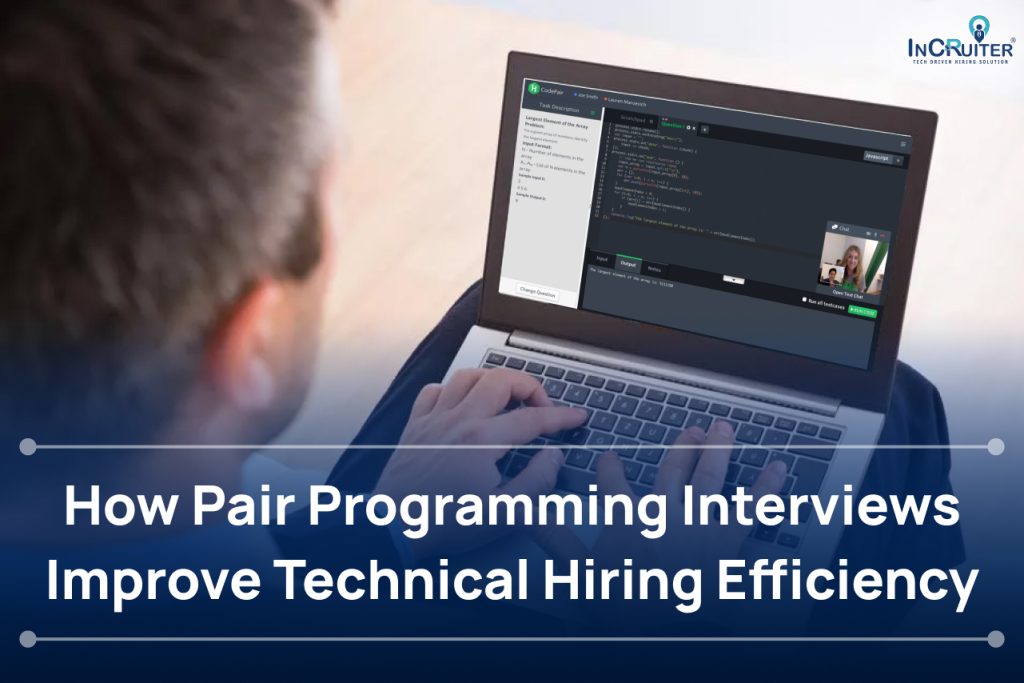
Pair programming interviews are usually conducted on a live coding tools that supports real-time collaboration. Both the interviewer and candidate join the session remotely or in person and work within a shared code editor. The environment often includes features like syntax highlighting, compiler support, and chat or audio communication.
The goal is to create a realistic development setup rather than a stressful test. Candidates are encouraged to think out loud, ask questions, and approach the problem naturally, just as they would in a real work scenario.
Role of Interviewer and Candidate
In a pair programming interview, both participants actively collaborate. The candidate typically starts as the Driver, writing code and implementing solutions. The interviewer acts as the Navigator, guiding the process by reviewing logic, suggesting improvements, and asking clarifying questions.
Roles may switch during the interview to observe how the candidate adapts, reviews code, and contributes beyond writing syntax. This role-sharing helps assess teamwork, flexibility, and communication skills.
Types of Problems Used
The problems used in pair programming interviews are usually job-relevant and practical. These may include debugging an existing function, building a small feature, or optimizing a piece of code. The focus is not on complex algorithms but on real-world challenges developers face daily.
By using realistic tasks, interviewers can better evaluate how candidates apply knowledge, handle edge cases, and structure clean, maintainable code.
What Interviewers Observe During the Session
During the session, interviewers look beyond the final output. They observe how the candidate breaks down the problem, communicates ideas, responds to feedback, and handles mistakes. Attention is also given to coding style, logic clarity, and debugging approach.
This holistic observation helps hiring teams understand whether the candidate is a good technical and cultural fit for the organization.
Key Benefits of Pair Programming Interviews for Technical Hiring
Real-Time Assessment of Coding and Problem-Solving Skills
One of the strongest advantages of pair programming interviews is the ability to evaluate candidates while they code. Instead of depending on resumes or theoretical whiteboard questions, recruiters can see how a candidate approaches a real problem, writes logic, and fixes errors in real time.
This method reveals practical skills such as code structure, debugging ability, and decision-making under realistic conditions. It gives hiring teams a clearer picture of how a candidate would perform on actual job tasks.
Better Evaluation of Communication and Collaboration Skills
Technical skills alone are not enough for modern development teams. Pair programming interviews allow recruiters to observe how well a candidate communicates ideas, responds to suggestions, and collaborates during problem-solving.
Through live interaction, interviewers can assess analytical thinking, openness to feedback, and the ability to explain code clearly. This helps determine whether the candidate can work effectively in a team-based environment.
Clear Insight into the Candidate’s Thought Process
Pair programming interviews go beyond checking whether the final solution works. They focus on how the candidate thinks while coding. Recruiters can understand the reasoning behind each decision, the approach to breaking down problems, and how the candidate handles complexity.
This insight is valuable for identifying developers who can align with team workflows, adapt to challenges, and contribute meaningfully to collaborative projects.
Pair Programming Interview Examples
Example for Junior Developers
In a pair programming interview for junior developers, the focus is on fundamentals rather than speed or complex logic. The interviewer may ask the candidate to solve a basic problem such as validating user input, fixing a small bug, or writing a simple function.
During the session, the interviewer observes how the candidate understands requirements, writes clean code, and explains basic decisions. Even if the solution is not perfect, the ability to ask questions, accept guidance, and improve the code matters more. This approach helps identify candidates who are eager to learn and can grow within a team.
Example for Mid-Level Engineers
For mid-level engineers, the interview usually involves a more practical and slightly complex task. The candidate might be asked to build a small feature, refactor existing code, or optimize a function for better performance.
Here, interviewers pay attention to problem-solving structure, code organization, and collaboration style. Candidates are expected to justify their choices, handle edge cases, and respond confidently to feedback. This type of session reveals how well the candidate balances technical skills with teamwork.
Example for Senior or System Design Roles
Pair programming interviews for senior roles focus less on syntax and more on decision-making and architecture. The interviewer may present a high-level problem, such as designing a scalable feature or improving an existing system.
Instead of writing large amounts of code, the candidate collaborates on breaking down requirements, discussing trade-offs, and planning implementation steps. Interviewers observe leadership qualities, communication clarity, and the ability to guide technical discussions. This format helps assess whether the candidate can mentor others and contribute to long-term system design.
How to Evaluate Candidates in Pair Programming Interviews
Evaluating candidates in pair programming interviews requires a broader lens than traditional coding tests. The goal is not just to check whether the code works, but to understand how the candidate thinks, communicates, and collaborates in real time.
Instead of scoring candidates on speed alone, interviewers should focus on observable behaviors during the session. Pair programming provides a rare opportunity to assess both technical and interpersonal skills together, making evaluation more accurate and practical.
Below is a structured way to assess candidates across key skill areas.
Pair Programming Interview Evaluation Criteria
| Skill Area | What to Look For |
|---|---|
| Problem-Solving | Breaks problems into steps, considers edge cases, discusses trade-offs before coding |
| Communication | Clearly explains logic, thinks aloud, asks relevant clarifying questions |
| Collaboration | Responds positively to hints, discusses alternatives, works as a partner rather than in isolation |
| Code Quality | Writes readable code, uses meaningful names, structures logic for maintainability |
| Adaptability | Accepts feedback, adjusts approach when needed, remains calm under guidance |
Best Practices for Conducting Pair Programming Interviews
Pair programming interviews work best when they are structured, fair, and focused on real-world skills. A well-run interview not only improves hiring accuracy but also creates a positive experience for candidates.
Below are best practices that hiring teams should follow before, during, and after the interview.
Preparing for the Interview
Preparation sets the tone for the entire session. Interviewers should select problems that reflect real tasks from the role rather than puzzle-based challenges.
Key preparation tips:
- Choose a problem that can be discussed and partially solved within the interview time
- Share expectations with the candidate in advance (language, tools, time limits)
- Ensure the coding environment is tested and ready before the interview starts
- Define evaluation criteria beforehand to avoid subjective decisions
Good preparation helps candidates focus on problem-solving instead of guessing what the interviewer wants.
Conducting the Interview
During the interview, the focus should be on collaboration rather than pressure. Interviewers should act as partners, not silent observers or judges.
Best practices during the session:
- Encourage candidates to think aloud while coding
- Ask open-ended questions instead of giving direct answers
- Observe how candidates respond to hints and feedback
- Allow space for discussion, refactoring, and alternative approaches
The goal is to understand how the candidate works, not to rush them to a perfect solution.
Post-interview evaluation
Evaluation should happen immediately after the session while observations are fresh. Instead of relying on memory, interviewers should review notes mapped to predefined skill areas.
Effective post-interview steps:
- Assess candidates using structured criteria, not gut feelings
- Discuss observations with other interviewers if involved
- Balance technical skills with communication and collaboration abilities
- Document feedback clearly for future reference
This approach leads to fairer decisions and reduces bias in technical hiring.
Pair Programming Interviews vs Other Technical Interview Formats
Choosing the right technical interview format plays a major role in hiring the right developers. Traditional methods often test knowledge in isolation, while modern approaches focus on real-world skills.
Pair programming interviews stand out because they simulate how developers actually work on the job. Let’s compare pair programming interviews with other commonly used technical interview formats.
Comparison of Technical Interview Formats
| Interview Format | What It Focuses On | Limitations | How Pair Programming Is Better |
|---|---|---|---|
| Pair Programming Interviews | Real-time coding, communication, collaboration, problem-solving | Requires trained interviewers | Most realistic view of on-the-job performance |
| Live Coding Tests | Speed and correctness of code | High pressure, limited collaboration | Pair programming reduces stress and encourages discussion |
| Whiteboard Interviews | Theoretical knowledge and logic | Unrealistic, no real coding environment | Pair programming reflects actual coding workflows |
| Take-Home Assignments | Code quality and completeness | Time-consuming, risk of external help | Pair programming ensures authenticity and fairness |
Pair Programming vs Live Coding Interviews
Live coding interviews often focus on how fast a candidate can produce a solution. While speed is important, it does not reflect how developers collaborate in real projects.
Pair programming interviews:
- Allow candidates to explain their thinking
- Encourage teamwork and discussion
- Reduce anxiety caused by silent observation
This leads to a more accurate evaluation of problem-solving ability.
Pair Programming vs Whiteboard Interviews
Whiteboard interviews test theoretical understanding but fail to represent real coding environments. Developers rarely write production code on whiteboards.
Pair programming interviews:
- Use real development tools
- Allow testing, debugging, and refactoring
- Reflect daily engineering workflows
As a result, hiring decisions are based on practical skills rather than memorization.
Pair Programming vs Take-Home Assignments
Take-home assignments give candidates flexibility but introduce challenges such as long completion times and uncertainty about who wrote the code.
Pair programming interviews:
- Ensure the candidate writes the code themselves
- Save time for both candidates and hiring teams
- Enable real-time interaction and feedback
This makes them more reliable for evaluating true technical capability.
Challenges in Pair Programming Interviews and How to Overcome Them
While pair programming interviews are highly effective, they come with a few challenges. The good news is that most of these issues can be easily managed with the right approach.
Understanding these challenges helps hiring teams run smoother interviews and make better decisions.
Time Constraints
Pair programming interviews require enough time for discussion, coding, and feedback. When rushed, candidates may struggle to demonstrate their full potential.
How to overcome it:
- Choose focused problems that can be explored in stages
- Clearly define the scope at the beginning of the interview
- Prioritize problem-solving approach over complete solutions
This ensures meaningful evaluation without unnecessary pressure.
Candidate Nervousness
Many candidates feel anxious when coding in front of an interviewer, especially in a collaborative setup. Nervousness can affect communication and performance.
How to overcome it:
- Start with a brief introduction and clarify expectations
- Encourage candidates to ask questions and think aloud
- Maintain a friendly, conversational tone throughout the session
A supportive environment helps candidates perform naturally.
Interviewer Bias
Unstructured evaluation can lead to bias, where interviewers favor certain coding styles or personalities over actual skills.
How to overcome it:
- Use predefined evaluation criteria for all candidates
- Focus on skills such as reasoning, adaptability, and clarity
- Avoid comparing candidates against each other
Structured assessment promotes fairness and consistency.
Tooling and Setup Issues
Technical issues with coding tools or platforms can disrupt the interview flow and frustrate candidates.
How to overcome it:
- Test the interview platform before the session
- Use stable, collaborative coding environments
- Have a backup plan in case of technical failures
Smooth tooling ensures the interview stays focused on skills, not software problems.
The Role of Pair Programming Interviews in Reducing Bias
Skill-based evaluation over resumes
One of the best aspects of pair programming interviews is to promote an unbiased interview process. In real-time coding, one must assess a candidate’s fundamental skills. Keeping aside past experiences or CV.
Structured observation reduces subjectivity
Traditional interviews are influencing hiring choices to be surrounded only by resumes. This can lead to common hiring mistakes as it neglects the candidate’s practical skills. Estimates prove such errors can cost as much as 30% of an employee’s first-year salary. Pair programming emphasizes an objective and impartial procedure.
Tools Used for Pair Programming Interviews
The success of a pair programming interview depends not only on the interviewer and candidate, but also on the tools used during the session. The right setup enables smooth collaboration, clear communication, and uninterrupted coding.
Instead of focusing on tool names, hiring teams should focus on capabilities required to run effective pair programming interviews.
When to Use a Dedicated Pair Programming Platform
A dedicated pair programming platform becomes essential when technical interviews move beyond simple code evaluation and require deeper collaboration.
You should consider using a dedicated platform when:
- Interviews are conducted remotely or across time zones
- Real-time collaboration and code execution are required
- Interviewers need visibility into candidate thought processes
- Sessions need to be recorded for later review
- Hiring volume is high and consistency matters
Dedicated platforms offer features such as shared code editors, audio/video communication, role switching, and session tracking. These features help interviewers focus on evaluating skills rather than managing tools.
For organizations hiring at scale, a purpose-built platform ensures a standardized and fair interview experience across all candidates.
Conclusion
Pair programming interviews work because they mirror how developers solve problems in real work environments. Instead of testing candidates in isolation, this method evaluates technical skills, communication, collaboration, and adaptability—all at the same time.
This interview format is ideal for companies hiring for roles where teamwork, problem-solving, and real-world coding matter more than memorized answers. It is especially effective for remote hiring, growing engineering teams, and organizations that want to reduce hiring bias and false positives.
When implemented with clear structure, fair evaluation criteria, and the right interview setup, pair programming interviews lead to more confident hiring decisions and better long-term outcomes.
For teams looking to run pair programming interviews at scale or streamline the interview experience, using a dedicated pair programming platform can make the process more consistent and efficient. You can explore how a pair programming platform improves technical interview quality to understand this approach in more detail.
By shifting from traditional interview methods to collaborative, skill-focused evaluations, companies can build stronger engineering teams with confidence.
Frequently Asked Questions(FAQs)
Are pair programming interviews better than traditional technical interviews?
Yes, pair programming interviews are often more effective because they reflect real-world development scenarios. Unlike whiteboard or solo coding tests, they show how candidates think, collaborate, and respond to feedback while coding.
What skills are assessed in a pair programming interview?
Pair programming interviews assess:
1. Problem-solving approach
2. Coding and debugging skills
3. Communication clarity
4. Collaboration and adaptability
5. Code quality and structure
This provides a well-rounded evaluation of a candidate’s technical and interpersonal abilities.
Do pair programming interviews work for remote hiring?
Absolutely. Pair programming interviews are especially effective for remote hiring because they use shared coding environments and live collaboration tools, allowing interviewers to assess candidates regardless of location.
What tools are needed to run a pair programming interview?
While basic tools can work, a dedicated pair programming platform helps by providing real-time collaboration, code execution, role switching, and session recording—making interviews smoother and more consistent.
Do candidates need prior experience with pair programming?
No. Candidates do not need prior pair programming experience. Interviewers should explain the process briefly and create a supportive environment to help candidates feel comfortable.
Ready to Transform Your Hiring Process?
Discover how our AI-powered interview platform can streamline your recruitment and find the best candidates faster.

Related Blogs

What Recruiters Don’t Know About Interview as a Service?
Interview as a Service (IaaS) offers more than just convenience. It combines expertise, analytics, and scalability to revolutionize hiring practices.

Modernize Hiring By Outsourcing Technical Interview Services?
The recruitment process is a critical component of any organization’s growth and success. However, relying solely y on traditional methods, even in 2023, may not...

Why An Interview Outsourcing Company Is The Need of the Hour?
A good employee can be an asset or a liability to an organization. A study suggests that a bad hire can cost an organization 30%...

Why AI Mock Interviews Are the Future of Interview Prep?
AI mock interviews are revolutionizing interview prep with real-time feedback, practice at scale, and smarter evaluation.

AI Interview Software: Make Interviews Less Biased
Recruitment and selection have been a subject of bias for a long time because of issues relating to diversity and equity. Though, with the help...

Video Interview Software That Combines AI Insights with Human Touch
Discover how AI-powered video interview software enhances recruitment by combining automation with accurate human evaluation for smarter hiring decisions.


